Home › GCSE › GCSE Maths › GCSE Percentages
GCSE Quadratics Revision Guide
Master the art of solving, factoring, and graphing quadratic equations with our comprehensive academic guide designed for Edexcel, AQA, and OCR specifications.
Foundation
Higher Tier
Exam Practice
Formulae
Topic Overview
Quadratic equations are second-degree algebraic expressions involving the square of a variable. They form the backbone of advanced algebra and appear frequently in exam questions ranging from simple factorising to complex parabolic modeling in real-world scenarios. This guide breaks down every key skill you need to achieve your target grade.
Quick Navigation
Formulae
Lessons
Workthrough
Resources
Essential Formulae
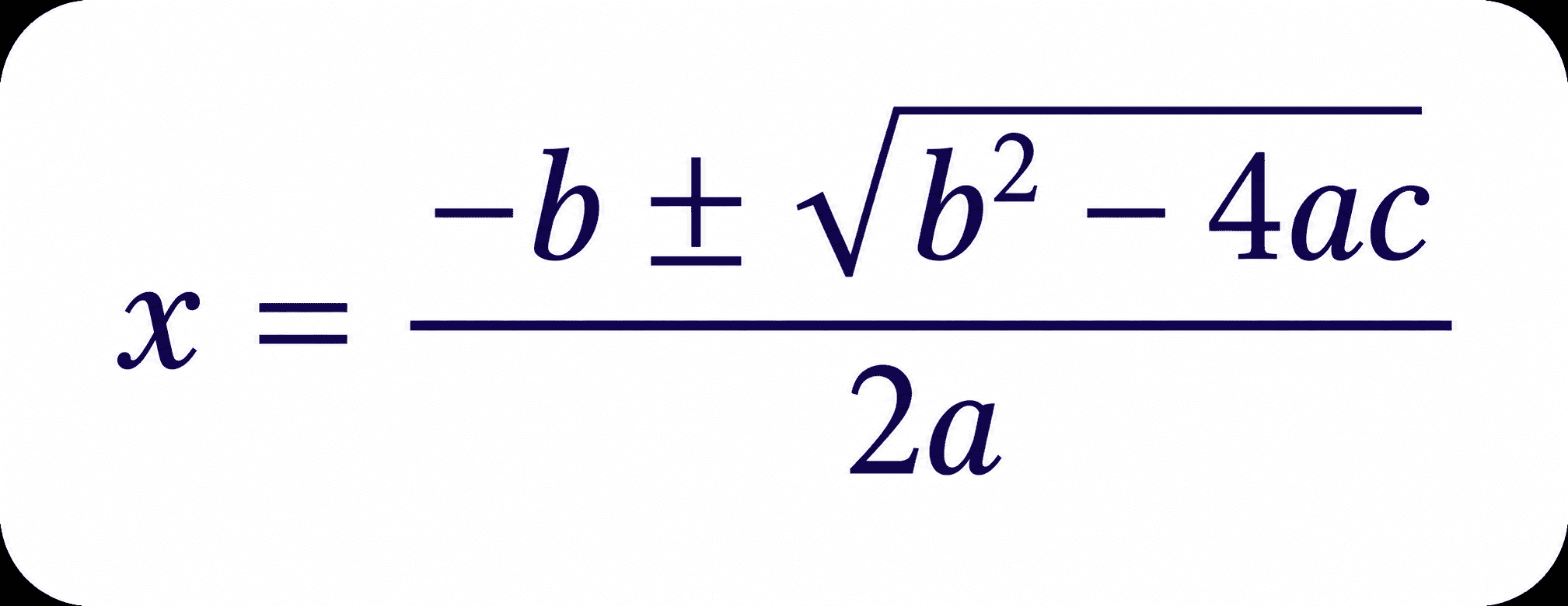
Note: For ax² + bx + c = 0, identify a, b and c first.
Lesson Modules
Completing the square
Learn how to rewrite quadratic expressions in the form a(x + b)² + c for finding turning points.
Quadratic formula
Master the application of the formula for non-factorable equations and high-decimal precision.
Solving by factorising
The fundamental method for solving simple quadratics by identifying common factors and pairs.
Core Subtopics
Structured lessons for every syllabus requirement.
Worked Example
Step-by-Step Walkthrough
THE QUESTION
Factorise completely: 6x² + 12x
Method
- Identify two numbers that multiply to give +6 and add to give −5.
- The numbers are −2 and −3.
- Factorise the equation:(x − 2)(x − 3) = 0
- Set each factor equal to zero:x − 2 = 0 or x − 3 = 0
- Solve each equation:x = 2 or x = 3
Common Mistake
Be careful with the signs. For an equation in the form x² + bx + c = 0, the two chosen numbers must multiply to give c and add to give b.
Final Answer
x = 2 or x = 3
Revision Resources
Worksheet
PDF Download
Revision Quiz
Interactive Test
Exam Qs
Real Past Papers
Mark Scheme
Check Answers
Expert Video Tutorials
Explore Related Topics
Frequently Asked Questions
How do i know when to use the quadratic formula?
You should use the quadratic formula when the equation cannot be easily factorised or when the question asks for an answer to a specific number of decimal places or significant figures.
what is the discriminant and why is it important?
The discriminant is the part of the formula under the square root: b² – 4ac. It tells you how many real solutions an equation has: if it’s positive, there are 2; if zero, there is 1; if negative, there are no real solutions.
Are quadratics on the Foundatiom paper?
Yes, basic quadratic factorisation and solving by factoring are common on Foundation papers. However, the Quadratic Formula and Completing the Square are typically Higher Tier topics.