Calculate both values: x = 2.35078… or x = −0.850781… .
Round to 3 significant figures: x = 2.35 or x = −0.851.
x = 2.35 or x = −0.851, each to 3 significant figures.
The predicted proportion is 195/600 = 0.325, matching the observed relative frequency.
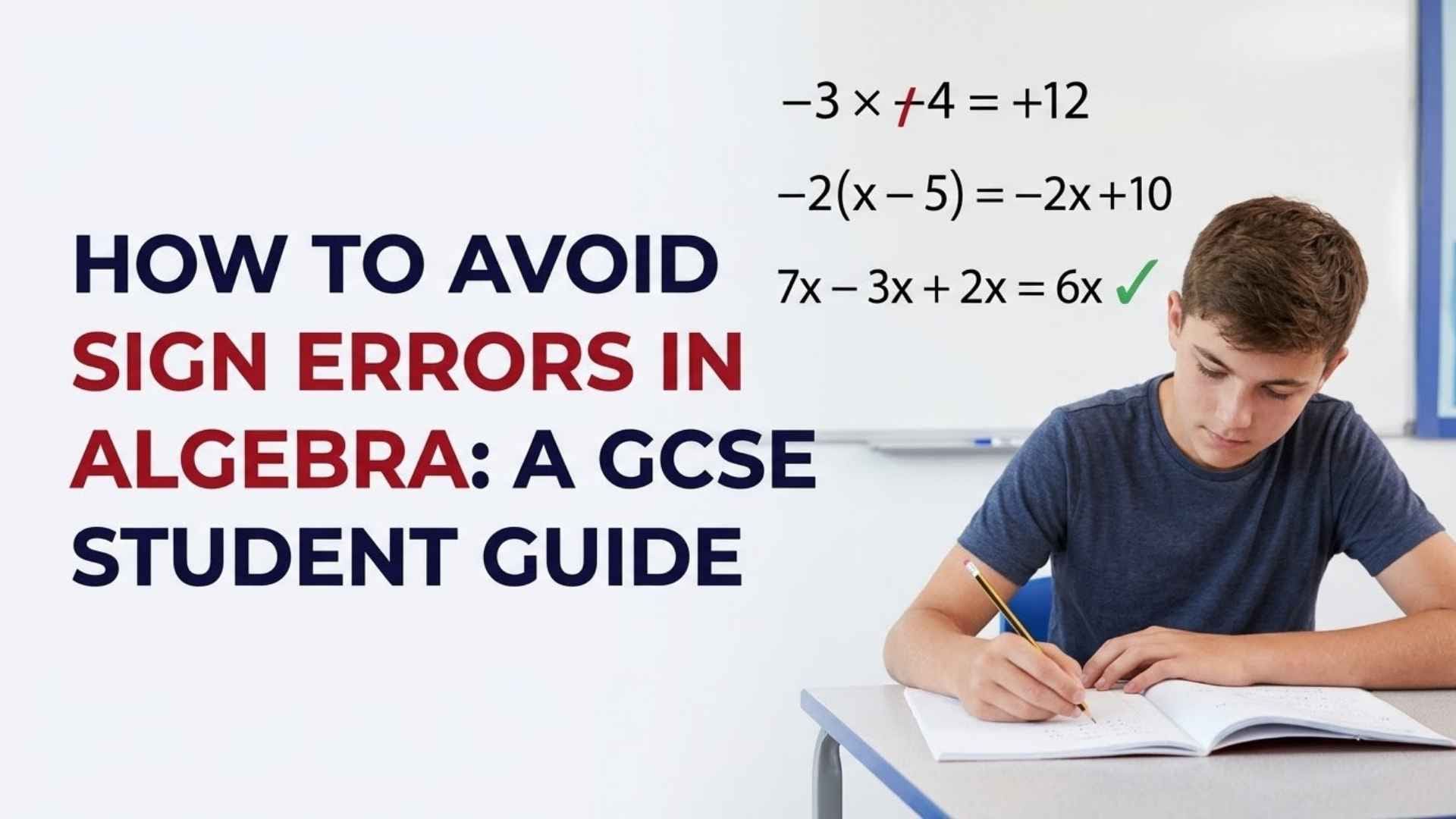
Do not use b = 3. The coefficient is b = −3, so brackets are essential when substituting and squaring.
Common GCSE Mistakes
Not Rearranging to Zero
Losing a Negative Coefficient
Dividing Only Part of the Numerator
Forgetting the Second Root
Using the Zero-Product Rule Too Early
Rounding Before the Final Step
Exam Tips
Rearrange the equation into ax² + bx + c = 0 before deciding which method to use.
Try factorising first when integer factors are easy to spot; otherwise use a permitted reliable method.
When using the formula, write a, b and c separately with their signs before substituting.
Show the factorisation, zero-product equations or full formula substitution so the method is clear.
State both solutions and follow the requested form and accuracy, including exact surds where required.
Ready to Practice?
Printable Worksheet
Download and print practice questions with answers.
Interactive Quiz
Test your knowledge with instant feedback and hints.
Exam-Style Questions
Timed questions to build confidence for the real exam.
Watch the Quadratics Equation Tutorial
Clear, step-by-step explanation of expanding brackets, simplifying complex expressions, and solving for x. Perfect for visual learners who need a breakdown of the rules in action.
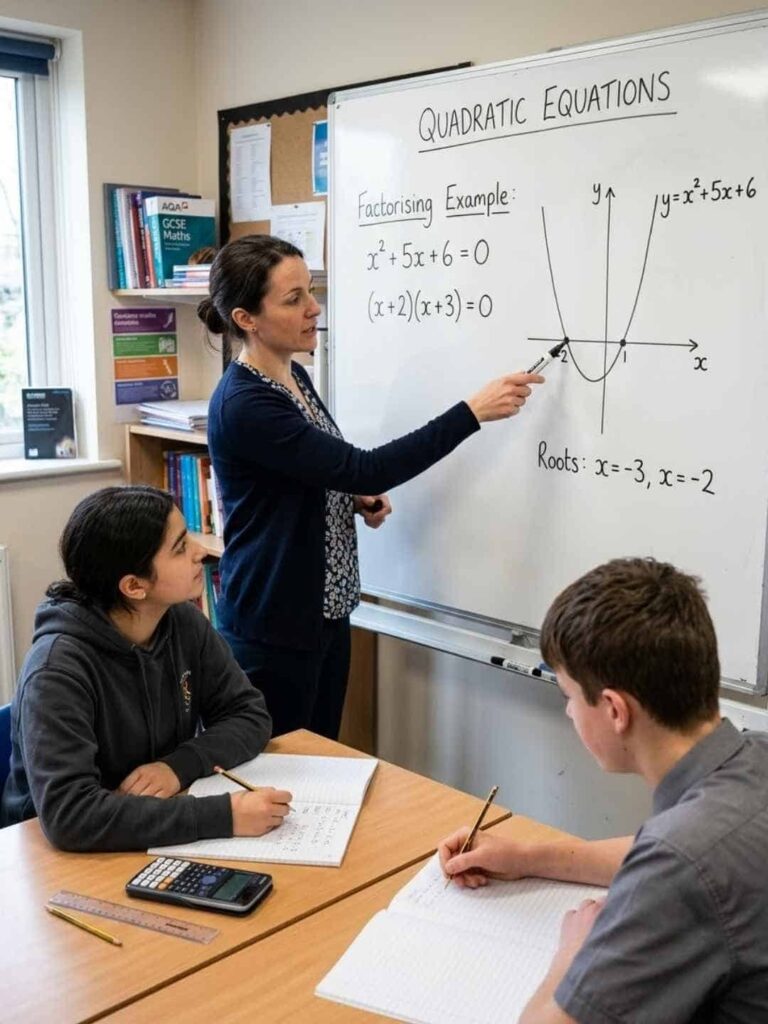
A quadratic equation is an equation that can be written as ax² + bx + c = 0, where a, b and c are constants and a ≠ 0. The highest power of the variable is 2. A quadratic expression does not include an equals sign, while a quadratic equation does.
First rearrange the equation so it equals zero. Factorising is usually quickest when suitable factors are easy to find. The quadratic formula works for every quadratic in standard form. Completing the square is useful when the question requests that form or asks about a turning point.
The graph of a quadratic may cross the x-axis twice, touch it once or miss it completely. Algebraically, this is determined by the discriminant b² − 4ac. A positive value gives two distinct real roots, zero gives one repeated real root and a negative value gives no real roots.
A root is an x-value for which the quadratic equals zero, so it corresponds to an x-intercept. A turning point is the maximum or minimum point of the parabola. Completed-square form shows the turning point directly, but it does not normally give the roots without further solving.