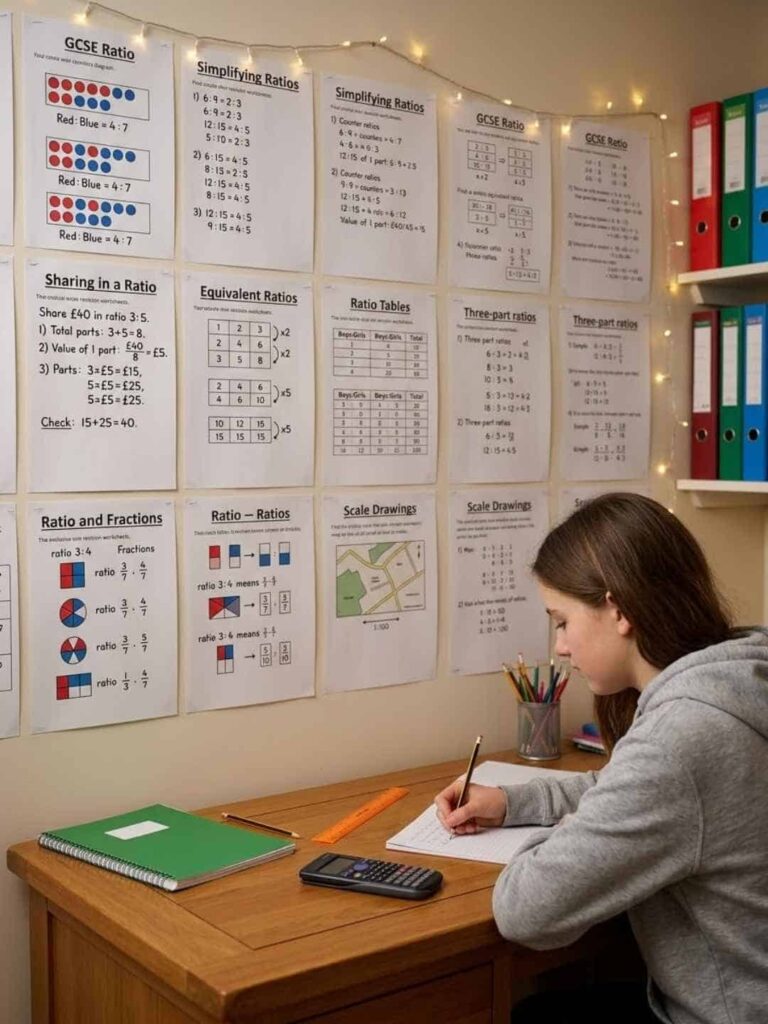
Convert quantities to consistent units, calculate equivalent unit prices and compare value fairly.
Sharing In A Ratio
Find the total number of parts, calculate one part and determine every share accurately.
Simplifying Ratio
Use common factors and unit conversions to write two- and three-part ratios in simplest form.
CORE SUBTOPICS
Ratios with Different Units
Convert quantities to the same unit before comparing or simplifying their numerical values.
Scaling Recipes
Find a scale factor or one-part value and apply it equally to every ingredient.
Missing Ratio Quantities
Use equivalent ratios, fractions of a total or a unitary method to calculate an unknown amount.
Ratio and Percentage
Convert a ratio share into a fraction of the total, then multiply by 100 to obtain a percentage.
Combining Two Ratios
Create matching values for the shared category before forming a complete three-part ratio.
Algebraic Ratio Problems
Translate a stated ratio into an equation when quantities are represented by expressions.
Worked Example
Sharing a Total in a Three-Part Ratio
QUESTION
A charity fund of £378 is shared between Projects A, B and C in the ratio 2:3:4. Calculate each share.
Given information: The ratio order is A:B:C = 2:3:4, and the three shares must total £378.
Method: Find the total number of equal parts, calculate the value of one part, then multiply by each ratio number.
Add the ratio parts: 2 + 3 + 4 = 9 parts.
Find one part: £378 ÷ 9 = £42.
Project A receives 2 × £42 = £84.
Project B receives 3 × £42 = £126.
Project C receives 4 × £42 = £168.
Check the total: £84 + £126 + £168 = £378.
Project A receives £84, Project B receives £126 and Project C receives £168.
The shares simplify to 84:126:168 = 2:3:4 after dividing every part by 42, and they add to £378.
Do not divide £378 by 4, the largest ratio number. Divide by the total number of parts, 9.
Common GCSE Mistakes
Changing the Ratio Order
Ignoring Different Units
Dividing Only Some Parts
Using One Ratio Number as the Total Parts
Comparing Total Prices in Best Buys
Rounding Unit Prices Too Early
Exam Tips
Write labels beside the ratio parts so the required order remains clear.
Convert quantities to compatible units before simplifying, scaling or comparing them.
For sharing questions, show the sum of parts, the value of one part and every final share.
For best buys, state the common comparison unit and use it for every option.
Keep full calculator values until the final decision or requested rounding step.
Ready to Practice?
Printable Worksheet
Practise simplifying, unit conversions, sharing totals, recipe scaling, combined ratios and best-buy comparisons.
Interactive Quiz
Check ratio order, equivalent ratios, total parts, unit prices and common misconceptions.
Exam-Style Questions
Apply ratio methods to money, measures, recipes, maps and multi-stage GCSE contexts.
Watch the Ratio Tutorial
Clear, step-by-step explanation of expanding brackets, simplifying complex expressions, and solving for x. Perfect for visual learners who need a breakdown of the rules in action.
A ratio compares quantities in a stated order. For example, red:blue = 2:3 means there are 2 equal parts of red for every 3 equal parts of blue. The numbers describe relative parts, not necessarily the actual quantities.
First convert the quantities to compatible units. Then divide every part by a common factor. For a whole-number ratio, using the highest common factor reaches simplest form in one step. Check that no factor greater than 1 divides every remaining part.
Add all ratio parts, divide the total by that sum to find one part, and multiply by each ratio number. Keep the shares in the original order. Finally, add them together to confirm that they reproduce the total amount.
Add the ratio parts to find the total number of parts. In the ratio 2:3, there are 5 parts altogether, so the first quantity is 2/5 of the total and the second is 3/5. The fraction denominator is the total parts.