GCSE Maths • Foundation & Higher
GCSE Surds Revision Guide
Simplify irrational roots and keep exact answers exact.
Foundation
Exam practice
Worked examples
What You'll Learn
Identify Surds
Distinguish exact irrational roots from roots that simplify rationally.
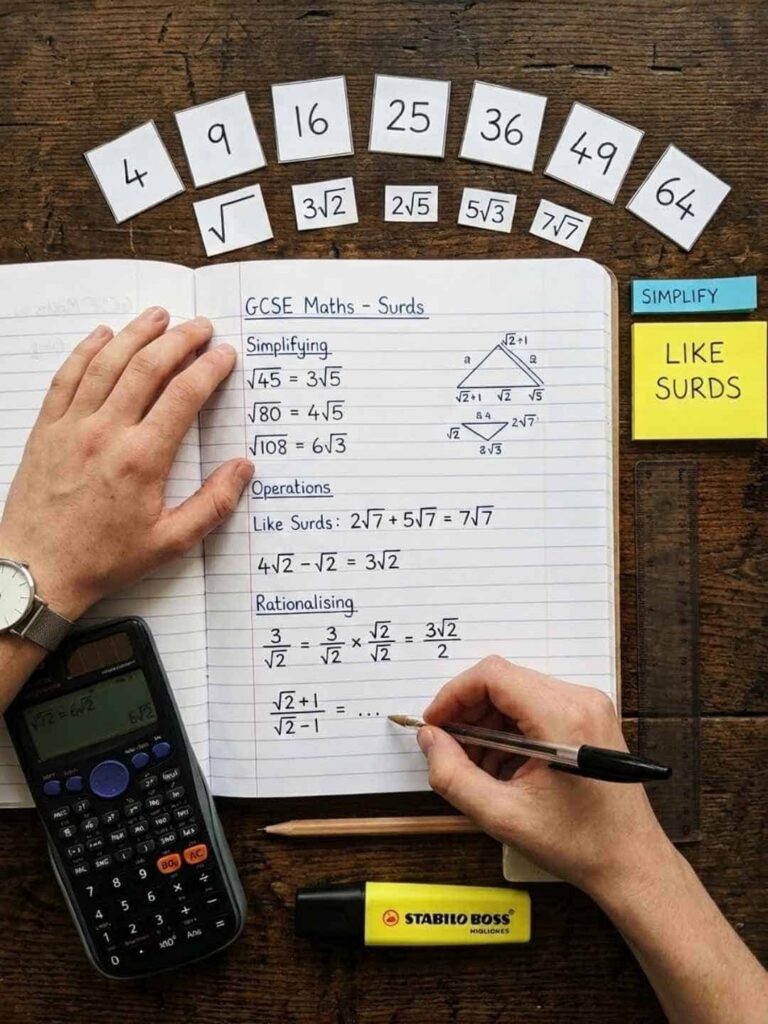
Simplify Square Roots
Extract the largest convenient perfect-square factor.
Collect Like Surds
Simplify first, then combine matching radical parts.
Multiply and Expand
Apply distributive multiplication and root product rules correctly.
Rationalise Denominators
Use a matching surd or conjugate to remove radicals below the fraction line.
Use Exact Values
Retain surds in geometry and algebra until approximation is requested.
Key Rules and Formulas
Surds Lessons
Rationalising The Denominator
Remove surds from single-term and binomial denominators using equivalent fractions.
Simplifying Surds
Extract perfect-square factors and write roots in fully simplified exact form.
CORE SUBTOPICS
Perfect-Square Factors
Recognise 1, 4, 9, 16, 25, 36, 49, 64, 81 and 100 quickly.
Adding and Subtracting
Simplify before collecting coefficients of like surds.
Multiplying Surds
Multiply numerical coefficients and radical parts separately.
Expanding Brackets
Use every-term multiplication and collect rational and surd terms.
Conjugates
Pair a+b√c with a-b√c to create a rational difference of squares.
Geometry and Exact Values
Keep exact lengths from Pythagoras or trigonometry in surd form.
Worked Example
Rationalising a Binomial Denominator
Rationalise and simplify 1/(3 + √2).
- Given information: The conjugate of 3 + √2 is 3 - √2.
- Method: Multiply numerator and denominator by the conjugate and use the difference of two squares.
- Multiply by (3 - √2)/(3 - √2).
- The numerator becomes 3 - √2.
- The denominator is (3 + √2)(3 - √2).
- Apply (a+b)(a-b)=a²-b²: 3² - (√2)² = 9 - 2 = 7.
- The denominator is rational and no common factor remains.
- Final answer: (3 - √2)/7.
- Independent answer check: (3 + √2)(3 - √2) = 7, so multiplying (3 - √2)/7 by 3 + √2 gives 1.
- One common mistake: Do not multiply a two-term denominator by √2 alone; use the conjugate to cancel the surd cross-terms.
- Common GCSE Mistakes
- Adding Unlike Surds
- Combining Before Simplifying
- Stopping Too Early
- Splitting a Sum Under a Root
- Dropping Coefficients
- Rationalising Only the Denominator
- Using the Wrong Conjugate
- Using Decimal Approximations
- Exam Tips
- 20. List perfect squares before starting simplification questions.
- Choose the largest convenient square factor to reduce repeated steps.
- Simplify all surds before adding or subtracting.
- Keep brackets when multiplying a conjugate through a numerator.
- Keep exact answers throughout geometry working.
- After rationalising, simplify numerical fractions and remaining surds.
Ready to Practice?
Watch the Surds Tutorial
Clear, step-by-step explanation of expanding brackets, simplifying complex expressions, and solving for x. Perfect for visual learners who need a breakdown of the rules in action.

- 12 minute comprehensive guide
- High-definition whiteboard walk-through
Continue Your GCSE Maths Revision
Frequently Asked Questions
A surd is an irrational root retained in exact form, such as √2.
No. √9 = 3, so it simplifies to a rational integer.
Factor the radicand using a perfect square, take its root outside, and repeat until fully simplified.
No further exact simplification is possible because they are unlike surds.
It rewrites an equivalent exact fraction with no irrational term in the denominator.
Revision Resource In Your Inbox
Get expert revision tips, study resources, and exam support delivered straight to your inbox.