
Foundation vs Higher Algebra Skills: GCSE Grades 1–9 Made Easy
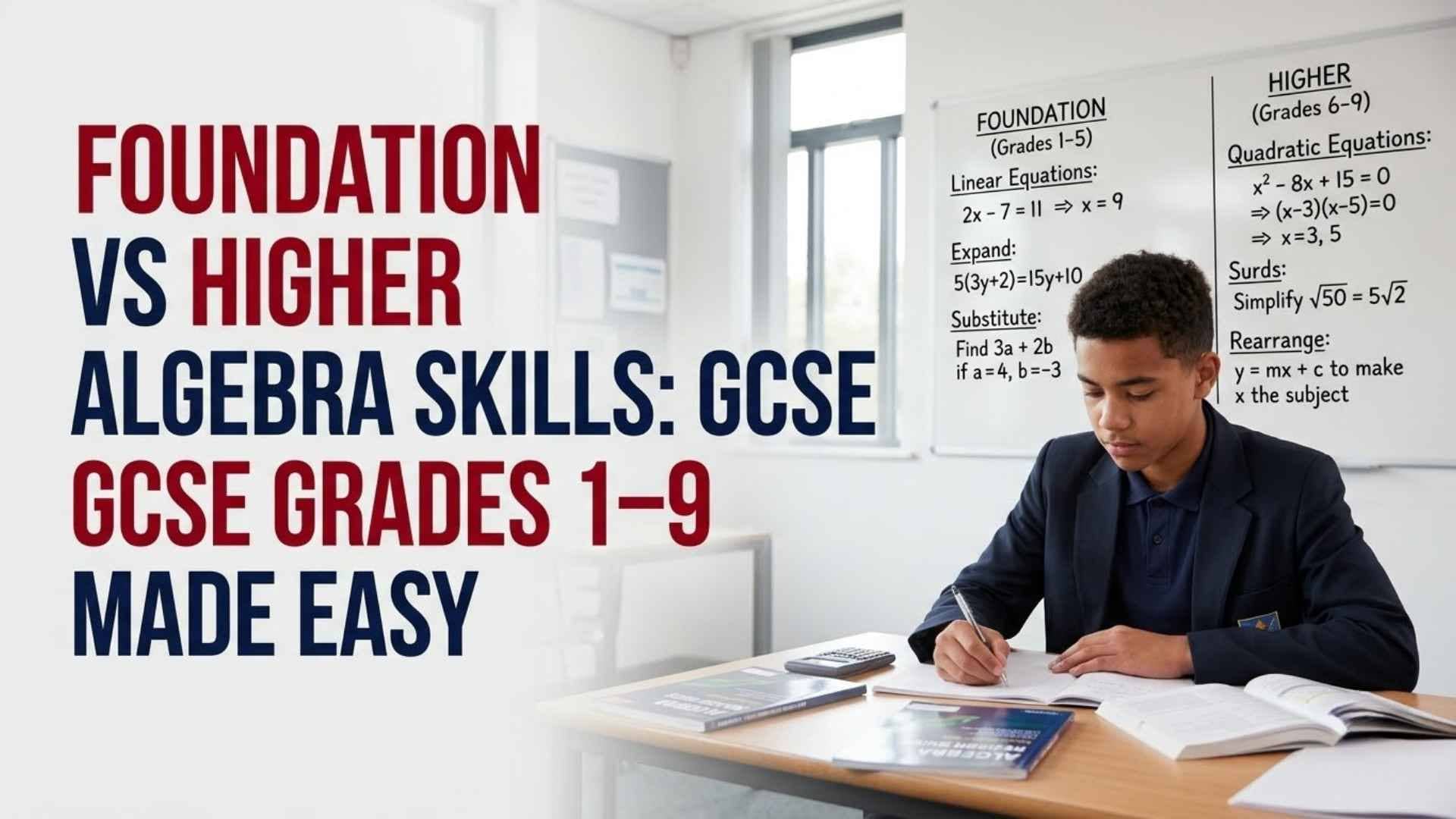
Understanding Foundation vs Higher algebra skills can make revision much less confusing. Both tiers share important algebra foundations, but Higher adds greater depth, more advanced content and questions that require more independent problem solving. This guide shows what to learn, what to practise and how to judge where your time is best spent. If you are creating a GCSE maths revision plan, begin with the tier you are actually studying and the evidence from your latest homework, tests or mocks. Revision should answer a practical question: which skill, if improved next, would help you gain the most marks?
Table of Contents
What Is the Difference Between Foundation and Higher GCSE Maths?
For AQA GCSE Mathematics, Foundation tier gives access to grades 1–5 and Higher tier gives access to grades 4–9. The current national subject content is common across exam boards, although the exact wording and question style can vary. Always use your own board’s specification and your teacher’s advice. Foundation vs Higher algebra skills should therefore be matched to your actual tier.
Foundation vs Higher algebra skills should not be thought of as “easy maths” versus “hard maths”. Higher students still need the same core skills used at Foundation. The difference is that Higher includes additional content and can require several ideas to be connected in one unfamiliar problem. A useful GCSE algebra revision habit is to divide topics into “secure”, “needs practice” and “not confident yet”. Use marked work rather than guessing. If expanding brackets is reliable but rearranging formulae is not, your next session has an obvious priority.
Which Algebra Skills Do Both Tiers Need?
Both tiers require students to read algebraic notation, simplify expressions, substitute values, expand brackets, factorise, solve equations, use formulae and work with sequences and graphs. Foundation vs Higher algebra skills overlap strongly because advanced questions are built from these basic operations. During GCSE maths revision, keep practising negative numbers, fractions and arithmetic alongside algebra. A student can understand the main method and still lose a mark through a sign error, an incorrect fraction or a copied number. Accurate basics make longer questions easier to manage.
Foundation vs Higher Algebra Skills: What Foundation Students Need
At Foundation, aim for reliable control of the shared core before worrying about difficult Higher-only material. Foundation vs Higher algebra skills at this stage include simplifying, substitution, single-bracket expansion, simple factorising, linear equations, straightforward formulae, sequences, coordinates and straight-line graphs. Your GCSE maths revision should include algebra written in words as well as equations already set up for you. Practise turning a short situation into an expression or equation. Students often know how to solve an equation once it exists but find forming it from a problem more difficult.
A useful Foundation checklist is to collect like terms accurately, substitute positive and negative values, expand a single bracket, factorise using a common factor, solve linear equations, use straightforward formulae, continue sequences, find simple nth terms, and plot or interpret straight-line graphs. For GCSE algebra revision, use that checklist actively. Choose one weak item, answer several questions without notes, mark them and redo every mistake from a clean start. If you can complete a method only while copying an example, it needs more independent practice.
What Extra Algebra Appears at Higher Tier?
Higher students meet the same foundations plus additional content and harder combinations. Foundation vs Higher algebra skills can separate more clearly around quadratics, algebraic fractions, simultaneous equations, functions, iteration, inequalities, proof and problems connecting algebra with graphs or geometry. For GCSE maths revision at Higher tier, learn when to choose a method rather than memorising disconnected procedures. With a quadratic, for example, decide whether factorising is possible. With an algebraic fraction, simplify carefully and keep restrictions in mind instead of rushing through a remembered pattern.
A Higher checklist may include harder expansion and factorising, solving quadratic equations, completing the square where required, using the quadratic formula, simultaneous equations, algebraic fractions, functions, inequalities, algebraic proof and links between algebra and graphs. These Foundation vs Higher algebra skills help you see what extra depth Higher requires.
How Do Foundation and Higher Questions Feel Different?
A Foundation question might directly ask you to solve (4x+7=31). A Higher question might require you to form an equation from a diagram, rearrange it, solve it and interpret the answer. Foundation vs Higher algebra skills therefore differ in depth and in how independently you may need to select your steps. When doing GCSE maths revision, mark more than the final answer. Find the first line where your working became incorrect and classify the cause: wrong method, algebra mistake, arithmetic mistake or misread question. Each type of error needs a different correction.
How Important Is Algebra on Each Tier?
AQA’s subject-content guidance gives algebra an approximate weighting of 20% on Foundation and 30% on Higher. Foundation vs Higher algebra skills therefore deserve regular attention throughout the course, not a last-minute revision rush.
Are You Ready for Higher Algebra?
Judge readiness from consistency, not one difficult worksheet. Foundation vs Higher algebra skills give you useful questions to ask: can you solve linear equations reliably, handle fractions and negative numbers, expand and factorise accurately, substitute correctly and explain your working without depending on prompts? GCSE maths practice can test that consistency. Use questions matched to your current tier, mark them honestly and look at patterns across several sessions. If shared algebra is secure and Higher material is becoming manageable, discuss the evidence with your teacher before making assumptions about changing tier.
For GCSE algebra revision, prioritise weaknesses that affect several topics. Poor handling of negatives can damage substitution, equations and expansion. Weak factorising can make quadratics harder. Fixing one foundation skill can therefore improve several areas at once.
How Should Foundation Students Revise?
Foundation students should aim for accuracy before speed. Foundation vs Higher algebra skills become easier to manage when you know the methods required for your tier and practise them until the steps feel dependable rather than rushed. A simple GCSE maths revision session can start with five minutes of recall, move to focused questions, and finish with two or three mixed exam-style problems. Mark the work immediately, then redo mistakes without copying the solution. That gives you evidence of what you can actually do alone.
GCSE maths practice becomes more valuable when you return to a topic after a gap. Getting equations right immediately after a lesson shows understanding; getting similar equations right several days later without notes gives stronger evidence that the method is sticking.
How Should Higher Students Revise?
Higher students should protect basic accuracy while increasing difficulty. Foundation vs Higher algebra skills are layered: a demanding quadratic, proof or graph problem may contain simple expansion or equation solving inside it. Weak basics can make an advanced topic feel harder than it really is. During GCSE maths revision, alternate focused Higher-topic sessions with mixed sets containing older algebra. This stops you becoming confident only when the question type is obvious. It also helps you notice when a supposedly advanced mistake is actually caused by an earlier basic step.
For GCSE algebra revision, explain a difficult solution in your own words after marking it. If you can say why each step was taken, you are less dependent on memorised layouts and more prepared for a question that looks different from the examples you practised.
Common Mistakes to Avoid
GCSE maths practice should not become endless repetition of comfortable questions. Keep some easier work for fluency, but use your results to identify what still costs marks. The most useful practice changes something specific.
Your GCSE maths revision should end with one decision about what comes next. Write something specific, such as “redo equations with brackets on Thursday” or “try mixed quadratic questions next session”. A clear next action stops marking from becoming the end of the learning. Foundation vs Higher algebra skills are often weakened by the same avoidable mistakes: losing negative signs, combining unlike terms, expanding only one part of a bracket, or skipping working in multi-step equations. Treat these as patterns to correct, not as proof that you are “bad at algebra”.
Final Advice
Think of Foundation vs Higher algebra skills as layers rather than separate worlds. Both tiers need secure core algebra; Higher adds extra content and greater problem-solving demand. Build accuracy first, then increase difficulty in a controlled way. Use GCSE maths revision to answer three questions: What can I do without help? Where do I lose marks? What should I practise next? If every session answers those questions, your revision becomes purposeful instead of turning into a long list of topics.
GCSE maths practice works best when you mark it, learn from it and revisit weaknesses. Use English Made Simple topic guides alongside your school materials, and check your exam-board specification for the exact content you are expected to know.
For GCSE algebra revision, keep the routine simple: secure shared skills, practise your tier’s content, mix topics as the exam approaches and ask for help when the same mistake keeps returning. That gives you a much clearer route through algebra.
Frequently Asked Questions
Can a Foundation student get a grade 5?
Yes. Foundation tier gives access to grades 1–5. Grades 4 and 5 overlap with the Higher tier grade range. Foundation vs Higher algebra skills are connected, so secure basics still matter.
Do Higher students still need Foundation algebra?
Yes. Higher work depends on core skills such as substitution, expansion, factorising, equations, fractions and negative numbers. Foundation vs Higher algebra skills are connected, so secure basics still matter.
What algebra topic should I revise first?
Start with a weakness that affects other topics too. Negative numbers, collecting like terms, expanding brackets and linear equations are useful foundations.
How can I tell whether my algebra is improving?
Try fresh questions without notes, mark them carefully and repeat similar work after a gap. Improvement means you can choose the method and complete it accurately with less support.
