Combine like terms and simplify algebraic expressions.
Expand Brackets
Multiply terms inside brackets and simplify the result.
Factorise Expressions
Find the greatest common factor and factorise.
Substitute Values
Replace variables with values and evaluate expressions.
Write Algebraic Proofs
Use algebra to prove statements are always true.
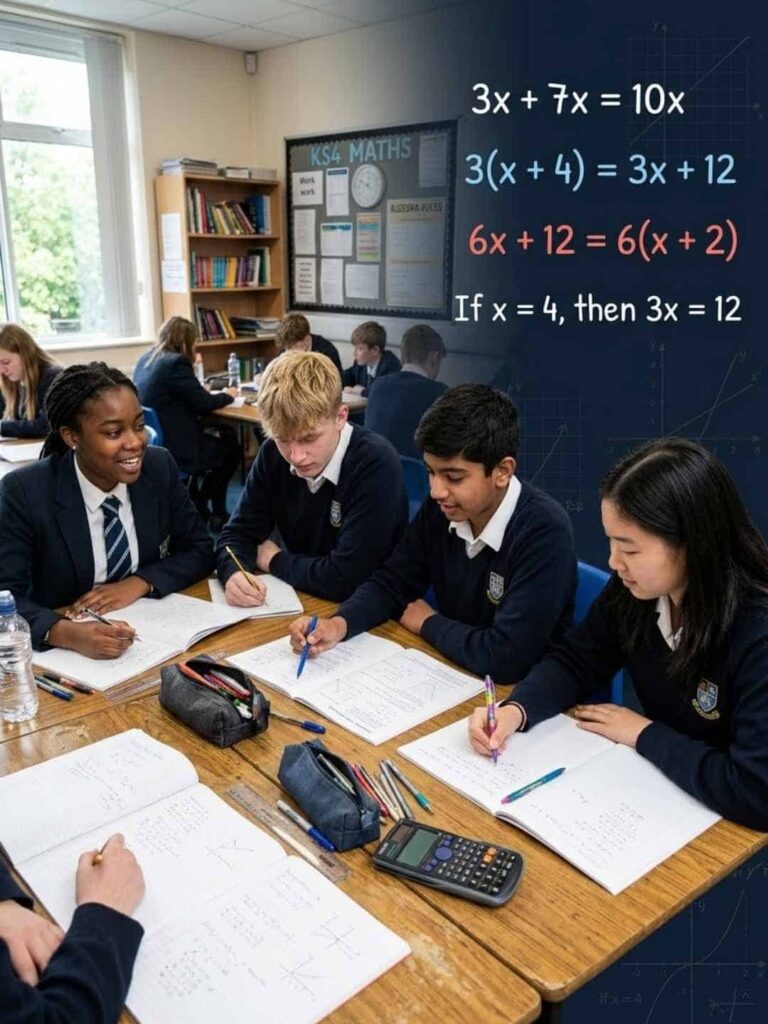
Key Algebra Rules
Like terms
3x + 7x = 10x
Expand brackets
3(x + 4) = 3x + 12
Factorise
6x + 12 = 6(x + 2)
Substitution
If x = 4, then 3x = 12
Proof forms
Even = 2n
Odd = 2n + 1
Algebra Lessons
Collecting Like Terms
Identify matching variables and combine coefficients correctly.
Foundation
Expanding Brackets
Multiply every term inside a bracket and simplify.
Foundation
Factorising Basics
Find the greatest common factor & place it outside the bracket.
Foundation
Substitution
Replace variables with values, use brackets and follow BIDMAS.
Foundation
Algebraic Proof
Use variables to prove a statement is always true.
Higher
Worked Examples
Example 1: Collect like terms
4x + 8 + 6x + 3 = 10x + 11
Step 1: Group like terms.
(4x + 6x) + (8 + 3)
Step 2: Add the coefficients.
10x + 11
Example 2: Expand brackets
2(x + 5) = 2x + 10
Step 1: Multiply 2 by each term.
2 × x = 2x and 2 × 5 = 10
Step 2: Write without brackets.
2x + 10
Example 3: Substitution
If a = 6, then 2a + 4 = 16
Step 1: Replace a with 6.
2 × 6 + 4
Step 2: Calculate.
12 + 4 = 16
Common GCSE Mistakes
Combining unlike terms (e.g., saying 2x + 3 = 5x)
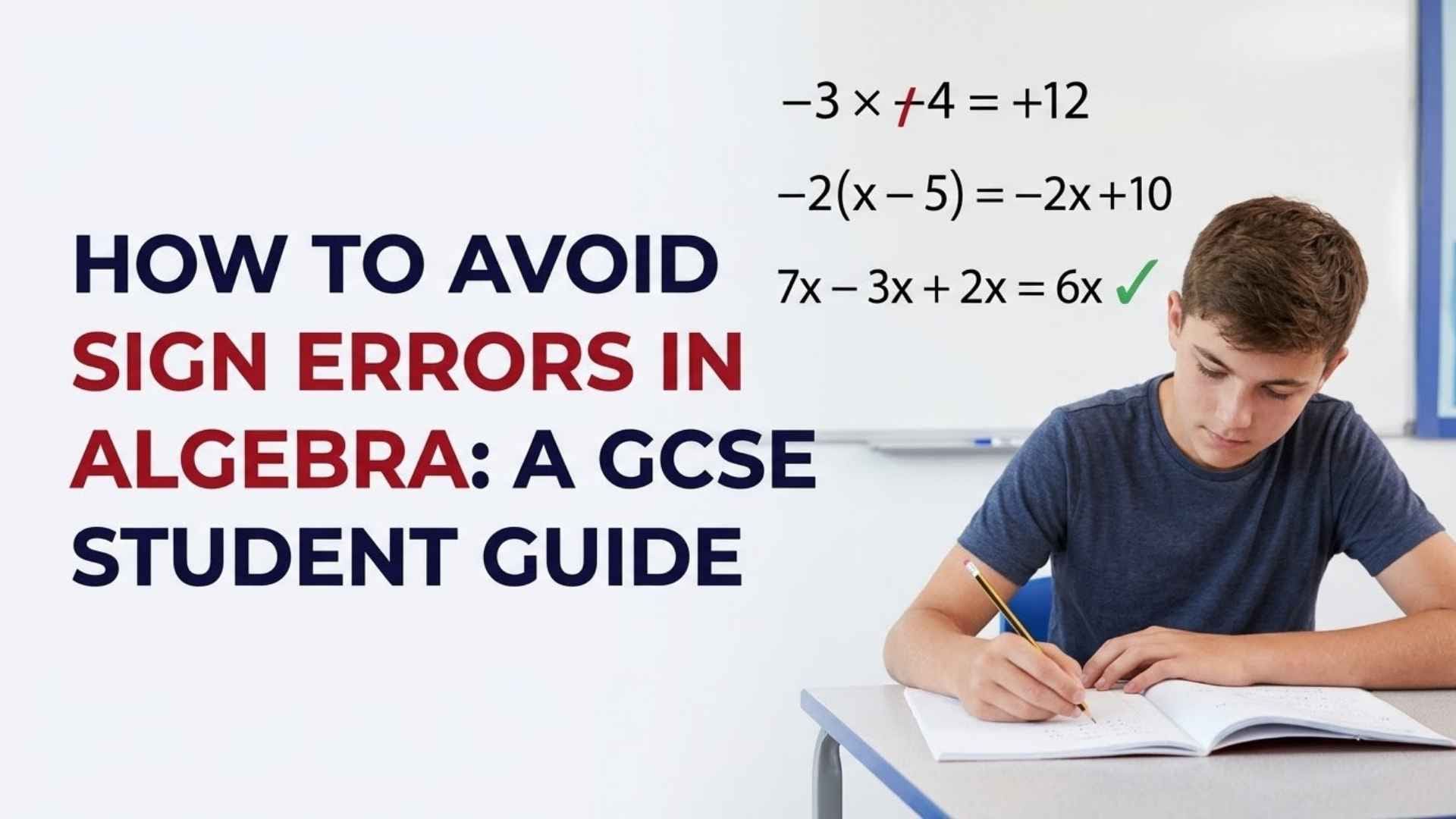
Missing negative signs when expanding brackets
Forgetting to multiply every term in the bracket
Not placing negative values in brackets when substituting
Exam Tips
Show every algebraic step to secure method marks
Check your factorising by expanding the brackets again
Use correct notation (e.g., write 4x, not 4 × x)
Write a clear conclusion for algebraic proof questions
Ready to Practice?
Printable Worksheet
Download and print practice questions with answers.
Interactive Quiz
Test your knowledge with instant feedback and hints.
Exam-Style Questions
Timed questions to build confidence for the real exam.
Watch the Algebra Tutorial
Clear, step-by-step explanation of expanding brackets, simplifying complex expressions, and solving for x. Perfect for visual learners who need a breakdown of the rules in action.
Algebra is a key part of GCSE Maths that focuses on using letters, symbols, and formulas to represent unknown values and solve mathematical problems. Students learn how to simplify expressions, solve equations, work with graphs, and apply algebraic methods to real-life problems.
Algebra is one of the most important areas of GCSE Maths because it develops problem-solving skills and is used in many other topics, including geometry, graphs, statistics, and higher-level mathematics.
Algebra can seem challenging at first because it uses unfamiliar symbols and methods. With clear explanations, step-by-step examples, and regular practice, students can build confidence and improve their algebra skills.
We noticed you're visiting from United States (US). We've updated our prices to United States (US) dollar for your shopping convenience. Use Pound sterling instead.Dismiss