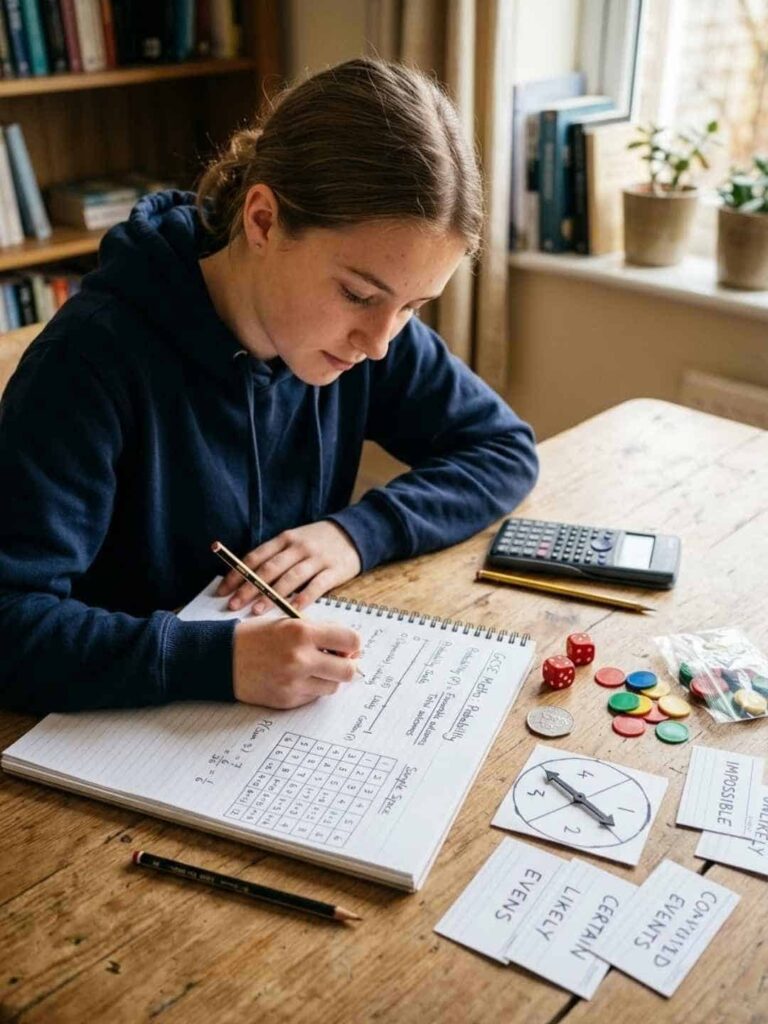
Calculate probabilities from equally likely outcomes and express answers in different forms.
Probability Scale
Interpret and position probabilities between impossible and certain.
Relative Frequency
Estimate probabilities from experiments, compare samples and predict future frequencies.
CORE SUBTOPICS
Events and Outcomes
An outcome is one possible result; an event is a set of one or more outcomes.
Fairness and Equally Likely Outcomes
A fair coin, die or equal-section spinner gives equal chances to its possible outcomes.
Mutually Exclusive Events
Events are mutually exclusive when they cannot happen together in the same trial.
Theoretical vs Experimental Probability
Theoretical probability comes from a model; relative frequency comes from observed data.
Sample Size and Variation
Repeated experiments can produce different results; larger samples generally give more stable estimates.
Systematic Outcome Listing
Tables and sample spaces help ensure no possible outcome is omitted or counted twice.
Worked Example
Experimental Probability and Prediction
QUESTION
A biased spinner is spun 240 times and lands on blue 78 times. (a) Estimate P(blue). (b) Estimate how many blue results would occur in the next 600 spins. (c) Estimate P(not blue).
Given information: The spinner is described as biased, so use the experimental results rather than assuming equal sections.
Method: Calculate relative frequency, multiply it by the future number of trials and use the complement rule.
Relative frequency of blue = 78/240 = 13/40 = 0.325.
Estimated blue results in 600 spins = 0.325 × 600 = 195.
P(not blue) = 1 - 0.325 = 0.675.
Check: 0.325 + 0.675 = 1.
Final answP(blue) ≈ 0.325; estimated blue results = 195; P(not blue) ≈ 0.675.er: The final price is £748, representing an overall decrease of 6.5%.
The predicted proportion is 195/600 = 0.325, matching the observed relative frequency.
Do not calculate 240/78. Relative frequency is event occurrences divided by total trials.
Common GCSE Mistakes
Using the Formula Without Equal Likelihood
Reversing the Relative-Frequency Division
Giving a Probability Outside 0 to 1
Confusing Unlikely with Impossible
Assuming Short Experiments Must Match Theory
Believing Previous Independent Results Change the Next Trial
Adding Overlapping Events Directly
Exam Tips
Write the event and sample space before counting favourable outcomes.
Check that every final probability lies between 0 and 1 and use a common form when comparing values.
Look for words such as fair, equally likely, biased, experimental and relative frequency because they determine the method.
Use the complement rule when “not”, “does not” or “at least one” can simplify the calculation.
Treat a predicted frequency as an estimate and keep sufficient accuracy until the final step.
For experimental data, compare both relative frequencies and sample sizes rather than raw frequencies alone.
Ready to Practice?
Printable Worksheet
Practise probability scales, equally likely outcomes, complements, relative frequency and predictions.
Interactive Quiz
Check probability vocabulary, conversions and common misconceptions with instant feedback.
Exam-Style Questions
Apply probability rules to tables, experiments and multi-step contexts.
Watch the Probability Tutorial
Clear, step-by-step explanation of expanding brackets, simplifying complex expressions, and solving for x. Perfect for visual learners who need a breakdown of the rules in action.