GCSE Maths • Foundation & Higher
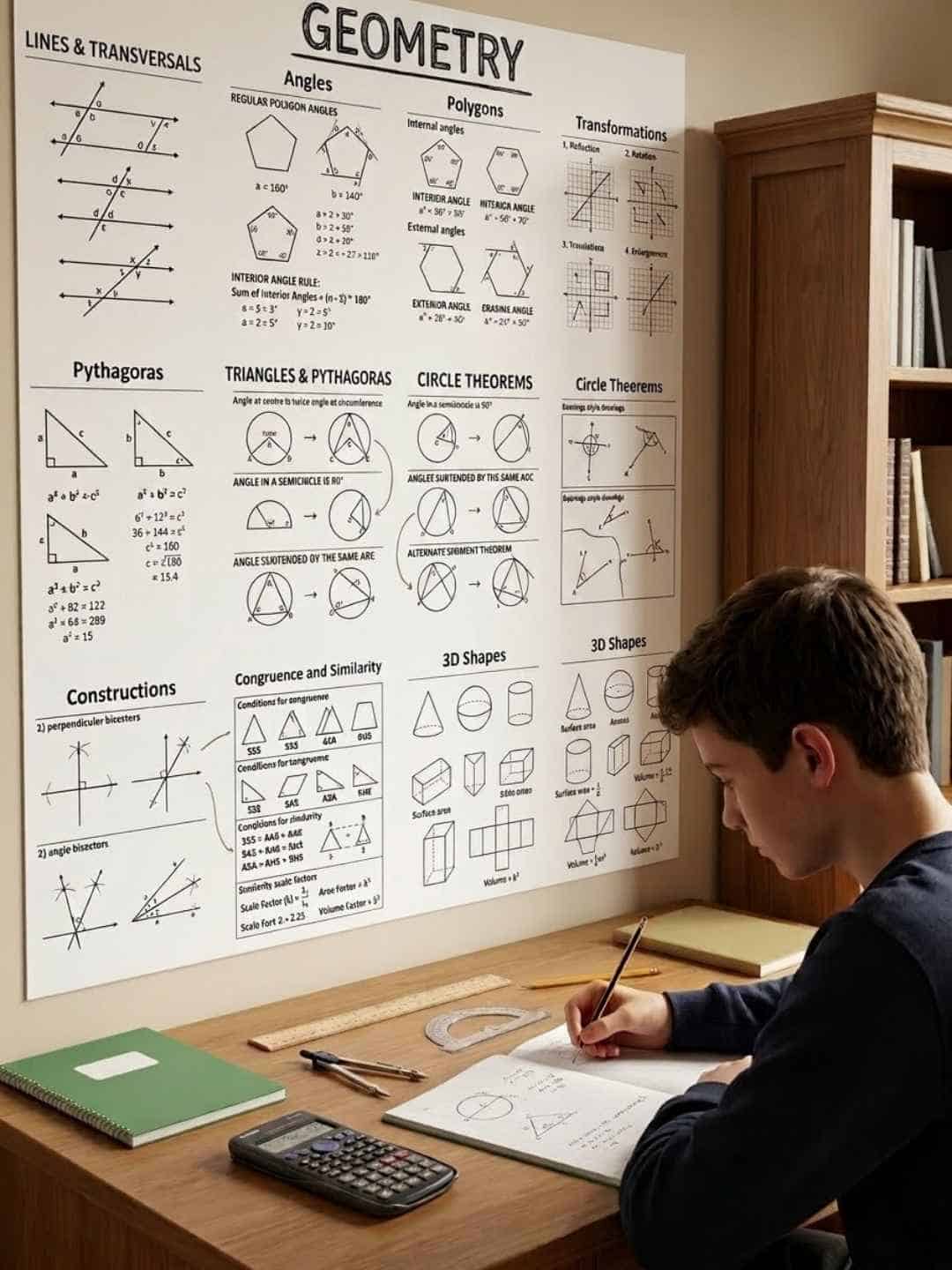
Master key angle facts, parallel-line rules and polygon calculations for GCSE Maths.
Use the fact that angles on a straight line add up to 180°.
Use the fact that angles around a point add up to 360°.
Recognise corresponding, alternate and co-interior angle relationships.
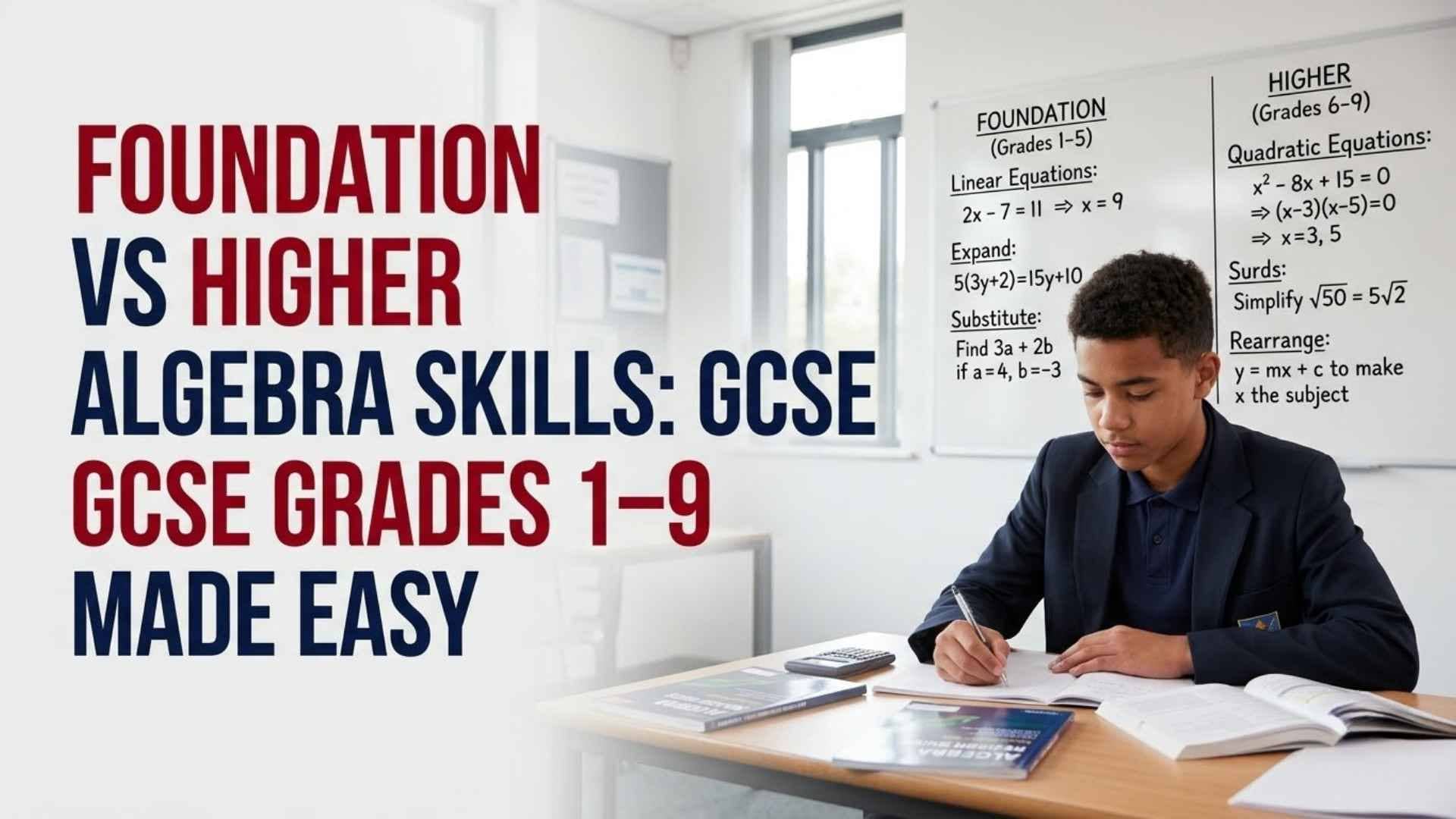
Form and solve equations when angles are written as expressions.
Recognise common polygons and distinguish between regular and irregular polygons.
Find interior angle sums, regular interior angles, exterior angles and the number of sides.
Explanation:A straight line represents half a full turn, so all adjacent angles along it total 180°. Condition or reminder: Use 180°, not 360°, when the diagram shows a straight line.
Explanation: A complete turn is 360°, so all angles meeting at one point must total 360°. Condition or reminder: Check that every angle around the point has been included.
Explanation: When a transversal crosses parallel lines, angles in matching positions have the same size. Condition or reminder: Look for the matching F-shape and confirm that the lines are parallel.
Explanation: Alternate angles lie on opposite sides of the transversal and form a Z-shape across parallel lines. Condition or reminder: Use this rule only when the relevant lines are parallel.
Explanation: These angles lie inside the parallel lines on the same side of the transversal and form a C-shape. Condition or reminder: Do not confuse co-interior angles with equal corresponding or alternate angles.
Explanation: A polygon can be divided into triangles, and each triangle contributes 180° to the total interior angle sum. Condition or reminder: Subtract 2 from the number of sides before multiplying by 180°.
Use the 360° rule to find missing angles, including questions with algebra.
Use the 180° straight-line rule to solve numerical and algebraic angle problems.
Name polygons and calculate interior-angle sums, regular angles, exterior angles and numbers of sides.
Identify corresponding, alternate and co-interior angles using F, Z and C patterns.
Angles on a straight line total 180°. Add the known angles and subtract from 180° to find a missing angle.
Angles meeting at one point total 360°. Add the known angles and subtract from 360°.
Use the relevant angle fact to form an equation, then solve it carefully.
Corresponding and alternate angles are equal, while co-interior angles sum to 180°.
Common polygons include triangles, quadrilaterals, pentagons, hexagons, heptagons, octagons and decagons.
Use (n − 2) × 180° for interior-angle sums and remember that exterior angles total 360°.
Practise simplifying, unit conversions, sharing totals, recipe scaling, combined ratios and best-buy comparisons.
Check ratio order, equivalent ratios, total parts, unit prices and common misconceptions.
Apply ratio methods to money, measures, recipes, maps and multi-stage GCSE contexts.
Watch the full video of Geormetry on YouTube.
Angles on a straight line add up to 180°.
Angles around a point add up to 360°.
Corresponding angles are in matching positions when a transversal crosses parallel lines, and they are equal.
Alternate angles lie on opposite sides of a transversal across parallel lines, and they are equal.