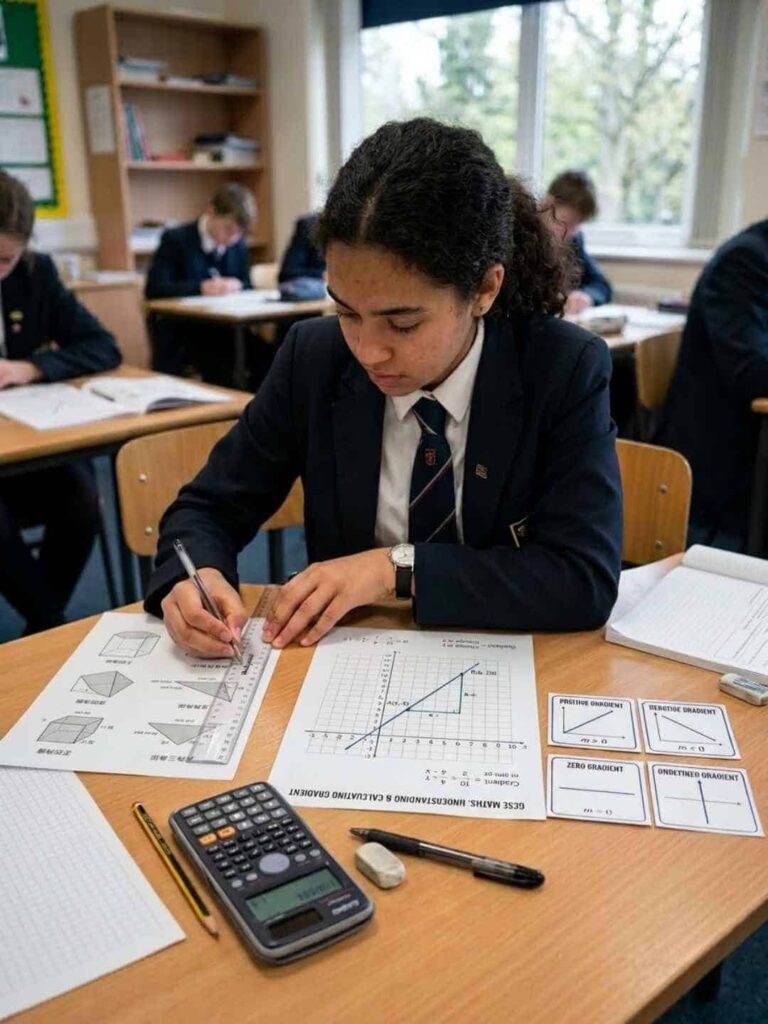
Calculate gradient from graphs, rise and run, and coordinate pairs. Interpret positive, negative, zero and undefined gradients.
Gradient Between Two Points
Use the coordinates of two points to calculate the gradient of a straight line using change in y divided by change in x.
CORE SUBTOPICS
Gradient
Gradient measures how steep a line is and shows whether it rises or falls from left to right.
Change in y and Change in x
Find the vertical change first and the horizontal change second, then divide change in y by change in x.
Gradient from Coordinates
Use two points on a line and substitute them into the gradient formula.
Gradient from a Graph
Choose two clear grid-intersection points on the line and calculate rise over run.
Positive, Negative and Zero Gradients
Positive gradients rise, negative gradients fall, and horizontal lines have gradient 0.
Vertical Lines
Vertical lines have undefined gradient because the change in x is zero.
Worked Example
Finding the Gradient Between Two Points
QUESTION
Find the gradient between (2, 3) and (6, 11).
Given information: The two points are (2, 3) and (6, 11).
Method: Find the change in y and the change in x, then divide.
Change in y = 11 − 3 = 8.
Change in x = 6 − 2 = 4.
Gradient = 8 ÷ 4 = 2.
Answer: Gradient = 2.
Key idea: The line rises 2 units for every 1 unit moved horizontally.
Common mistake: Do not subtract the y-values in one order and the x-values in the opposite order.
Common GCSE Mistakes
Mixing up change in x and change in y.
Subtracting coordinates in different orders.
Forgetting negative signs.
Choosing points that are not exactly on the line.
Treating a vertical line as gradient 0.
Exam Tips
Write change in y and change in x separately.
Keep subtraction order consistent.
Use clear grid-intersection points on graphs.
Check whether the gradient should be positive or negative.
Remember: horizontal = 0, vertical = undefined.
Ready to Practice?
Printable Worksheet
Practise simplifying, unit conversions, sharing totals, recipe scaling, combined ratios and best-buy comparisons.
Interactive Quiz
Check ratio order, equivalent ratios, total parts, unit prices and common misconceptions.
Exam-Style Questions
Apply ratio methods to money, measures, recipes, maps and multi-stage GCSE contexts.
Watch the Gradient Tutorial
Clear, step-by-step explanation of expanding brackets, simplifying complex expressions, and solving for x. Perfect for visual learners who need a breakdown of the rules in action.