
GCSE MATHS • HIGHER TIER
Rotation Made Simple
Rotate points and shapes accurately using the correct centre, angle and direction.
Clear method
Exam practice
Worked proofs
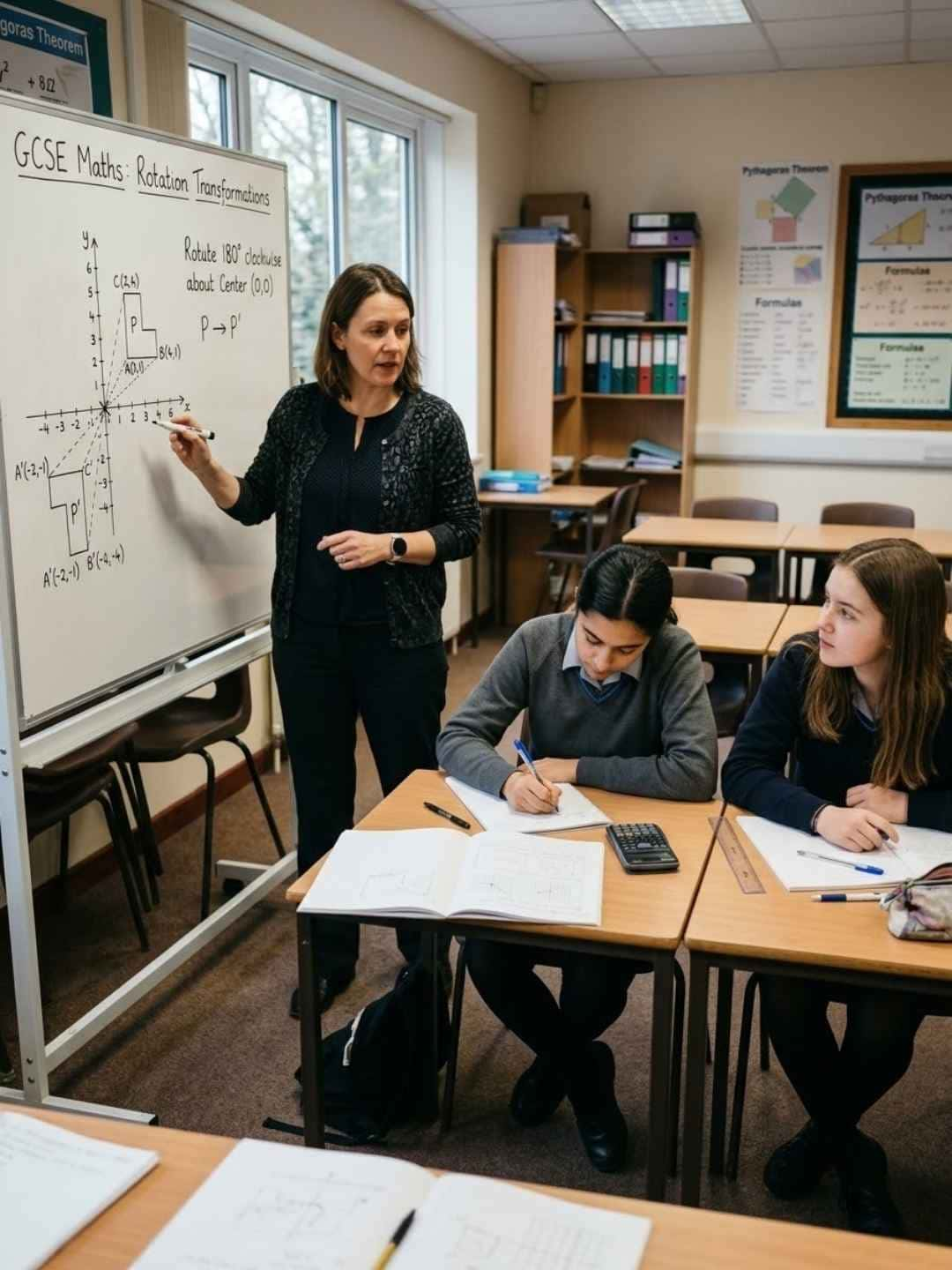
Rotation in Four Moves
1
Find the Centre
Identify the fixed point around which the shape rotates.
2
Choose the Angle
Identify the required rotation angle such as 90°, 180° or 270°.
3
Check the Direction
Decide whether the turn is clockwise or anti-clockwise.
4
Rotate and Plot
Rotate each vertex, plot the new points and join them to form the image.
What You’ll Learn
Understand what a rotation is.
Recognise common GCSE rotation angles.
Distinguish clockwise from anti-clockwise.
Understand the centre of rotation.
Rotate coordinates about the origin.
Perform rotations of shapes on coordinate grids.
Describe rotations fully.
Key Rules
Centre of rotation
A rotation turns a shape around a fixed centre of rotation.
Angle & direction
Always identify the angle and whether the turn is clockwise or anti-clockwise.
90° clockwise
(x, y) → (y, −x)
90° anti-clockwise
(x, y) → (−y, x)
180° rotation
(x, y) → (−x, −y)
Worked Proof: Rotation
Step-by-Step Method
- 1. Identify the centre of rotation.
- 2. Identify the angle of rotation.
- 3. Check whether the rotation is clockwise or anti-clockwise.
- 4. Rotate each vertex around the centre.
- 5. Plot the new vertices accurately.
- 6. Join the points to complete the rotated shape.
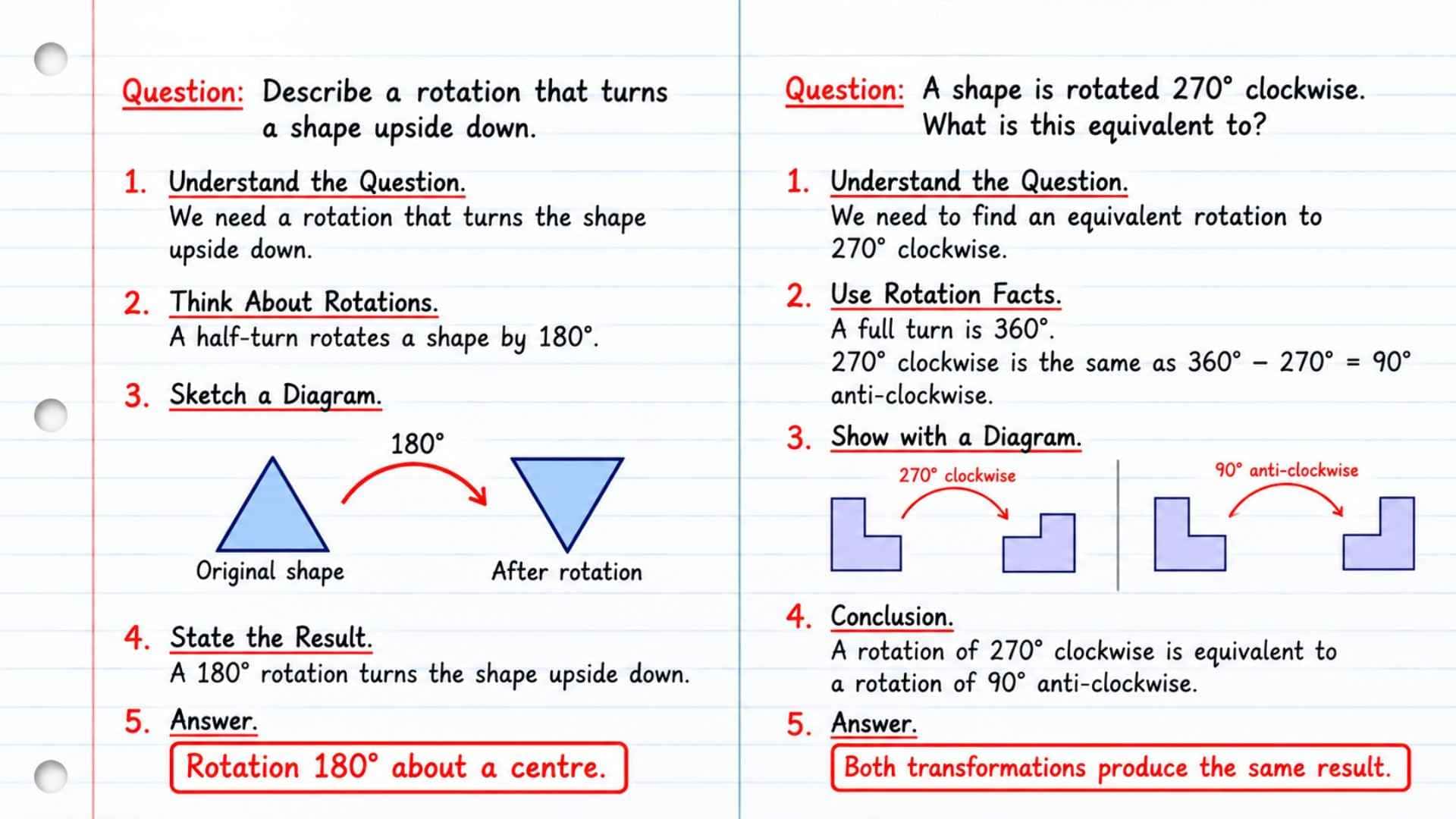
More Worked Examples
1
Rotate a point 90° clockwise about the origin.
Point: (2, 4)
Rule: (x, y) → (y, -x)
(2, 4) → (4, -2)
2
Rotate a point 90° anti-clockwise about the origin.
Point: (3, 1)
Rule: (x, y) → (-y, x)
(3, 1) → (-1, 3)
3
Rotate a point 180° about the origin.
Point: (5, 2)
Rule: (x, y) → (-x, -y)
(5, 2) → (-5, -2)
4
A triangle is rotated 90° clockwise around the origin.
Vertex A = (1, 2)
(1, 2) → (2, -1)
- Common GCSE Mistakes
- Confusing clockwise and anti-clockwise.
- Using the wrong centre of rotation.
- Rotating by the wrong angle.
- Forgetting that the shape stays the same size.
- Misplotting rotated coordinates.
- Exam Tips
- Misplotting rotated coordinates.
- Check the angle carefully.
- Confirm clockwise or anti-clockwise direction.
- Keep every vertex the same distance from the centre.
- Learn the common coordinate rules about the origin.
- When describing a rotation, include angle, direction and centre.
Skills Used in Rotation
Ready to Practise?
Watch the Rotation Tutorial
Step-by-step walkthroughs of Rotation with clear methods and exam tips.
Frequently Asked Questions
A rotation turns a shape around a fixed point called the centre of rotation.
No. A rotation keeps the same size and shape but changes orientation.
The angle, direction and centre of rotation.
(x, y) → (y, -x).
(x, y) → (-y, x).
It is equivalent to 90° anti-clockwise.
