GCSE Maths • Statistics • Primarily higher tier

GCSE Bearings Revision Guide

Build confidence with three-figure bearings, compass directions, accurate drawing and measuring, reverse bearings and exam-style navigation problems. Learn how bearings connect geometry, Pythagoras and trigonometry in Foundation and Higher Tier questions.

Foundation

Exam practice

Worked examples

What You'll Learn

Read Three-Figure Bearings

Interpret directions measured clockwise from North and write every bearing using three digits.

Draw and Measure Bearings

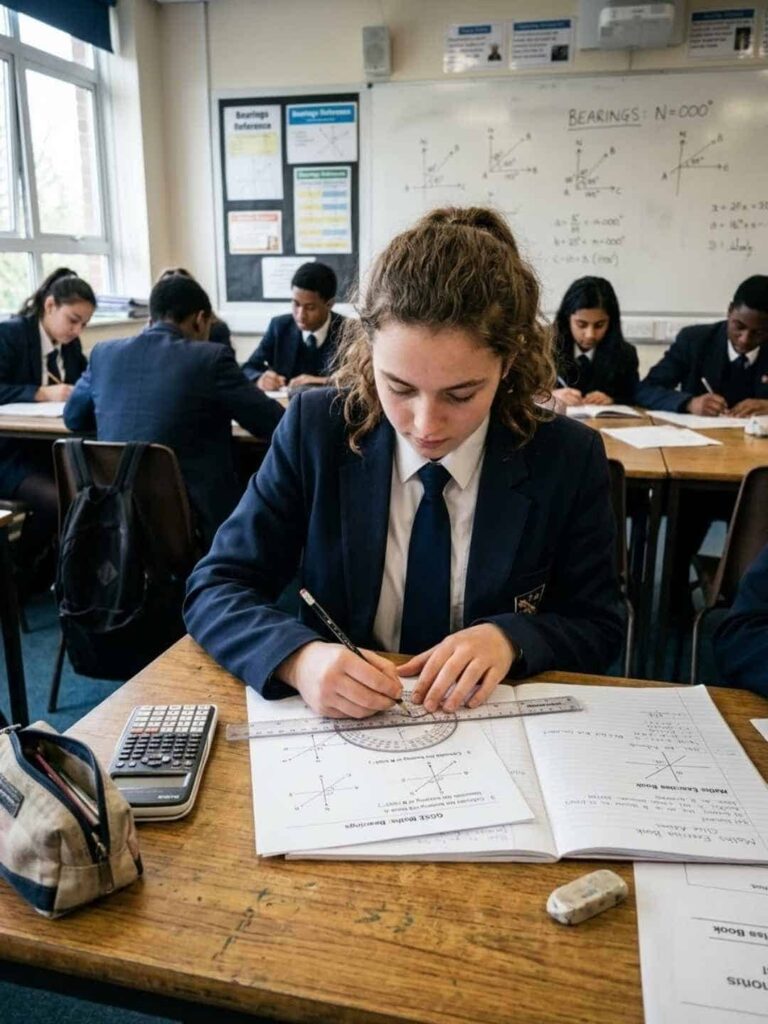
Draw a North line, place a protractor at the starting point, measure clockwise and draw the direction line accurately.

Find Reverse Bearings

Use the 180° relationship to find the direction back to the starting point.

Use Pythagoras and Trigonometry

Combine bearings with Pythagoras and SOHCAHTOA to calculate straight-line distances and angles.

Solve Exam-Style Problems

Sketch the journey, add North lines, label bearings and distances, choose a suitable method and check the final answer.

Key Bearing Rules

Clockwise measurement

Measure every bearing clockwise.

Start from North

Every bearing starts from a North line, with North pointing upwards.

Three-figure notation

Write bearings using three figures, including leading zeros: for example, 045° and 090°.

Reverse bearings

Add 180° when the bearing is less than 180°. Subtract 180° when the bearing is greater than 180°.

Accurate diagrams

Draw a clear sketch, add North lines, mark bearings and label distances before choosing a mathematical method.

Bearings Lessons

Three-Figure Bearings

Read compass directions and write angles measured clockwise from North using three figures.

Both

Drawing and Measuring Bearings

Use a North line and protractor to measure clockwise and draw a required direction accurately.

Both

Reverse Bearings

Find the direction back to a starting point by adding or subtracting 180°.

Both

Bearings with Pythagoras and SOHCAHTOA

Use right-angled triangles to calculate straight-line distances and angles from North.

Higher

Multi-Step Bearings Exam Questions

Interpret a journey, draw a sketch, add North lines, label distances and select the mathematical method needed.

Higher

Worked Examples

Example 1: Write a Three-Figure Bearing

A direction is 45° clockwise from North. Write the bearing.

1: Start from North and measure clockwise.

2. Write the angle using three figures: 45°.

Example 2: Find a Reverse Bearing

A bearing is 230°. Find the reverse bearing.

1. The bearing is greater than 180°, so subtract 180°.

2. 230° − 180° = 50°.

Example 3: Use Pythagoras

A boat travels 6 km East and then 8 km North. Find the straight-line distance from the start.

1. Draw a right-angled triangle..

2. Use Pythagoras: 6² + 8² = 100.

3. The straight-line distance is 10 km.

Example 4: Use SOHCAHTOA

A ship is 15 km East and 20 km North of a harbour. Find the bearing from the harbour.

1. Find the angle from North: tan θ = 15/20.

2. θ ≈ 36.9°.

3. Round to the nearest degree and write the bearing using three figures: 37°.

Example 5: Multi-Step Distance and Bearing

A plane flies 40 km on a bearing of 090° and then 30 km North.

1. Draw a right-angled triangle.

2. Use Pythagoras: 40² + 30² = 2500, so the distance is 50 km.

3. Find the angle from North: tan θ = 40/30, so θ ≈ 53.1°.

4. Write the bearing using three figures: 53°.

Ready to Practice?

Printable Worksheet

Practise three-figure notation, compass bearings, reverse bearings and right-triangle navigation questions, with answers.

Interactive Quiz

Test clockwise measurement from North, leading zeros, reverse bearings and method selection.

Exam-Style Questions

Build confidence with ships, aircraft, distances, angles and multi-step bearings problems.

Watch the Bearings Tutorial

Follow a clear, step-by-step explanation of measuring clockwise from North, writing three-figure bearings, drawing bearings, finding reverse bearings and solving navigation problems with Pythagoras and SOHCAHTOA.

Frequently Asked Questions

A bearing describes direction using an angle measured clockwise from North. It is always written using three figures, even when the angle is less than 100°.

East is 90°, South is 180° and West is 270°.

Draw a North line, place a protractor at the starting point, measure clockwise, mark the required angle and draw the direction line.

Add 180° when the original bearing is less than 180°. Subtract 180° when it is greater than 180°. The result is the direction back to the starting point.

Higher Tier questions can combine bearings with Pythagoras, SOHCAHTOA, the Sine Rule and the Cosine Rule to calculate distances and angles.

Source Practice Questions and Answers

Three-Figure Bearings

Answers: 1. 90°; 2. 180°; 3. 270°; 4. 35°; 5. 260°; 6. 120°

Bearings Exam Questions

Answers: 1. 250°; 2. 60°; 3. 13 km; 4. 15 km; 5. 27°; 6. 45°