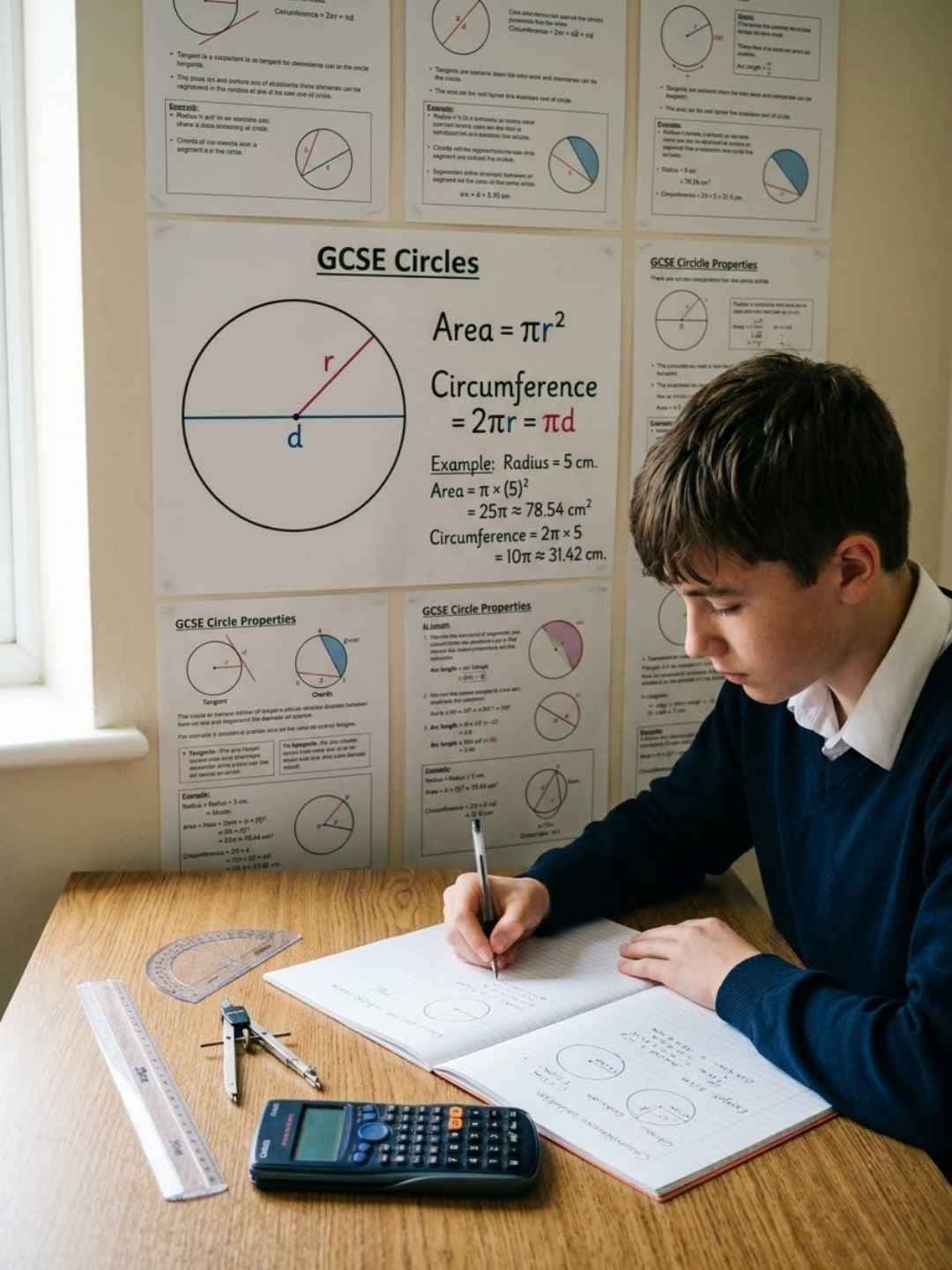
Circle questions become much easier when you identify the measurement given and select the matching formula. This guide explains the parts of a circle, circumference, area, arcs and sectors. You will learn to work with exact answers in terms of π, use correct units and check solutions through proportion and estimation.
A sector has radius 12 cm and central angle 150°. Find (a) its arc length, (b) its area and (c) its complete perimeter. Give exact answers and decimal answers to 1 decimal place.
Given information: The radius is 12 cm and the sector represents 150/360 = 5/12 of a full circle.
Method: Find the same fraction of the full circumference and full area, then add two radii to the arc for the sector perimeter.
Find the full circumference: C = 2πr = 2π × 12 = 24π cm.
Find the arc length: L = (150/360) × 24π = (5/12) × 24π = 10π cm ≈ 31.4 cm.
Find the full circle area: A = πr² = π × 12² = 144π cm².
Find the sector area: S = (150/360) × 144π = (5/12) × 144π = 60π cm² ≈ 188.5 cm².
Find the complete perimeter: P = arc + 2 radii = 10π + 24 cm ≈ 55.4 cm.
Final answer: Arc length = 10π cm ≈ 31.4 cm; sector area = 60π cm² ≈ 188.5 cm²; perimeter = 24 + 10π cm ≈ 55.4 cm.
Independent answer check: Both the arc and the sector are 5/12 of their respective full-circle measures: 10π/24π = 5/12 and 60π/144π = 5/12.
One common mistake: Do not report 10π cm as the complete perimeter. That is only the curved arc; the two 12 cm radii must also be included.
Common GCSE Mistakes
Confusing Radius and Diameter
Using the Wrong Formula
Forgetting to Square the Radius
Rounding π Too Early
Omitting Straight Edges
Mixing Length and Area Units
Using the Wrong Sector Angle
Exam Tips
Mark the radius and diameter on the diagram before selecting a formula; write d = 2r beside the working if a conversion is needed.
Write the full-circle formula first, then multiply by θ/360 for an arc or sector. This keeps the proportional method visible.
Leave answers in terms of π when the question asks for an exact value; otherwise keep the calculator value and round only at the end.
Trace a perimeter with your finger or pencil so that straight radii, diameters and other edges are not missed.
Check dimensions and size: an area needs square units, and a sector with angle below 180° should be less than half the full circle.
For reverse area questions, take the positive square root because a radius represents a non-negative length.
Ready to Practice?
Printable Worksheet
Practise radius and diameter conversions, circumference, area, arcs, sectors and part-circle perimeters in a planned sequence.
Interactive Quiz
Check formula selection, units, exact answers and common misconceptions with automatic marking and lesson-linked feedback.
Exam-Style Questions
Apply circle methods to reverse calculations, compound shapes and multi-step sectors while showing clear working.
Watch the Circle , Area and Circumference Tutorial
Clear, step-by-step explanation of expanding brackets, simplifying complex expressions, and solving for x. Perfect for visual learners who need a breakdown of the rules in action.
The radius is the distance from the centre to the circumference. The diameter runs from one side of the circle to the other through the centre, so d = 2r and r = d/2.
Circumference is the distance around a circle and uses linear units such as cm. Area is the region inside the circle and uses square units such as cm². Their formulae are C = 2πr or πd and A = πr².
Use the π symbol for an exact answer. For a decimal answer, use the calculator π key and keep the full value until the final rounding step unless the question specifically tells you to use an approximation such as 3.14.
Start with A = πr². Divide by π to obtain r² = A/π, then take the positive square root: r = √(A/π). Include a length unit, not a square unit, in the final radius.
Both use the central-angle fraction θ/360 when θ is measured in degrees. Multiply this fraction by the full circumference for an arc length or by the full circle area for a sector area.
Not on every exam board. AQA places arc lengths and areas of sectors in additional Foundation content, so they are relevant to Foundation and Higher students on AQA. Always check the specification for the exam board being studied.
Calculate the curved part first, then add every straight edge. A semicircle perimeter includes half the circumference plus the diameter. A sector perimeter includes its arc plus two radii.