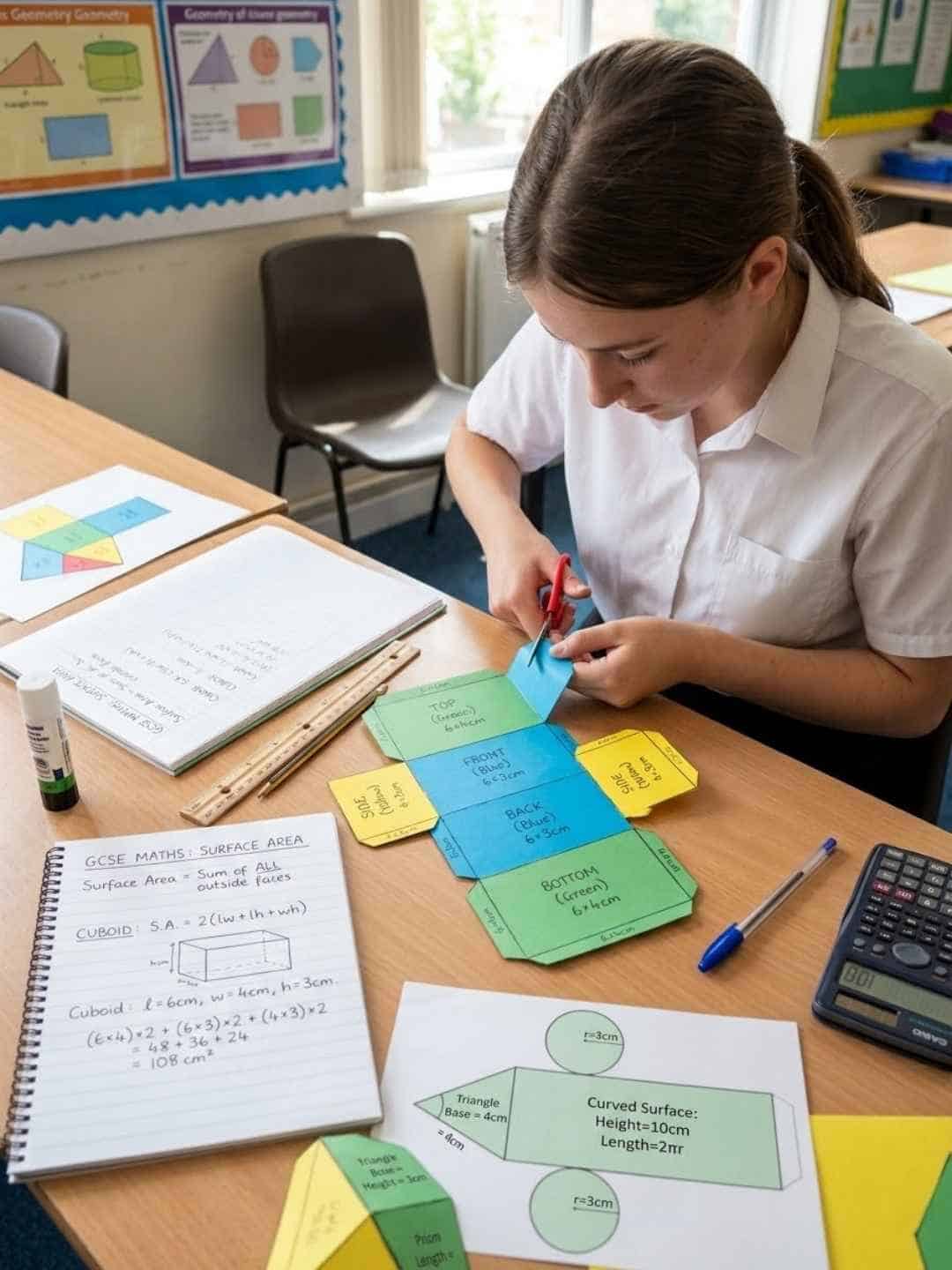
Use face properties, nets and formulae for rectangular solids.
Cylinders
Calculate curved and total surface area using radius, height and π.
Spheres And Cones
Apply sphere and cone formulae, including slant-height questions.
CORE SUBTOPICS
Nets
Use a flat layout to count faces and identify matching dimensions.
Curved versus Total Area
Decide whether bases or end circles must be included.
Open Containers
Omit only the faces explicitly missing from the object.
Compound Solids
Count exterior surfaces and exclude internal joins.
Missing Dimensions
Rearrange formulae or use Pythagoras for a cone’s slant height.
Similarity and Scale Factors
Surface areas scale with the square of the linear scale factor.
Worked Example
Total Surface Area of a Cone
QUESTION
A right cone has radius 5 cm and vertical height 12 cm. Find its total surface area in terms of π and to 1 decimal place.
Given information: The cone formula needs slant height l, which is not supplied directly.
Method: Use Pythagoras to find l, then add the circular base and curved surface.
Find the slant height: l=√(5²+12²)=√169=13 cm.
Base area: πr²=π×5²=25π cm².
Curved surface area: πrl=π×5×13=65π cm².
Total surface area: 25π+65π=90π cm².
Using π on a calculator, 90π≈282.7 cm² to 1 decimal place.
Final answer: 90π cm², approximately 282.7 cm².
Independent answer check: Both base and curved surface are included, and 25π+65π=90π.
One common mistake: Do not substitute the vertical height 12 cm for the slant height in πrl.
Common GCSE Mistakes
Confusing Area and Volume
Missing a Face
Counting a Joined Face
Using Diameter as Radius
Using Vertical Height for Cone Area
Including the Wrong Ends
Converting Units Linearly
Rounding Too Early
Exam Tips
Write every relevant formula before substitution.
Mark radius, diameter, vertical height and slant height separately.
For open shapes, cross out only the missing surfaces.
Keep exact π values during working and round once at the end.
Write square units on intermediate and final area results.
For compound solids, subtract hidden joins or count exposed regions directly.
Ready to Practice?
Printable Worksheet
Download and print practice questions with answers.
Interactive Quiz
Test your knowledge with instant feedback and hints.
Exam-Style Questions
Timed questions to build confidence for the real exam.
Watch the Surface Area Tutorial
Clear, step-by-step explanation of expanding brackets, simplifying complex expressions, and solving for x. Perfect for visual learners who need a breakdown of the rules in action.