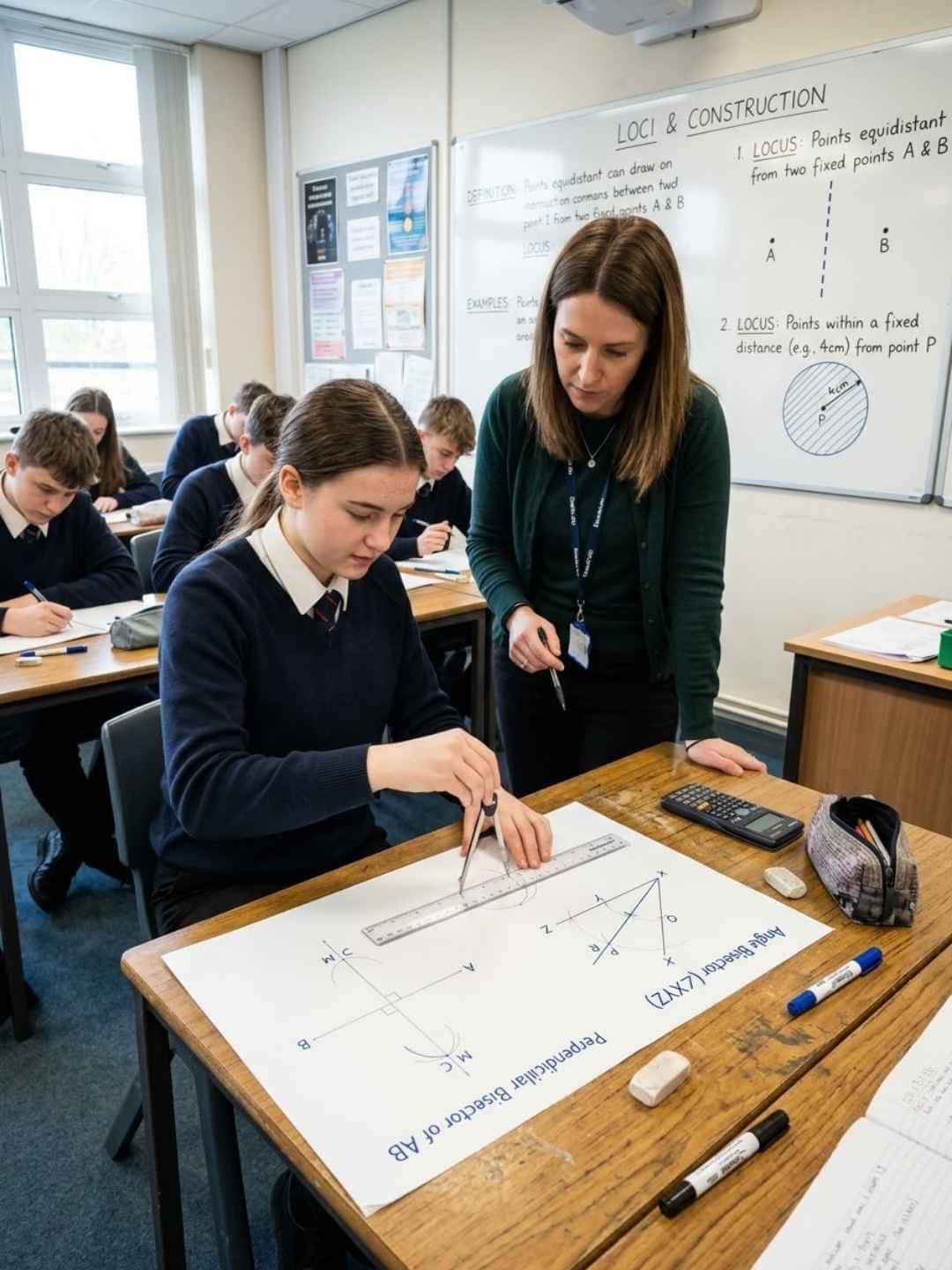
Points A and B are marked on a map. Shade the region that is within 4 cm of A and closer to A than to B.
Given information: “Within 4 cm” gives a circular region. “Closer to A than B” uses the perpendicular bisector of AB as a boundary.
Method: Construct both boundaries accurately, identify the valid side or interior for each condition, then take their overlap.
Set the compass to 4 cm and draw a circle centred at A.
Construct the perpendicular bisector of AB using equal-radius arcs from A and B.
The points within 4 cm of A lie inside the circle.
The points closer to A than B lie on the A side of the perpendicular bisector.
Shade only the part inside the circle that is also on the A side of the bisector.
Because “closer” is strict, points on the perpendicular bisector are not part of that condition; follow the diagram convention required by the question.
Final answer: The required region is the intersection of the circle’s interior and the half-plane on A’s side of the perpendicular bisector.
Independent answer check: Choose a test point in the shading: its distance from A must be no more than 4 cm and smaller than its distance from B.
One common mistake: Do not shade the entire circle; the closer-to-A condition removes the part on B’s side.
Common GCSE Mistakes
Erasing Construction Arcs
Changing Compass Width
Using Too Small a Radius
Measuring Instead of Constructing
Shading Between Parallel Loci
Using Only One Angle Bisector
Ignoring Boundary Words
Taking the Union Instead of the Overlap
Exam Tips
Use a sharp pencil and keep the compass setting steady.
Make construction arcs long enough to intersect clearly.
Measure distance from a line at 90°.
Label centres, vertices and boundaries so the reasoning is easy to follow.
Translate each condition separately before combining regions.
Use a test point to decide which side of a boundary is valid.
Check whether the object is a point, infinite line, ray or finite segment.
Do not remove valid construction evidence when finishing the diagram.
Ready to Practice?
Printable Worksheet
Practise bisectors, triangle constructions and standard loci.
Interactive Quiz
Match conditions to circles, parallels, bisectors and regions.
Exam-Style Questions
Construct and shade regions satisfying multiple conditions.
Watch the Constructions and Loci Tutorial
Clear, step-by-step explanation of expanding brackets, simplifying complex expressions, and solving for x. Perfect for visual learners who need a breakdown of the rules in action.
Constructions are accurate geometric drawings made using a ruler and compass. Common examples include constructing perpendicular bisectors, angle bisectors, perpendicular lines and triangles.
A locus is a set of points that follow a particular rule or condition. For example, all points that are the same distance from a fixed point form a circle.
You will usually need a ruler, compass and pencil. Some questions may also require a protractor, although many traditional constructions must be completed using only a ruler and compass.
A perpendicular bisector is a line that cuts another line segment exactly in half at a 90° angle. Every point on the perpendicular bisector is the same distance from the two endpoints.
An angle bisector is a line that divides an angle into two equal angles. Points on an angle bisector are equally distant from the two sides of the angle.