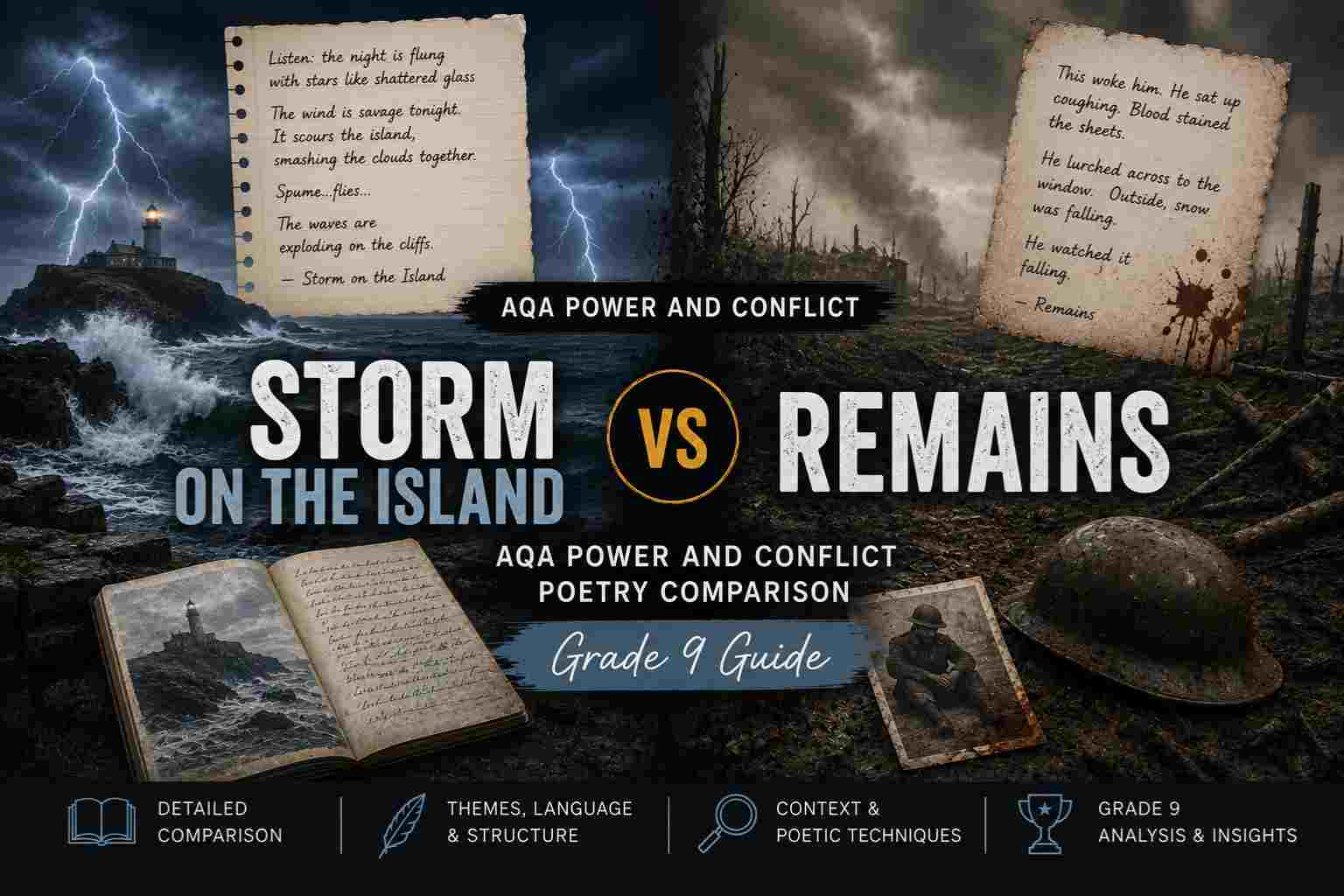
Storm on the Island vs Remains: AQA Power and Conflict Poetry Comparison (Grade 9 Guide)
Introduction
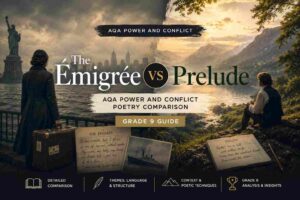
Storm on the Island by Seamus Heaney and Remains by Simon Armitage both explore conflict, fear, and human vulnerability, but they present these ideas through different types of experience. Heaney focuses on a community facing the overwhelming force of nature, while Armitage presents an individual soldier dealing with the psychological consequences of war. Together, the poems suggest that conflict—whether natural or human—can leave lasting emotional and psychological effects.
Quick Comparison Summary
| Theme | Storm on the Island | Remains |
|---|---|---|
| Conflict | Human vs nature | War / moral conflict |
| Power | Nature dominates | Individual action + guilt |
| Perspective | Collective (“we”) | First-person individual |
| Tone | Tense, controlled | Conversational, disturbing |
| Structure | Single stanza, enjambment | Fragmented narrative |
Order Book Now
Key similarities: a Grade 9 comparison
Similarity 1: Both poems present overwhelming conflict
In Storm on the Island, the community is “bombarded by the empty air”, suggesting invisible yet powerful forces.
In Remains, the speaker is overwhelmed by the memory of killing: “his bloody life in my bloody hands”.
Grade 9 Comparison Point:
Both poets show that conflict overwhelms individuals and removes control.
Similarity 2: Both poems explore fear
Heaney presents fear through anticipation: “it is a huge nothing that we fear”.
Armitage presents ongoing fear and trauma: “the drink and the drugs won’t flush him out”.
Grade 9 Comparison Point:
Both poems show fear as central to human experience in conflict.
Similarity 3: Both poems show loss of control
In Storm on the Island, nature cannot be controlled.
In Remains, the speaker cannot control his memories or guilt.
Grade 9 Comparison Point:
Both poems show humans as powerless in conflict.
Difference 1: Type of conflict
Storm on the Island
Natural conflict.
Remains
Human and moral conflict.
Grade 9 Comparison Point:
Heaney explores external threat, Armitage explores internal conflict.
Difference 2: Perspective
Storm on the Island
Collective voice.
Remains
Individual voice.
Grade 9 Comparison Point:
Heaney presents shared experience, Armitage presents personal trauma.
Difference 3: Structure
Storm on the Island
- Single stanza
- Continuous flow
Remains
- Shifts in time
- Fragmented
Grade 9 Comparison Point:
Heaney reflects steady tension, Armitage reflects psychological disruption.

Buy T-Shirt Now
Key Quotes Comparison Table
| Storm on the Island | Remains |
|---|---|
| “bombarded by the empty air” | “probably armed, possibly not” |
| “huge nothing that we fear” | “his bloody life in my bloody hands” |
| “we just sit tight” | “blood-shadow stays” |
| “flung spray” | “won’t flush him out” |
Context Comparison
Storm on the Island
- Reflects rural life and natural forces
- Can symbolise conflict (e.g. Northern Ireland)
Remains
- Based on Iraq War experiences
- Focus on PTSD and trauma
Exam Question 1
Compare how poets present conflict in Storm on the Island and Remains.
Grade 9 Model Response
Both Heaney and Armitage present conflict as overwhelming and destabilising, but they explore it through different dimensions: external natural forces versus internal psychological trauma. In Storm on the Island, conflict is presented as a confrontation between humans and nature. The opening declaration “we are prepared” initially suggests control, but this is quickly undermined by the force of the storm. The phrase “we are bombarded by the empty air” uses militaristic language to describe nature, implying that the environment itself becomes an enemy. The paradox of “empty air” highlights the invisible yet powerful nature of the threat, suggesting that conflict is unpredictable and difficult to resist.
In Remains, Armitage presents conflict as deeply personal and psychological. The speaker recounts the moment of killing with uncertainty—“probably armed, possibly not”—which introduces moral ambiguity. This lack of clarity suggests that conflict is not only physical but also ethical, leaving lasting emotional consequences. The repeated imagery of blood, particularly in “his bloody life in my bloody hands”, emphasises the speaker’s guilt and inability to move on. Unlike the communal experience in Heaney’s poem, the conflict in Remains continues internally long after the event.
Structurally, Heaney uses a single stanza with continuous enjambment to create a sense of sustained pressure, while Armitage uses shifts between past and present to reflect the ongoing impact of trauma. This contrast highlights the difference between external and internal conflict.
Therefore, both poets present conflict as overwhelming, but Heaney focuses on immediate external pressure, while Armitage emphasises long-term psychological effects.
Exam Question 2
Compare how poets present fear in Storm on the Island and Remains.
Grade 9 Model Response
Both poems explore fear as a central response to conflict, but they present it in different ways. In Storm on the Island, fear is anticipatory and shared. The phrase “it is a huge nothing that we fear” suggests that the community fears the unknown as much as the physical storm. This abstract fear is heightened by the lack of a visible enemy, making it more psychologically complex. The use of the collective pronoun “we” reinforces the idea that fear is experienced communally, creating a sense of unity but also emphasising the scale of the threat.
In Remains, fear is more personal and enduring. The speaker is haunted by his actions, as shown in “the drink and the drugs won’t flush him out”. This suggests that fear has become internalised, manifesting as trauma. The colloquial tone makes the experience feel realistic and immediate, highlighting the lasting impact of conflict on the individual.
Structurally, Heaney’s controlled form reflects contained tension, while Armitage’s fragmented narrative reflects the breakdown of mental stability.
Therefore, both poets present fear as powerful, but Heaney focuses on shared anticipation, while Armitage emphasises individual psychological trauma.
Exam Question 3
Compare how poets present the role of individuals or communities in conflict.
Grade 9 Model Response
Both Heaney and Armitage explore how people respond to conflict, but they present contrasting perspectives. In Storm on the Island, the focus is on a community working together to endure the storm. The repeated use of “we” creates a sense of solidarity, suggesting that collective experience provides strength. However, the phrase “we just sit tight” indicates a passive response, highlighting the limits of human control.
In Remains, the focus is on an individual who is isolated by his experiences. The first-person narrative allows the reader to engage directly with his thoughts, particularly his guilt and confusion. Unlike the shared experience in Heaney’s poem, the speaker in Remains is alone with his memories, reflecting the isolating nature of trauma.
Structurally, Heaney’s continuous flow reflects stability and shared endurance, while Armitage’s shifts in time reflect disruption and fragmentation.
Therefore, both poets show that humans are vulnerable in conflict, but Heaney emphasises collective endurance, while Armitage highlights individual isolation.
Further Revision Links
- AQA Power and Conflict Poetry Anthology (All 15 Poems): https://englishmadesimple.org/aqa-power-and-conflict-poetry-anthology-complete-gcse-revision-guide-all-15-poems/
- Storm on the Island – Grade 9 Guide: https://englishmadesimple.org/storm-on-the-island-by-seamus-heaney-how-to-get-a-grade-9-aqa-gcse-english-literature/
- Remains – Grade 9 Guide: https://englishmadesimple.org/remains-by-simon-armitage-how-to-get-a-grade-9-aqa-gcse-english-literature/
You might also like…
- Remains vs War Photographer: https://englishmadesimple.org/remains-vs-war-photographer/
- Exposure vs Storm on the Island: https://englishmadesimple.org/exposure-vs-storm-on-the-island/
- Exposure vs Remains: https://englishmadesimple.org/exposure-vs-remains/
Final Grade 9 Tip
When comparing these poems, remember: Heaney shows communities facing external natural threats, while Armitage reveals the lasting internal impact of human conflict.