The Prelude vs Bayonet Charge: AQA Power and Conflict Poetry Comparison (Grade 9 Guide)
Introduction
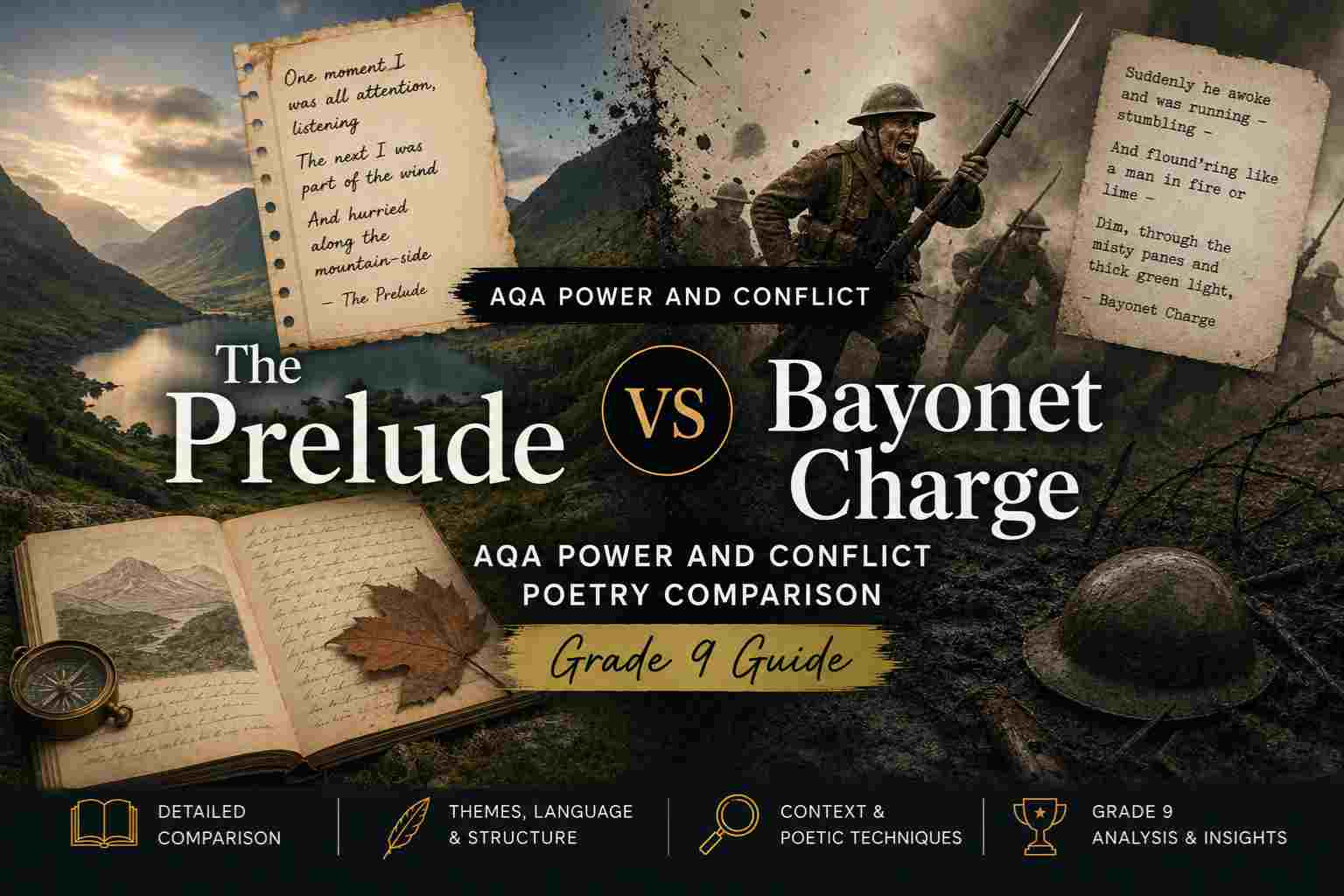
The Prelude (extract) by William Wordsworth and Bayonet Charge by Ted Hughes both explore conflict, power, and human vulnerability, but they present these ideas in different ways. Wordsworth focuses on a personal encounter with nature that shapes identity, while Hughes presents a soldier’s chaotic experience in battle. Together, the poems suggest that powerful forces—whether natural or human—can overwhelm individuals and challenge their sense of control.
Quick Comparison Summary
| Theme | The Prelude | Bayonet Charge |
|---|---|---|
| Conflict | Human vs nature | War / human conflict |
| Power | Nature dominates | War and instinct dominate |
| Perspective | Reflective individual | Immediate individual |
| Tone | Awe and reflection | Panic and chaos |
| Structure | Blank verse narrative | Fragmented, enjambment |

Order Book Now
Key similarities: a Grade 9 comparison
Similarity 1: Both poems present overwhelming forces
In The Prelude, nature is overwhelming: “a huge peak, black and huge”.
In Bayonet Charge, war overwhelms the soldier: “Suddenly he awoke and was running”.
Grade 9 Comparison Point:
Both poets show individuals overwhelmed by forces beyond their control.
Similarity 2: Both poems explore fear
Wordsworth presents fear through awe and uncertainty.
Hughes presents immediate fear: “his terror’s touchy dynamite”.
Grade 9 Comparison Point:
Both poems show fear as a key response to powerful experiences.
Similarity 3: Both poems show loss of control
In The Prelude, the speaker loses confidence when faced with nature.
In Bayonet Charge, the soldier loses control over his actions and thoughts.
Grade 9 Comparison Point:
Both poets present humans as vulnerable.
The Prelude and Bayonet Charge: key differences
Difference 1: Type of conflict
The Prelude
Natural, psychological conflict.
Bayonet Charge
Physical, violent conflict.
Grade 9 Comparison Point:
Wordsworth explores internal reflection, Hughes explores external chaos.
Difference 2: Perspective
The Prelude
Retrospective and reflective.
Bayonet Charge
Immediate and immersive.
Grade 9 Comparison Point:
Wordsworth reflects after the event, Hughes places the reader inside it.
Difference 3: Structure
The Prelude
- Continuous blank verse
- Narrative development
Bayonet Charge
- Fragmented
- Enjambment
Grade 9 Comparison Point:
Wordsworth shows development, Hughes shows disruption.

Buy T-Shirt Now
Key Quotes Comparison Table
| The Prelude | Bayonet Charge |
|---|---|
| “huge peak, black and huge” | “Suddenly he awoke and was running” |
| “troubled pleasure” | “his terror’s touchy dynamite” |
| “grave and serious mood” | “bullets smacking the belly out of the air” |
| “no familiar shapes remained” | “cold clockwork of the stars” |
Context Comparison
The Prelude
- Romanticism
- Nature as a powerful force shaping identity
Bayonet Charge
- Modern warfare
- Focus on instinct and survival
How to answer a comparison question on The Prelude and Bayonet Charge
Exam Question 1
Compare how poets present conflict in The Prelude and Bayonet Charge.
Grade 9 Model Response
Both Wordsworth and Hughes present conflict as an overwhelming experience that disrupts human control, but they explore it through different forms: nature versus war. In The Prelude, conflict arises from the speaker’s encounter with nature. The image of the “huge peak, black and huge” emphasises the scale and dominance of the natural world, creating a sense of fear and awe. This moment challenges the speaker’s confidence and forces him to reconsider his place in the world. The conflict is therefore psychological, as the speaker grapples with his understanding of nature.
In Bayonet Charge, Hughes presents conflict as immediate and violent. The opening line “Suddenly he awoke and was running” places the reader directly in the middle of battle, creating a sense of urgency and confusion. The fragmented imagery reflects the soldier’s disorientation, while the metaphor “bullets smacking the belly out of the air” conveys the intensity of the violence. Unlike Wordsworth’s reflective conflict, Hughes presents conflict as chaotic and uncontrollable.
Structurally, Wordsworth uses continuous blank verse to reflect the unfolding experience, while Hughes uses enjambment and fragmentation to mirror the chaos of battle. This contrast highlights the difference between reflection and immediacy.
Therefore, both poets present conflict as overwhelming, but Wordsworth focuses on internal struggle, while Hughes emphasises physical chaos.
Exam Question 2
Compare how poets present fear in The Prelude and Bayonet Charge.
Grade 9 Model Response
Both poems explore fear as a response to powerful experiences, but they present it in different ways. In The Prelude, fear is gradual and reflective. The speaker’s encounter with nature creates a sense of awe, but also unease. The phrase “troubled pleasure” reflects this complexity, suggesting that fear is mixed with admiration. This fear leads to reflection and personal growth.
In Bayonet Charge, fear is immediate and overwhelming. The phrase “his terror’s touchy dynamite” suggests that the soldier’s fear is explosive and uncontrollable, reflecting the intensity of the situation. Unlike the controlled tone in Wordsworth’s poem, Hughes presents fear as something that disrupts rational thought and leads to panic.
Structurally, Wordsworth’s steady narrative reflects controlled reflection, while Hughes’ fragmented structure mirrors the breakdown of thought under pressure.
Therefore, both poets present fear as powerful, but Wordsworth shows it leading to understanding, while Hughes shows it causing chaos.
Exam Question 3
Compare how poets present the effects of powerful experiences.
Grade 9 Model Response
Both Wordsworth and Hughes explore the effects of powerful experiences on individuals, but they present contrasting outcomes. In The Prelude, the speaker’s encounter with nature leads to personal growth and reflection. The phrase “grave and serious mood” suggests that the experience has a lasting impact, shaping the speaker’s identity and understanding of the world.
In Bayonet Charge, the soldier’s experience leads to confusion and loss of purpose. The questioning of “King, honour, human dignity” suggests that the ideals that motivated him have lost meaning. This reflects the destructive impact of war on identity.
Structurally, Wordsworth’s narrative reflects development over time, while Hughes’ fragmented structure reflects disruption and instability.
Therefore, both poets show that powerful experiences affect individuals deeply, but Wordsworth presents growth, while Hughes presents destruction.
Further Revision Links
- AQA Power and Conflict Poetry Anthology (All 15 Poems): https://englishmadesimple.org/aqa-power-and-conflict-poetry-anthology-complete-gcse-revision-guide-all-15-poems/
- The Prelude – GCSE Poetry Guide: https://englishmadesimple.org/the-prelude-by-william-wordsworth-gcse-poetry/
- Bayonet Charge – GCSE Poetry Guide: https://englishmadesimple.org/bayonet-charge-by-ted-hughes-gcse-poetry/
You might also like…
- Prelude vs Storm on the Island: https://englishmadesimple.org/prelude-vs-storm-on-the-island/
- Exposure vs Bayonet Charge: https://englishmadesimple.org/exposure-vs-bayonet-charge/
- Storm on the Island vs Bayonet Charge: https://englishmadesimple.org/storm-on-the-island-vs-bayonet-charge/
Final Grade 9 Tip
When comparing these poems, remember: Wordsworth presents powerful experiences as shaping identity, while Hughes shows them destroying control and creating chaos.