The Émigrée vs Poppies: AQA Power and Conflict Poetry Comparison (Grade 9 Guide)
Introduction
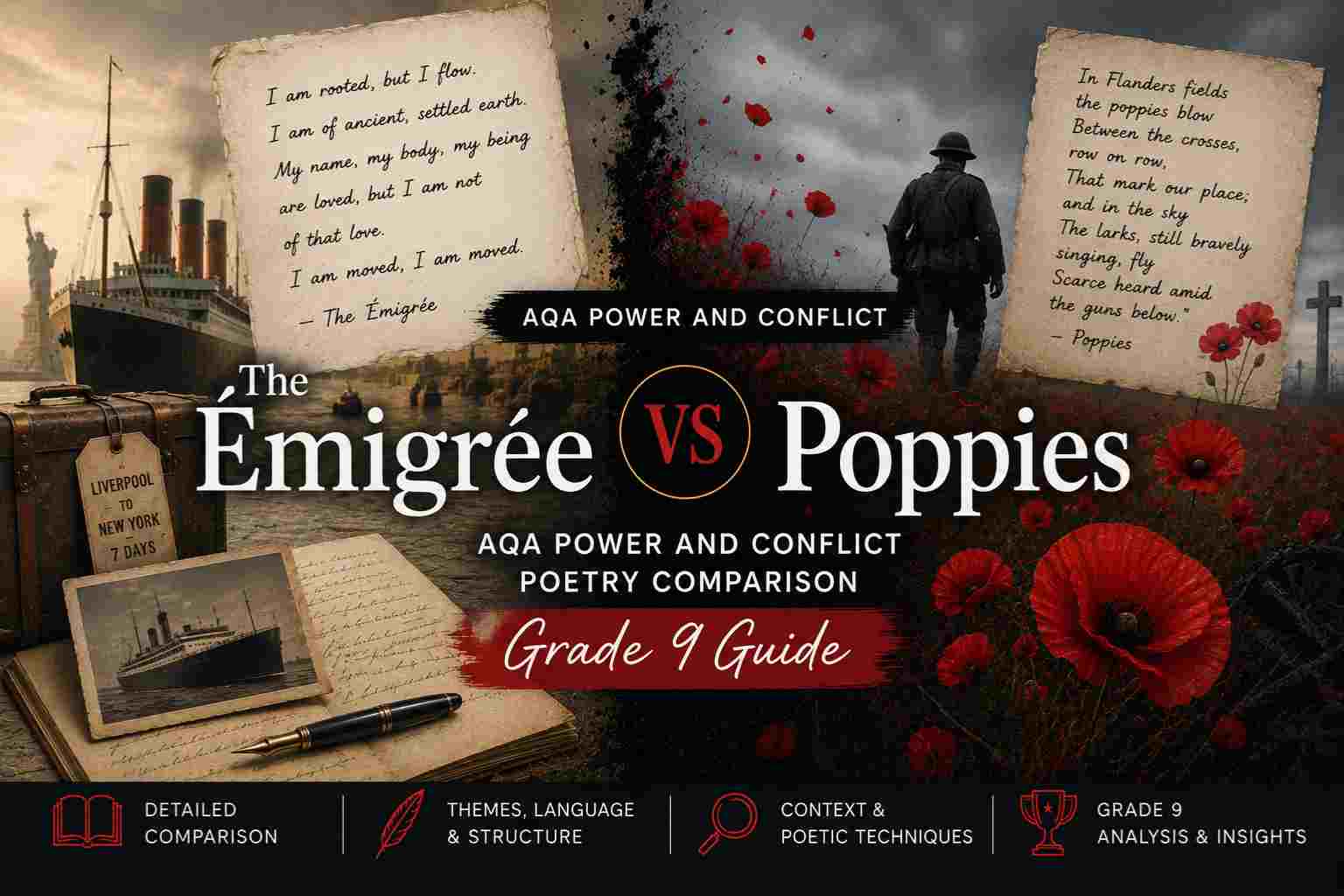
The Émigrée by Carol Rumens and Poppies by Jane Weir both explore memory, loss, and the emotional impact of conflict, but from different perspectives. Rumens presents a speaker reflecting on a lost homeland shaped by memory, while Weir presents a mother coping with the loss of her son to war. Together, the poems suggest that conflict leaves lasting emotional effects, shaping identity and relationships through memory and grief.
Quick Comparison Summary
| Theme | The Émigrée | Poppies |
|---|---|---|
| Memory | Idealised homeland | Personal memories of a child |
| Conflict | Political / exile | War / personal loss |
| Identity | Shaped by memory | Shaped by motherhood and grief |
| Tone | Nostalgic, reflective | Emotional, mournful |
| Structure | Controlled, consistent | Fragmented, shifting |

Order Book Now
Key similarities: a Grade 9 comparison
Similarity 1: Both poems explore memory
In The Émigrée, memory is “sunlight-clear”, suggesting idealisation.
In Poppies, memory appears through small details, such as preparing the uniform.
Grade 9 Comparison Point:
Both poets show memory as central to emotional experience.
Similarity 2: Both poems explore loss
The speaker in The Émigrée has lost her homeland.
The speaker in Poppies has lost her son to war.
Grade 9 Comparison Point:
Both poems show how loss shapes identity.
Similarity 3: Both poems explore conflict
Rumens presents political conflict causing exile.
Weir presents war causing personal loss.
Grade 9 Comparison Point:
Both poems show conflict affecting individuals deeply.
The Émigrée and Poppies: key differences
Difference 1: Type of loss
The Émigrée
Loss of place.
Poppies
Loss of a person.
Grade 9 Comparison Point:
Rumens presents abstract loss, Weir presents personal loss.
Difference 2: Tone
The Émigrée
Idealised and reflective.
Poppies
Raw and emotional.
Grade 9 Comparison Point:
Rumens romanticises memory, Weir presents grief realistically.
Difference 3: Structure
The Émigrée
- Three stanzas
- Consistent
Poppies
- Free verse
- Fragmented timeline
Grade 9 Comparison Point:
Rumens reflects stability, Weir reflects emotional disruption.

Buy T-Shirt Now
Key Quotes Comparison Table
| The Émigrée | Poppies |
|---|---|
| “sunlight-clear” | “spasms of paper red” |
| “There once was a country” | “I pinned one onto your lapel” |
| “they accuse me” | “released a song bird” |
| “my memory of it is sunlight-clear” | “hoping to hear your playground voice” |
Context Comparison
The Émigrée
- Political exile
- Memory and displacement
Poppies
- Modern war context
- Focus on family and emotional impact
How to answer a comparison question on The Émigrée and Poppies
Exam Question 1
Compare how poets present memory in The Émigrée and Poppies.
Grade 9 Model Response
Both Rumens and Weir present memory as a powerful force that shapes emotional experience, but they explore it in different ways depending on the type of loss being experienced. In The Émigrée, memory is idealised and almost romanticised. The phrase “my memory of it is sunlight-clear” suggests clarity, warmth, and positivity, indicating that the speaker chooses to remember her homeland in a way that protects her identity. This idealisation may also suggest that memory is selective, shaped more by emotion than reality. The repetition of “sunlight” reinforces this sense of warmth and attachment, suggesting that memory provides comfort despite the speaker’s displacement.
In Poppies, memory is more fragmented and tied to specific, personal moments. The speaker recalls preparing her son’s uniform, using sensory detail to bring the memory to life. The phrase “spasms of paper red” symbolises both remembrance and violence, linking memory directly to loss. Unlike Rumens’ speaker, who holds onto a stable image of the past, Weir’s speaker experiences memory as something that shifts and evolves, reflecting her ongoing grief.
Structurally, Rumens uses a consistent form to reflect the stability of memory, while Weir uses a fragmented structure to mirror the unpredictability of emotional recollection.
Therefore, both poets present memory as powerful, but Rumens emphasises its ability to preserve identity, while Weir highlights its role in processing grief.
Exam Question 2
Compare how poets present loss in The Émigrée and Poppies.
Grade 9 Model Response
Both poems explore loss as a central theme, but they present it in different ways. In The Émigrée, loss is abstract and linked to place. The speaker has been separated from her homeland, which is suggested through the phrase “There once was a country”. This creates a sense of distance and nostalgia, as the country exists only in memory. The repeated references to “sunlight” suggest that the speaker clings to positive memories to cope with this loss.
In Poppies, loss is deeply personal and emotional. The speaker reflects on her son leaving for war, and the poem suggests that he may have died. The line “hoping to hear your playground voice” highlights the speaker’s longing for the past, emphasising the emotional impact of loss. Unlike the distant loss in The Émigrée, the loss in Poppies is immediate and deeply felt.
Structurally, Rumens’ controlled form reflects a stable but distant sense of loss, while Weir’s fragmented structure reflects the ongoing and unresolved nature of grief.
Therefore, both poets present loss as impactful, but Rumens focuses on the loss of place, while Weir emphasises the loss of a loved one.
Exam Question 3
Compare how poets present the effects of conflict.
Grade 9 Model Response
Both Rumens and Weir explore the effects of conflict, but they present them in different ways. In The Émigrée, conflict is political and results in displacement. The speaker’s identity is shaped by her separation from her homeland, and her memories act as a way of maintaining a connection. The phrase “they accuse me” suggests that conflict continues to affect her, even in exile.
In Poppies, conflict is personal and emotional. The war itself is not directly described; instead, the focus is on its impact on the mother. The imagery of “spasms of paper red” links remembrance with violence, suggesting that the effects of conflict are both physical and emotional.
Structurally, Rumens’ consistent form reflects the ongoing influence of conflict on identity, while Weir’s fragmented structure reflects the disruption caused by loss.
Therefore, both poets show that conflict has lasting effects, but Rumens focuses on displacement and identity, while Weir highlights personal grief and emotional trauma.
Further Revision Links
- AQA Power and Conflict Poetry Anthology (All 15 Poems): https://englishmadesimple.org/aqa-power-and-conflict-poetry-anthology-complete-gcse-revision-guide-all-15-poems/
- The Émigrée – GCSE Poetry Guide: https://englishmadesimple.org/the-emigree-by-carol-rumens-gcse-poetry/
- Poppies – GCSE Poetry Guide: https://englishmadesimple.org/poppies-by-jane-weir-gcse-poetry/
You might also like…
- Poppies vs Kamikaze: https://englishmadesimple.org/poppies-vs-kamikaze/
- War Photographer vs Poppies: https://englishmadesimple.org/war-photographer-vs-poppies/
- Tissue vs The Émigrée: https://englishmadesimple.org/tissue-vs-the-emigree/
Final Grade 9 Tip
When comparing these poems, remember: Rumens shows memory preserving identity after loss of place, while Weir shows memory shaped by personal grief and emotional loss.