Ozymandias vs Charge of the Light Brigade: AQA Power and Conflict Poetry Comparison (Grade 9 Guide)
Introduction
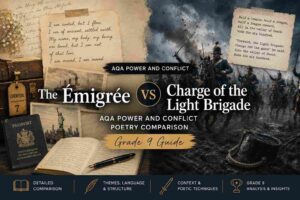
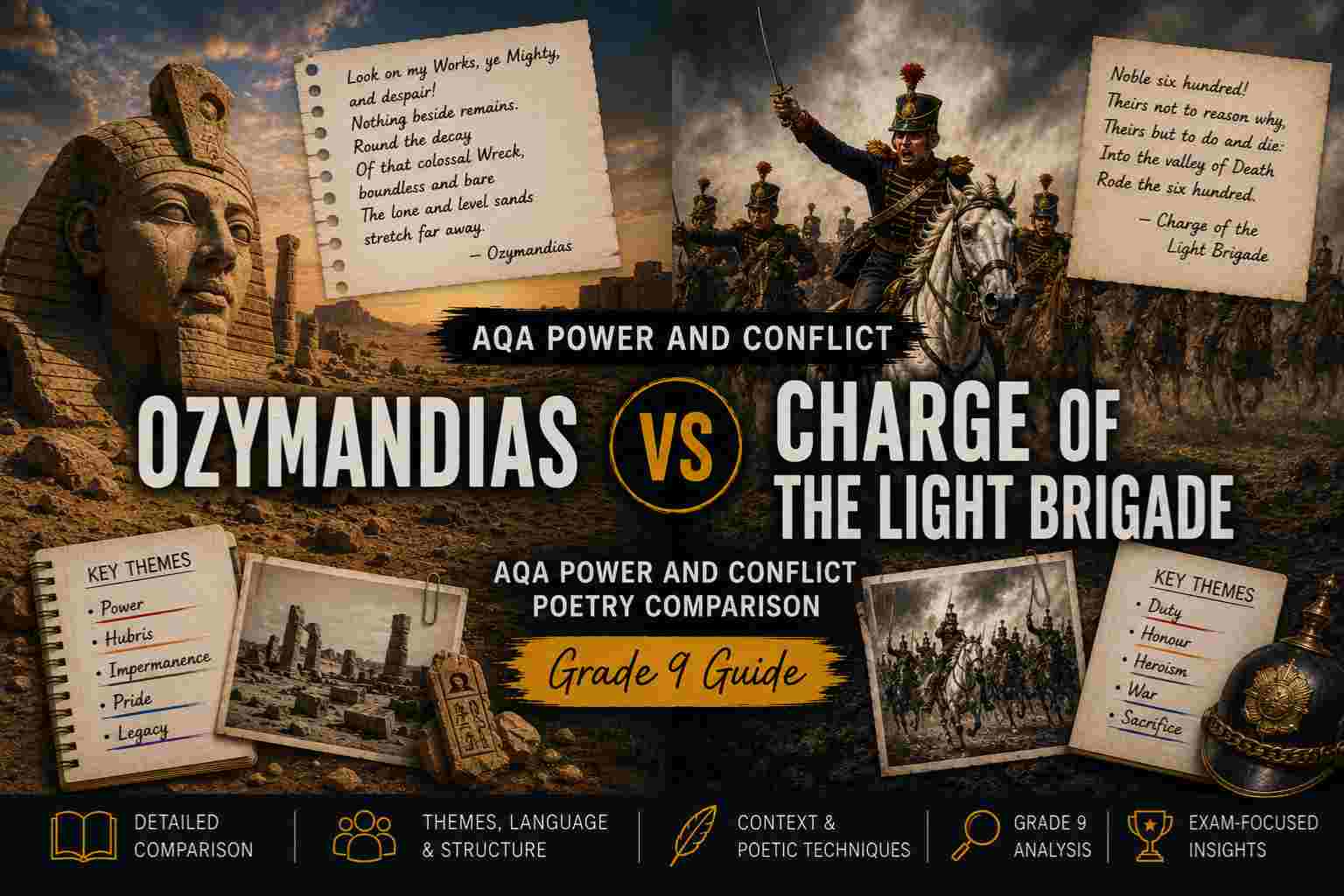
Ozymandias by Percy Bysshe Shelley and Charge of the Light Brigade by Alfred Lord Tennyson both explore power, conflict, and authority, but they present these ideas in contrasting ways. Shelley critiques the illusion and eventual collapse of political power, while Tennyson presents a dramatic account of soldiers following orders in battle, highlighting both bravery and the consequences of leadership. Together, the poems suggest that power—whether political or military—is complex and often leads to destructive outcomes.
Quick Comparison Summary
| Theme | Ozymandias | Charge of the Light Brigade |
|---|---|---|
| Power | Political authority | Military command |
| Conflict | Empire and conquest | Crimean War battle |
| Authority | Arrogant ruler | Flawed leadership |
| Identity | Lost over time | Defined by duty |
| Tone | Ironic, critical | Dramatic, honouring |

Buy Book Now
Key similarities: a Grade 9 comparison
Similarity 1: Both poems explore power and its consequences
In Ozymandias, the ruler’s command “Look on my Works, ye Mighty, and despair!” is undermined by “Nothing beside remains”.
In Charge of the Light Brigade, the soldiers follow orders despite knowing the danger: “Theirs not to reason why”.
Grade 9 Comparison Point:
Both poets show that power leads to consequences that are not always positive.
Similarity 2: Both poems present conflict critically
Shelley shows the aftermath of conflict through ruins.
Tennyson presents the chaos and danger of battle: “Into the valley of Death”.
Grade 9 Comparison Point:
Both poems highlight the destructive nature of conflict.
Similarity 3: Both poems explore authority
In Ozymandias, authority is linked to arrogance.
In Charge of the Light Brigade, authority is flawed, as a mistake leads soldiers into danger.
Grade 9 Comparison Point:
Both poets question the effectiveness of leadership.
Ozymandias and Charge of the Light Brigade: key differences
Difference 1: Presentation of power
Ozymandias
Power is presented as ultimately meaningless.
Charge of the Light Brigade
Power is linked to duty and honour.
Grade 9 Comparison Point:
Shelley critiques power, while Tennyson partly glorifies it.
Difference 2: Perspective
Ozymandias
Distant narrative.
Charge of the Light Brigade
Immediate, rhythmic account of battle.
Grade 9 Comparison Point:
Shelley reflects, Tennyson immerses.
Difference 3: Structure
Ozymandias
- Sonnet form
- Framed narrative
Charge of the Light Brigade
- Ballad-like rhythm
- Repetition
- Strong rhythm
Grade 9 Comparison Point:
Shelley contains meaning, Tennyson drives momentum.
Key Quotes Comparison Table
| Ozymandias | Charge of the Light Brigade |
|---|---|
| “Look on my Works” | “Theirs not to reason why” |
| “sneer of cold command” | “Into the valley of Death” |
| “Nothing beside remains” | “Cannon to right of them” |
| “lone and level sands” | “Honour the Light Brigade” |

Buy T-Shirt Now
Context Comparison
Ozymandias
- Shelley criticised tyranny.
Charge of the Light Brigade
- Tennyson wrote about the Crimean War.
- Reflects Victorian attitudes to duty and honour.
How to answer exam questions on Ozymandias and Charge of the Light Brigade
Exam Question 1
Compare how poets present power in Ozymandias and Charge of the Light Brigade.
Grade 9 Model Response
Both Shelley and Tennyson present power as influential but ultimately flawed, though they approach it from different angles. In Ozymandias, Shelley presents political power as something rooted in arrogance and control. The command “Look on my Works, ye Mighty, and despair!” reflects the ruler’s belief that his authority is permanent and superior. However, this is immediately undermined by the phrase “Nothing beside remains”, which reveals that time has erased his empire. Shelley therefore suggests that political power is temporary and ultimately meaningless.
In Charge of the Light Brigade, Tennyson presents power through military command. The soldiers are bound by duty, as shown in “Theirs not to reason why”, which emphasises obedience and lack of individual agency. However, the poem also implies that leadership is flawed, as the charge results from a mistake. The repeated imagery of danger, such as “Cannon to right of them”, highlights the consequences of this power.
Structurally, Shelley uses a sonnet to reflect the contained rise and fall of power, while Tennyson uses repetition and rhythm to mimic the movement of the charge, creating urgency.
Therefore, both poets present power as flawed. Shelley shows it collapsing over time, while Tennyson shows it leading to immediate consequences in battle.
Exam Question 2
Compare how poets present conflict in Ozymandias and Charge of the Light Brigade.
Grade 9 Model Response
Both Shelley and Tennyson explore conflict, but they present it in contrasting ways. In Ozymandias, conflict is implied through the ruler’s empire, but its effects are seen only in the ruined statue and empty landscape. The “lone and level sands” emphasise that any victories or conflicts have been erased by time, suggesting that conflict ultimately leads to no lasting success.
In Charge of the Light Brigade, conflict is immediate and intense. The repeated phrase “Into the valley of Death” creates a sense of inevitability and danger, while the rhythmic structure reflects the movement of the soldiers. Unlike Shelley, who presents conflict as distant, Tennyson immerses the reader in the action.
Structurally, Shelley condenses the consequences of conflict into a single image, while Tennyson expands it through repetition and vivid imagery.
Therefore, both poets present conflict as destructive, but Shelley focuses on its long-term insignificance, while Tennyson emphasises its immediate intensity.
Exam Question 3
Compare how poets present the role of the individual in conflict.
Grade 9 Model Response
Both Shelley and Tennyson explore the role of individuals within conflict, but they present contrasting perspectives. In Ozymandias, the individual is a ruler who seeks to dominate others. The “sneer of cold command” suggests arrogance and authority, but as the statue lies broken, this individual is reduced to insignificance. Shelley suggests that individuals who rely on power are ultimately forgotten.
In Charge of the Light Brigade, the individuals are soldiers who act collectively. The use of “Theirs” emphasises unity and shared responsibility, while also suggesting a lack of personal control. The soldiers’ bravery is highlighted, but their lack of agency raises questions about leadership.
Structurally, Shelley distances the reader through narrative, while Tennyson uses rhythm and repetition to create a sense of unity.
Therefore, both poets present individuals as shaped by power, but Shelley shows their insignificance over time, while Tennyson emphasises their bravery and sacrifice.
Further Revision Links
- AQA Power and Conflict Poetry Anthology (All 15 Poems): https://englishmadesimple.org/aqa-power-and-conflict-poetry-anthology-complete-gcse-revision-guide-all-15-poems/
- Ozymandias – Grade 9 Guide: https://englishmadesimple.org/ozymandias-by-percy-bysshe-shelley-how-to-get-a-grade-9-aqa-gcse-english-literature98627-2/
- Charge of the Light Brigade – GCSE Poetry Guide: https://englishmadesimple.org/charge-of-the-light-brigade-by-alfred-lord-tennyson-gcse-poetry/
You might also like…
- Bayonet Charge vs Charge of the Light Brigade: https://englishmadesimple.org/bayonet-charge-vs-charge-of-the-light-brigade/
- Exposure vs Charge of the Light Brigade: https://englishmadesimple.org/exposure-vs-charge-of-the-light-brigade/
- Ozymandias vs War Photographer: https://englishmadesimple.org/ozymandias-vs-war-photographer/
Final Grade 9 Tip
When comparing these poems, remember: Shelley critiques the illusion of lasting power, while Tennyson highlights the bravery and consequences of following authority in war.