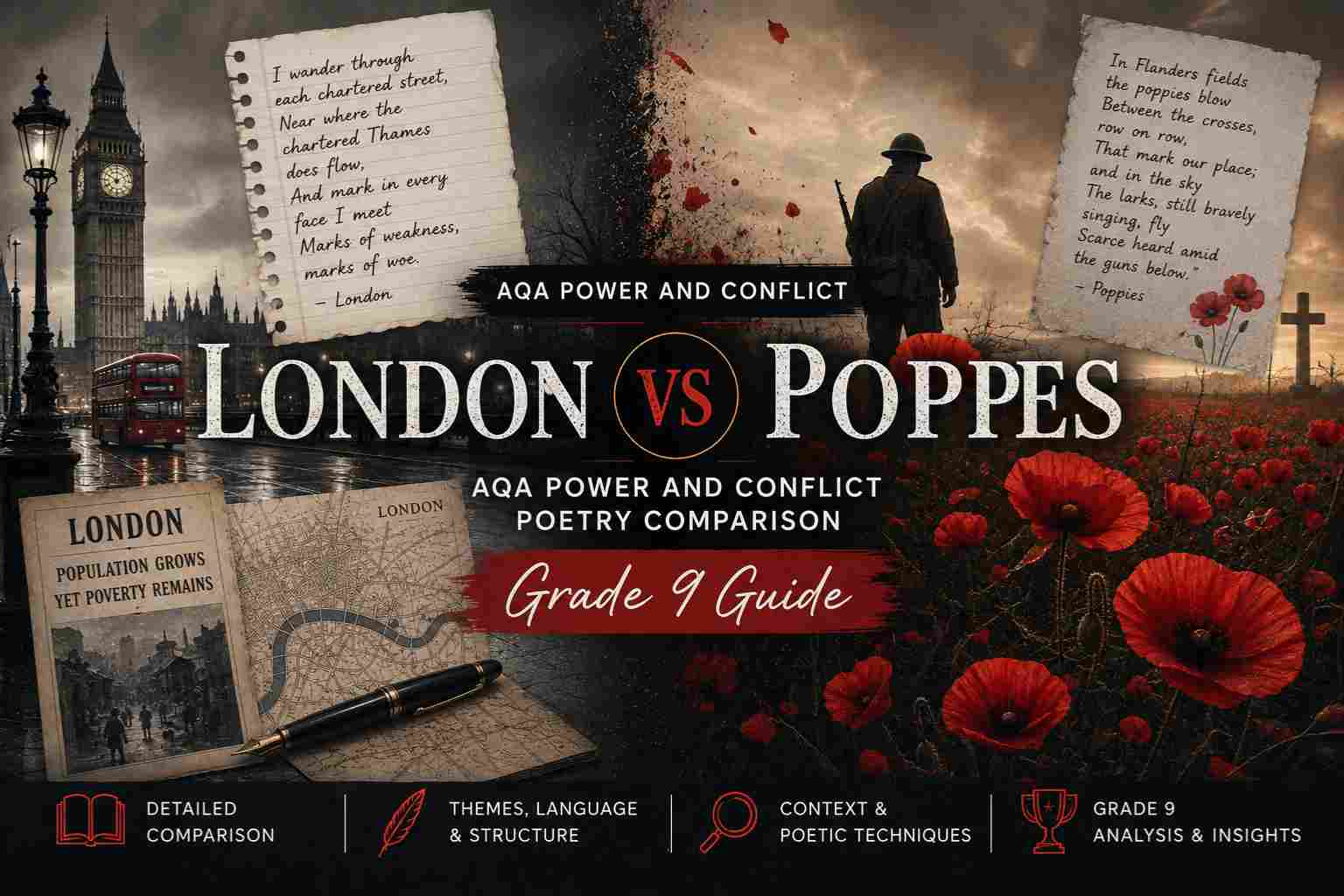
London vs Poppies: AQA Power and Conflict Poetry Comparison (Grade 9 Guide)
Introduction
London by William Blake and Poppies by Jane Weir both explore power, conflict, and the human cost of war, but from very different perspectives. Blake exposes the systemic oppression within society, while Weir presents the personal, emotional impact of conflict on a mother. Together, the poems reveal how power structures and war affect both society as a whole and individuals on a deeply personal level.
Quick Comparison Summary
| Theme | London | Poppies |
|---|---|---|
| Power | Institutional control | Emotional / parental power |
| Conflict | Social oppression | War and personal loss |
| Perspective | Observer of society | First-person mother |
| Tone | Angry, critical | Emotional, reflective |
| Structure | Regular quatrains | Free verse, fragmented |

Order Book Now
Key similarities: a Grade 9 comparison
Similarity 1: Both poems explore the effects of conflict
In London, conflict is seen in the suffering of the population, such as the “hapless soldier”.
In Poppies, conflict leads to the loss of a son and emotional trauma.
Grade 9 Comparison Point:
Both poets show that conflict has damaging effects on people.
Similarity 2: Both poems present power
Blake presents power through institutions such as the Church and monarchy.
Weir presents power through emotional relationships and the impact of war.
Grade 9 Comparison Point:
Both poems show that power influences human lives.
Similarity 3: Both poems present suffering
In London, suffering is widespread: “every cry of every Man”.
In Poppies, suffering is personal and emotional.
Grade 9 Comparison Point:
Both poets highlight the human cost of conflict.
London and Poppies: key differences
Difference 1: Scale of suffering
London
Widespread societal suffering.
Poppies
Individual emotional suffering.
Grade 9 Comparison Point:
Blake presents collective suffering, Weir presents personal grief.
Difference 2: Tone
London
Angry and critical.
Poppies
Reflective and emotional.
Grade 9 Comparison Point:
Blake condemns society, Weir explores feelings.
Difference 3: Structure
London
- Regular quatrains
- Repetition
Poppies
- Free verse
- Shifts in time
Grade 9 Comparison Point:
Blake reflects order and control, Weir reflects emotional fragmentation.

Buy T-Shirt Now
Key Quotes Comparison Table
| London | Poppies |
|---|---|
| “mind-forg’d manacles” | “spasms of paper red” |
| “hapless soldier” | “I pinned one onto your lapel” |
| “every cry of every Man” | “released a song bird” |
| “black’ning Church” | “hoping to hear your playground voice” |
Context Comparison
London
- Industrial Revolution
- Critique of institutions and inequality
Poppies
- Modern war context
- Focus on family and emotional impact
How to answer a comparison question on London and Poppies
Exam Question 1
Compare how poets present the effects of conflict in London and Poppies.
Grade 9 Model Response
Both Blake and Weir present the effects of conflict as deeply damaging, but they explore these effects on different scales: societal versus personal. In London, Blake presents conflict as embedded within the structure of society. The repeated use of “every” in phrases such as “every cry of every Man” suggests that suffering is universal, affecting all members of society. This is reinforced by the image of the “hapless soldier”, whose suffering is directly linked to those in power, as suggested by “runs in blood down Palace walls”. Blake implies that conflict is not only physical but also systemic, caused by institutions that exploit and control individuals.
In contrast, Poppies presents the effects of conflict on a deeply personal level. The speaker reflects on her son leaving for war, focusing on small, intimate moments such as “I pinned one onto your lapel”. This detail highlights the emotional significance of the event, suggesting that conflict disrupts everyday life. The phrase “spasms of paper red” symbolises both remembrance and violence, linking personal memory with the wider context of war. Unlike Blake’s broad critique of society, Weir focuses on the emotional impact of conflict on individuals.
Structurally, Blake uses regular quatrains and repetition to emphasise the relentless nature of suffering, while Weir uses free verse and shifts in time to reflect the fragmented nature of memory and grief. This contrast highlights the difference between ongoing societal oppression and personal emotional experience.
Therefore, both poets present conflict as harmful, but Blake emphasises its widespread societal impact, while Weir highlights its personal emotional consequences.
Exam Question 2
Compare how poets present power in London and Poppies.
Grade 9 Model Response
Both poems explore power and its effects on individuals, but they present it in different forms. In London, power is associated with institutions such as the Church, monarchy, and government. The phrase “mind-forg’d manacles” suggests that people are controlled not only physically but also psychologically, indicating that power operates through ideology as well as authority. Blake presents this power as oppressive, limiting freedom and contributing to widespread suffering.
In Poppies, power is more personal and emotional. The speaker’s role as a mother suggests a form of protective power, but this is ultimately limited by the larger forces of war. The act of “pinning” the poppy onto her son’s uniform symbolises both care and loss of control, as she prepares him to leave. This suggests that individual power is often overshadowed by larger societal forces, such as war.
Structurally, Blake’s regular form reflects the rigid control of institutions, while Weir’s free verse reflects the unpredictability of emotional experience.
Therefore, both poets present power as influential, but Blake critiques institutional control, while Weir highlights the limits of personal power in the face of conflict.
Exam Question 3
Compare how poets present suffering in London and Poppies.
Grade 9 Model Response
Both Blake and Weir highlight suffering as a central theme, but they present it in different ways. In London, suffering is collective and visible throughout society. The repetition of “every” emphasises the scale of this suffering, suggesting that it is unavoidable. The imagery of the “chimney-sweeper’s cry” and the “hapless soldier” highlights the impact of oppression on vulnerable groups, suggesting that those in power are responsible for this suffering.
In Poppies, suffering is internal and emotional. The speaker’s memories of her son create a sense of longing and loss, particularly in the line “hoping to hear your playground voice”. This highlights the personal impact of conflict, suggesting that suffering continues even after the physical event has ended.
Structurally, Blake’s repetition reinforces the persistence of suffering, while Weir’s fragmented structure reflects the ongoing and unresolved nature of grief.
Therefore, both poets present suffering as significant, but Blake focuses on widespread societal suffering, while Weir emphasises individual emotional pain.
Further Revision Links
- AQA Power and Conflict Poetry Anthology (All 15 Poems): https://englishmadesimple.org/aqa-power-and-conflict-poetry-anthology-complete-gcse-revision-guide-all-15-poems/
- London – GCSE Poetry Guide: https://englishmadesimple.org/london-by-william-blake-gcse-poetry/
- Poppies – GCSE Poetry Guide: https://englishmadesimple.org/poppies-by-jane-weir-gcse-poetry/
You might also like…
- War Photographer vs Poppies: https://englishmadesimple.org/war-photographer-vs-poppies/
- Remains vs Poppies: https://englishmadesimple.org/remains-vs-poppies/
- London vs Checking Out Me History: https://englishmadesimple.org/london-vs-checking-out-me-history/
Final Grade 9 Tip
When comparing these poems, remember: Blake exposes how power creates widespread suffering, while Weir shows the personal emotional impact of conflict on individuals.