The Émigrée vs My Last Duchess: AQA Power and Conflict Poetry Comparison (Grade 9 Guide)
Introduction
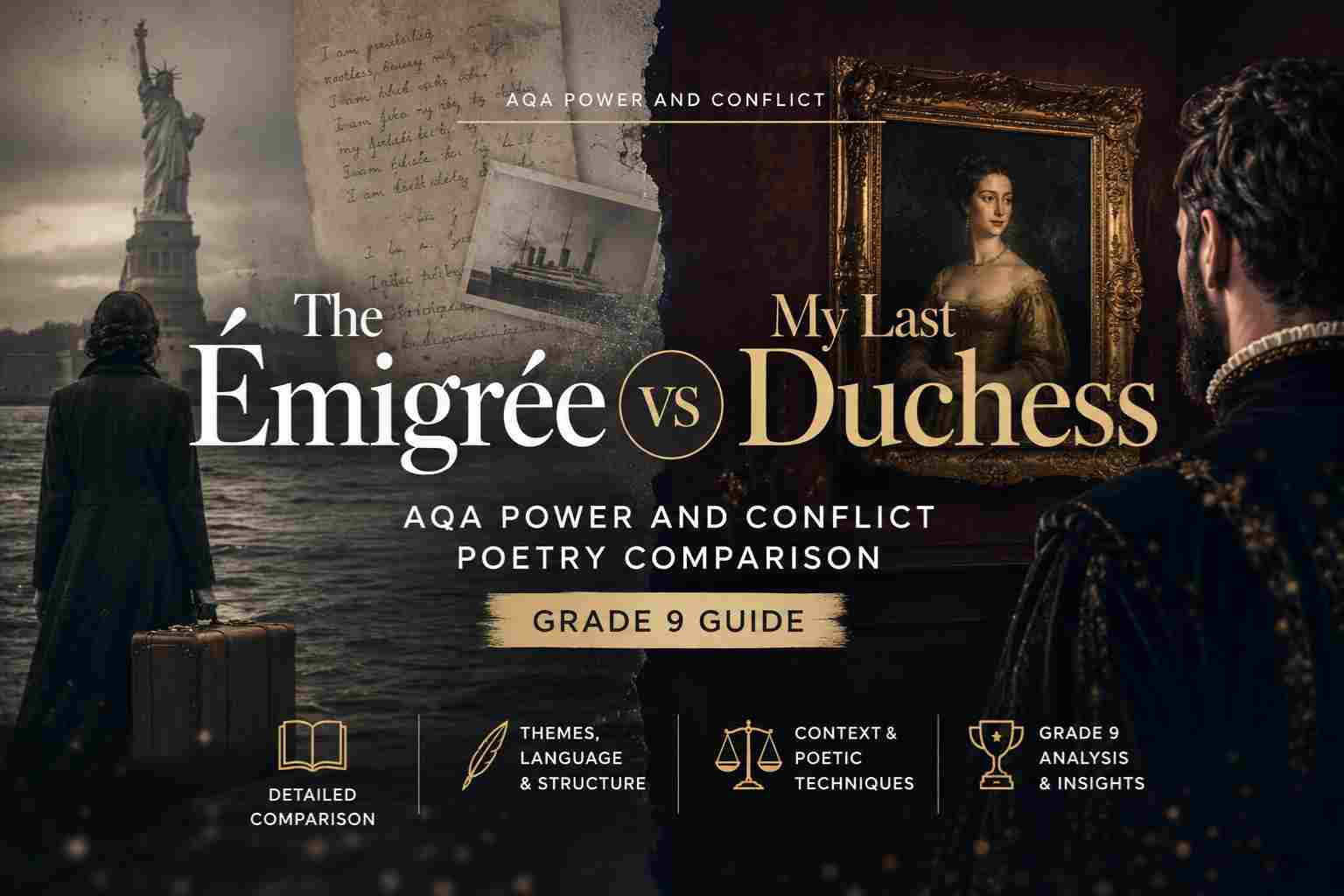
The Émigrée by Carol Rumens and My Last Duchess by Robert Browning both explore power, control, and identity, but from very different perspectives. Rumens presents a speaker who resists political oppression through memory and emotional attachment to her homeland, while Browning presents a controlling Duke obsessed with authority and possession. Together, the poems suggest that power can shape identity, relationships, and emotional experience.
Quick Comparison Summary
| Theme | The Émigrée | My Last Duchess |
|---|---|---|
| Power | Political oppression | Personal and patriarchal control |
| Identity | Preserved through memory | Controlled by the Duke |
| Perspective | Reflective exile | Dramatic monologue |
| Tone | Nostalgic, defiant | Arrogant, controlling |
| Structure | Controlled three stanzas | Single dramatic monologue |

Order Book Now
Key similarities: a Grade 9 comparison
Similarity 1: Both poems explore power
In The Émigrée, political power forces exile.
In My Last Duchess, the Duke exercises control over others.
Grade 9 Comparison Point:
Both poets show power affecting individuals’ lives and identities.
Similarity 2: Both poems explore identity
The speaker in The Émigrée preserves her identity through memory.
The Duchess’ identity is controlled and silenced by the Duke.
Grade 9 Comparison Point:
Both poems explore how identity can be shaped by powerful forces.
Similarity 3: Both poems explore control
Rumens presents authorities attempting to control the speaker.
Browning presents the Duke controlling his wife and her image.
Grade 9 Comparison Point:
Both poets critique oppressive forms of control.
The Émigrée and My Last Duchess: key differences
Difference 1: Presentation of power
The Émigrée
Power is political and external.
My Last Duchess
Power is personal and domestic.
Grade 9 Comparison Point:
Rumens focuses on political oppression, Browning on individual tyranny.
Difference 2: Tone
The Émigrée
Hopeful and reflective.
My Last Duchess
Cold and arrogant.
Grade 9 Comparison Point:
Rumens preserves emotional warmth, Browning reveals disturbing control.
Difference 3: Structure
The Émigrée
- Three controlled stanzas
- Consistent form
My Last Duchess
- Dramatic monologue
- Continuous speech
Grade 9 Comparison Point:
Rumens reflects emotional stability, Browning reflects dominance and manipulation.

Buy T-Shirt Now
Key Quotes Comparison Table
| The Émigrée | My Last Duchess |
|---|---|
| “sunlight-clear” | “I gave commands” |
| “There once was a country” | “my gift of a nine-hundred-years-old name” |
| “they accuse me” | “too soon made glad” |
| “my memory of it is sunlight-clear” | “that’s my last Duchess painted on the wall” |
Context Comparison
The Émigrée
- Political exile and displacement
- Identity shaped by memory
My Last Duchess
- Renaissance Italy
- Patriarchal power and control
- Dramatic monologue tradition
The Émigrée and My Last Duchess: Grade 9 model answers
Exam Question 1
Compare how poets present power in The Émigrée and My Last Duchess.
Grade 9 Model Response
Both Rumens and Browning present power as something that strongly affects individuals, but they explore different types of power. In The Émigrée, power is political and linked to oppression. The phrase “they accuse me” suggests that authorities attempt to challenge or silence the speaker because of her attachment to her homeland. However, the speaker resists this power through memory, preserving a positive emotional connection to her country.
In contrast, My Last Duchess presents power as personal and controlling. The Duke believes he has authority over others, especially women. His statement “I gave commands” strongly implies that he arranged the Duchess’s death because she failed to behave according to his expectations. Unlike the speaker in The Émigrée, who resists oppression, the Duchess becomes a victim of the Duke’s need for control.
Structurally, Rumens uses a stable and consistent form to reflect emotional resilience, while Browning’s dramatic monologue allows the Duke’s arrogance and manipulation to dominate the poem.
Therefore, both poets present power as influential and damaging, but Rumens focuses on political oppression, while Browning explores personal tyranny and control.
Exam Question 2
Compare how poets present identity in The Émigrée and My Last Duchess.
Grade 9 Model Response
Both poems explore identity, but they present it differently. In The Émigrée, identity is preserved through memory. The repeated image of “sunlight-clear” suggests warmth, positivity, and emotional attachment. Even though the speaker has been separated from her homeland, her memories allow her to maintain a strong sense of self.
In My Last Duchess, the Duchess’ identity is controlled by the Duke. He judges her behaviour and believes she should value only “my gift of a nine-hundred-years-old name”. This suggests that the Duke expects complete obedience and sees his wife as a possession rather than an individual.
Structurally, Rumens’ controlled structure reflects stable identity, while Browning’s dramatic monologue reflects the Duke dominating the narrative and silencing the Duchess.
Therefore, both poets show identity being shaped by power, but Rumens presents resilience and self-preservation, while Browning presents identity being controlled and suppressed.
Exam Question 3
Compare how poets present control in The Émigrée and My Last Duchess.
Grade 9 Model Response
Both Rumens and Browning explore control, but they present it in different ways. In The Émigrée, control is political and external. The speaker’s exile suggests that authorities have forced her away from her homeland. However, the speaker resists this control emotionally through memory.
In My Last Duchess, control is personal and direct. The Duke attempts to control the Duchess’ behaviour and image, even after her death. The line “that’s my last Duchess painted on the wall” suggests that he prefers her as an object he can possess completely.
Structurally, Rumens’ controlled form reflects emotional resistance, while Browning’s dramatic monologue reflects the Duke’s dominance and desire for control.
Therefore, both poets criticise oppressive control, but Rumens focuses on political oppression, while Browning highlights personal domination and possessiveness.
Further Revision Links
- AQA Power and Conflict Poetry Anthology (All 15 Poems): https://englishmadesimple.org/aqa-power-and-conflict-poetry-anthology-complete-gcse-revision-guide-all-15-poems/
- The Émigrée – GCSE Poetry Guide: https://englishmadesimple.org/the-emigree-by-carol-rumens-gcse-poetry/
- My Last Duchess – GCSE Poetry Guide: https://englishmadesimple.org/my-last-duchess-by-robert-browning-gcse-poetry/
You might also like…
- London vs My Last Duchess: https://englishmadesimple.org/london-vs-my-last-duchess-aqa-power-and-conflict-poetry-comparison-grade-9-guide/
- Ozymandias vs My Last Duchess: https://englishmadesimple.org/ozymandias-vs-my-last-duchess-aqa-power-and-conflict-poetry-comparison-grade-9-guide/
- The Émigrée vs London: https://englishmadesimple.org/london-vs-the-emigree-aqa-power-and-conflict-poetry-comparison-grade-9-guide/
Final Grade 9 Tip
When comparing these poems, remember: Rumens presents identity resisting political oppression through memory, while Browning shows how power and control can suppress and destroy individuality.