
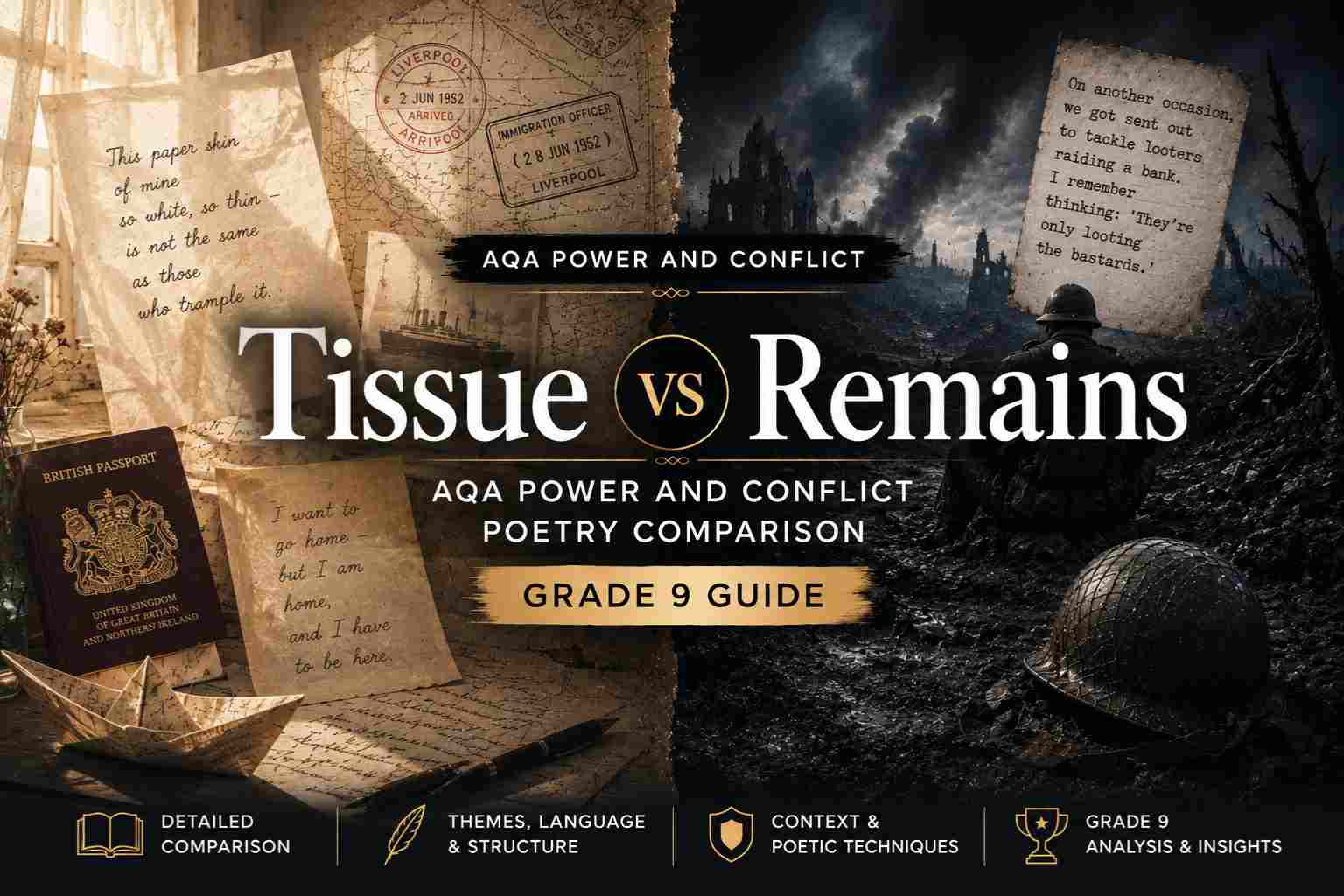
Tissue vs Remains: AQA Power and Conflict Poetry Comparison (Grade 9 Guide)
Introduction
Tissue by Imtiaz Dharker and Remains by Simon Armitage both explore power, fragility, and the impact of human actions, but from very different perspectives. Dharker presents the fragility of human systems and structures, while Armitage focuses on the psychological consequences of violence and war. Together, the poems suggest that human power is unstable and that conflict leaves lasting emotional and moral damage.
Quick Comparison Summary
| Theme | Tissue | Remains |
|---|---|---|
| Power | Fragile human systems | Power to take life |
| Conflict | Implied social/political conflict | War and moral conflict |
| Human vulnerability | Fragility of life and control | Psychological trauma |
| Tone | Reflective, philosophical | Conversational, disturbing |
| Structure | Fragmented free verse | Narrative free verse |

Order Book Now
Key similarities: a Grade 9 comparison
Similarity 1: Both poems explore human vulnerability
In Tissue, humans and their systems are presented as fragile.
In Remains, the speaker is emotionally vulnerable after war.
Grade 9 Comparison Point:
Both poets show that humans are vulnerable despite attempts to appear powerful.
Similarity 2: Both poems explore power
Dharker critiques the fragility of human control.
Armitage presents the destructive consequences of power in war.
Grade 9 Comparison Point:
Both poets question the nature and effects of human power.
Similarity 3: Both poems explore conflict
Tissue suggests social and political divisions.
Remains presents direct military conflict.
Grade 9 Comparison Point:
Both poems show conflict causing damage to individuals and society.
Tissue and Remains: key differences
Difference 1: Presentation of power
Tissue
Power is temporary and fragile.
Remains
Power is immediate and destructive.
Grade 9 Comparison Point:
Dharker questions systems of control, Armitage explores violence.
Difference 2: Tone
Tissue
Calm and reflective.
Remains
Disturbing and unsettled.
Grade 9 Comparison Point:
Dharker philosophises, Armitage personalises trauma.
Difference 3: Structure
Tissue
- Fragmented free verse
- Light, flowing form
Remains
- Narrative structure
- Shifts in time
Grade 9 Comparison Point:
Dharker reflects instability of systems, Armitage reflects psychological disruption.

Buy T-Shirt Now
Key Quotes Comparison Table
| Tissue | Remains |
|---|---|
| “paper that lets the light shine through” | “probably armed, possibly not” |
| “maps too” | “his bloody life in my bloody hands” |
| “turned into your skin” | “blood-shadow stays” |
| “might fly our lives like paper kites” | “won’t flush him out” |
Context Comparison
Tissue
- Explores fragility of human systems
- Questions ownership and control
Remains
- Based on Iraq War experiences
- Focus on PTSD and guilt
Tissue and Remains: Grade 9 model answers
Exam Question 1
Compare how poets present power in Tissue and Remains.
Grade 9 Model Response
Both Dharker and Armitage explore power and its effects, but they present it in contrasting ways. In Tissue, power is shown as fragile and temporary. Dharker uses paper as a symbol of human systems such as maps, money, and buildings, suggesting that structures humans rely on are delicate and easily damaged. The phrase “paper that lets the light shine through” suggests openness and vulnerability, implying that true power may lie in transparency rather than control. Dharker questions whether human attempts to impose order are ultimately meaningless.
In contrast, Remains presents power as immediate and destructive. The speaker has the power to take life, but this power becomes psychologically damaging. The uncertainty in “probably armed, possibly not” suggests moral confusion, while “his bloody life in my bloody hands” shows the lasting emotional consequences of violence. Unlike Dharker’s abstract exploration of power, Armitage presents it as deeply personal and traumatic.
Structurally, Dharker’s fragmented free verse reflects the instability of human systems, while Armitage’s shifting narrative reflects the continuing effects of trauma.
Therefore, both poets question human power, but Dharker focuses on the fragility of systems, while Armitage highlights the destructive consequences of violence.
Exam Question 2
Compare how poets present human vulnerability in Tissue and Remains.
Grade 9 Model Response
Both poems present humans as vulnerable, but they explore different forms of vulnerability. In Tissue, vulnerability is linked to the fragility of human life and the systems people create. The phrase “turned into your skin” suggests that humans themselves are delicate and temporary, like paper. Dharker implies that despite attempts to create control and permanence, humans remain fragile.
In Remains, vulnerability is psychological. The speaker is haunted by his memories, shown through “blood-shadow stays” and “won’t flush him out”. This suggests that emotional trauma is impossible to escape. Unlike the reflective tone in Tissue, Armitage presents vulnerability as immediate and painful.
Structurally, Dharker’s flowing free verse reflects the delicate nature of life, while Armitage’s fragmented structure reflects mental instability.
Therefore, both poets present humans as vulnerable, but Dharker focuses on existential fragility, while Armitage highlights psychological damage.
Exam Question 3
Compare how poets present the effects of conflict.
Grade 9 Model Response
Both Dharker and Armitage explore the effects of conflict, but they present them differently. In Tissue, conflict is implied through references to maps and borders, suggesting political and social divisions created by humans. Dharker implies that these systems are fragile and temporary.
In Remains, conflict is direct and violent. The speaker’s experience of killing someone leaves him traumatised, showing that conflict has lasting emotional consequences. The repeated blood imagery suggests that the effects of war continue long after the physical event.
Structurally, Dharker’s fragmented form reflects instability and uncertainty, while Armitage’s narrative structure reflects the persistence of traumatic memory.
Therefore, both poets show that conflict causes damage, but Dharker focuses on fragile systems and divisions, while Armitage highlights personal trauma and guilt.
Further Revision Links
- AQA Power and Conflict Poetry Anthology (All 15 Poems): https://englishmadesimple.org/aqa-power-and-conflict-poetry-anthology-complete-gcse-revision-guide-all-15-poems/
- Tissue – GCSE Poetry Guide: https://englishmadesimple.org/tissue-by-imtiaz-dharker-how-to-get-a-grade-9-aqa-gcse-english-literature/
- Remains – Grade 9 Guide: https://englishmadesimple.org/remains-by-simon-armitage-how-to-get-a-grade-9-aqa-gcse-english-literature/
You might also like…
- Tissue vs The Émigrée: https://englishmadesimple.org/tissue-vs-the-emigree/
- Exposure vs Remains: https://englishmadesimple.org/exposure-vs-remains/
- Remains vs War Photographer: https://englishmadesimple.org/remains-vs-war-photographer/
Final Grade 9 Tip
When comparing these poems, remember: Dharker questions the fragility of human systems and power, while Armitage reveals the lasting psychological damage caused by violence and war.