Ozymandias vs The Prelude: AQA Power and Conflict Poetry Comparison (Grade 9 Guide)
Introduction
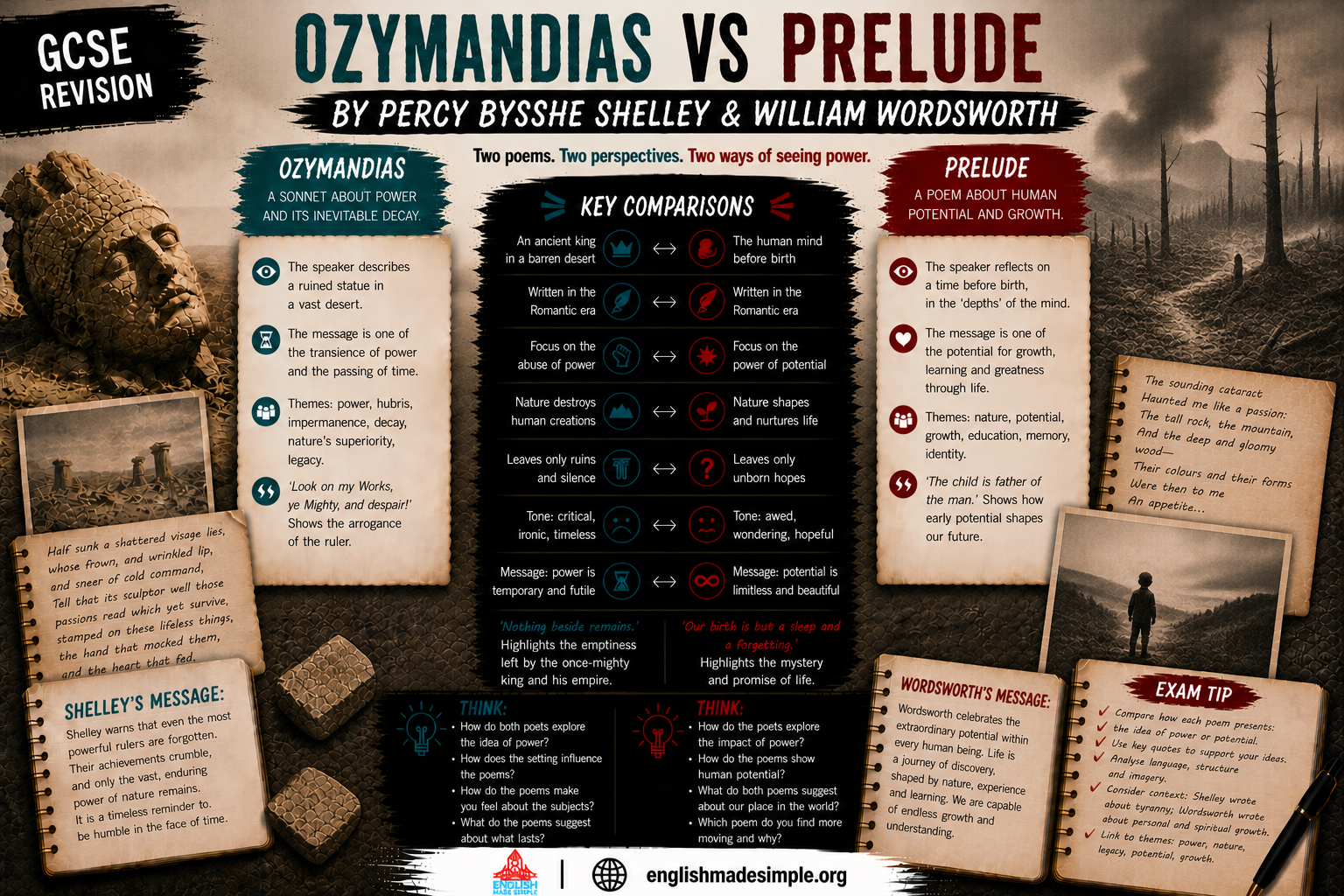
Ozymandias by Percy Bysshe Shelley and The Prelude (extract) by William Wordsworth both explore power, nature, and human identity, but they present these ideas in contrasting ways. Shelley presents a ruler whose political power has been destroyed by time and nature, while Wordsworth explores a personal encounter with nature that reshapes his identity. Together, the poems suggest that nature is ultimately more powerful than human authority and can influence how individuals understand themselves.
Quick Comparison Summary
| Theme | Ozymandias | The Prelude |
|---|---|---|
| Power | Political authority | Natural / psychological power |
| Nature | Destroys human power | Shapes identity |
| Conflict | Human vs time | Human vs nature |
| Identity | Lost over time | Transformed through experience |
| Tone | Ironic, reflective | Reflective, awe-filled |

Buy Book Now
Key similarities: a Grade 9 comparison
Similarity 1: Both poems present nature as powerful
In Ozymandias, nature erases the ruler’s empire, leaving “lone and level sands”.
In The Prelude, nature is overwhelming, shown through the “huge peak, black and huge”.
Grade 9 Comparison Point:
Both poets show that nature is more powerful than humans.
Similarity 2: Both poems explore the limits of human power
Shelley shows that Ozymandias’s power disappears completely: “Nothing beside remains”.
Wordsworth shows the speaker’s confidence collapsing when faced with nature.
Grade 9 Comparison Point:
Both poems suggest that human control is limited.
Similarity 3: Both poems explore identity
In Ozymandias, identity fades as power disappears.
In The Prelude, identity is shaped through experience with nature.
Grade 9 Comparison Point:
Both poems show identity being influenced by external forces.
Ozymandias and The Prelude: key differences
Difference 1: Type of power
Ozymandias
Political and external power.
The Prelude
Internal and psychological power.
Grade 9 Comparison Point:
Shelley critiques authority, while Wordsworth explores personal development.
Difference 2: Outcome
Ozymandias
Power is destroyed and forgotten.
The Prelude
Experience leads to growth and reflection.
Grade 9 Comparison Point:
Shelley presents loss, while Wordsworth presents transformation.
Difference 3: Structure
Ozymandias
- Sonnet form
- Framed narrative
The Prelude
- Blank verse
- Continuous narrative
Grade 9 Comparison Point:
Shelley compresses time, while Wordsworth develops experience.
Key Quotes Comparison Table
| Ozymandias | The Prelude |
|---|---|
| “Look on my Works” | “huge peak, black and huge” |
| “sneer of cold command” | “troubled pleasure” |
| “Nothing beside remains” | “grave and serious mood” |
| “lone and level sands” | “no familiar shapes remained” |

Buy T-Shirt Now
Context Comparison
Ozymandias
- Shelley criticised political tyranny.
The Prelude
- Wordsworth explores Romantic ideas about nature and self.
How to answer a comparison question on Ozymandias and The Prelude
Exam Question 1
Compare how poets present power in Ozymandias and The Prelude.
Grade 9 Model Response
Both Shelley and Wordsworth present power as something that challenges human control, but they explore different forms and consequences of that power. In Ozymandias, Shelley presents political power as something rooted in authority and dominance. The command “Look on my Works, ye Mighty, and despair!” reflects the ruler’s belief that his power is permanent and superior. However, this confidence is undermined by the phrase “Nothing beside remains”, which shows that time and nature have erased all evidence of his empire. Shelley therefore suggests that political power is fragile and ultimately meaningless when compared to the enduring forces of nature.
In The Prelude, Wordsworth presents power as something internal and psychological, emerging from the speaker’s interaction with nature. Initially, the speaker feels confident and in control, but this changes when he encounters the “huge peak, black and huge”. The repetition emphasises the overwhelming presence of nature, which disrupts his sense of certainty. Unlike Ozymandias, whose power is based on control over others, the speaker’s experience leads to a loss of confidence and a deeper understanding of his own limitations.
Structurally, Shelley uses a sonnet to contain and reflect on the rise and fall of power, reinforcing its eventual collapse. Wordsworth, however, uses continuous blank verse to mirror the unfolding experience, suggesting that power is something that develops over time rather than something fixed.
Therefore, both poets present power as something that challenges human control. Shelley shows it collapsing over time, while Wordsworth shows it transforming individual understanding.
Exam Question 2
Compare how poets present the effects of nature in Ozymandias and The Prelude.
Grade 9 Model Response
Both Shelley and Wordsworth present nature as a powerful force, but they explore its effects in different ways. In Ozymandias, nature acts as a destructive force that erases human achievements. The “lone and level sands” suggest a vast and empty landscape, emphasising the insignificance of the ruler’s empire. The image of decay highlights how nature outlasts human creations, suggesting that it is ultimately more powerful than political authority.
In The Prelude, nature is not only powerful but also transformative. The speaker’s encounter with the “huge peak, black and huge” creates a sense of awe and fear, leading to a shift in his perception. The phrase “grave and serious mood” suggests that the experience has a lasting impact on his thoughts and identity. Unlike Shelley, who presents nature as something that destroys, Wordsworth shows how it can shape and influence human understanding.
Structurally, Shelley condenses the effects of nature into a single image of decay, while Wordsworth develops them through a narrative that reflects the speaker’s changing emotions. This highlights the difference between destruction and transformation.
Therefore, both poets present nature as powerful, but Shelley focuses on its ability to destroy, while Wordsworth emphasises its capacity to shape human identity.
Exam Question 3
Compare how poets present the development of identity.
Grade 9 Model Response
Both Shelley and Wordsworth explore the development of identity, but they present contrasting outcomes. In Ozymandias, identity is closely linked to power and legacy. The ruler attempts to preserve his identity through the statue, which captures his “sneer of cold command”. However, as the statue lies broken, this identity is reduced to fragments, suggesting that it cannot survive without power. Shelley therefore presents identity as fragile and dependent on external factors.
In The Prelude, identity is shaped through personal experience and reflection. The speaker’s encounter with nature leads to a shift in his understanding of himself and the world around him. The phrase “no familiar shapes remained” suggests that his perception has changed, indicating personal growth. Unlike Ozymandias, whose identity is lost, the speaker’s identity develops through his experience.
Structurally, Shelley distances the reader from the individual through a framed narrative, while Wordsworth uses a continuous narrative to reflect the ongoing process of self-discovery. This contrast highlights the difference between a static identity and one that evolves over time.
Therefore, both poets present identity as influenced by external forces, but Shelley shows it fading with power, while Wordsworth shows it developing through experience.
Further Revision Links
- AQA Power and Conflict Poetry Anthology (All 15 Poems): https://englishmadesimple.org/aqa-power-and-conflict-poetry-anthology-complete-gcse-revision-guide-all-15-poems/
- Ozymandias – Grade 9 Guide: https://englishmadesimple.org/ozymandias-by-percy-bysshe-shelley-how-to-get-a-grade-9-aqa-gcse-english-literature98627-2/
- The Prelude – GCSE Poetry Guide: https://englishmadesimple.org/the-prelude-by-william-wordsworth-gcse-poetry/
You might also like…
- Prelude vs Storm on the Island: https://englishmadesimple.org/prelude-vs-storm-on-the-island/
- Ozymandias vs Storm on the Island: https://englishmadesimple.org/ozymandias-vs-storm-on-the-island/
- Tissue vs The Émigrée: https://englishmadesimple.org/tissue-vs-the-emigree/
Final Grade 9 Tip
When comparing these poems, remember: Shelley shows nature destroying human power, while Wordsworth shows nature shaping human identity.