Ozymandias vs Bayonet Charge: AQA Power and Conflict Poetry Comparison (Grade 9 Guide)
Introduction
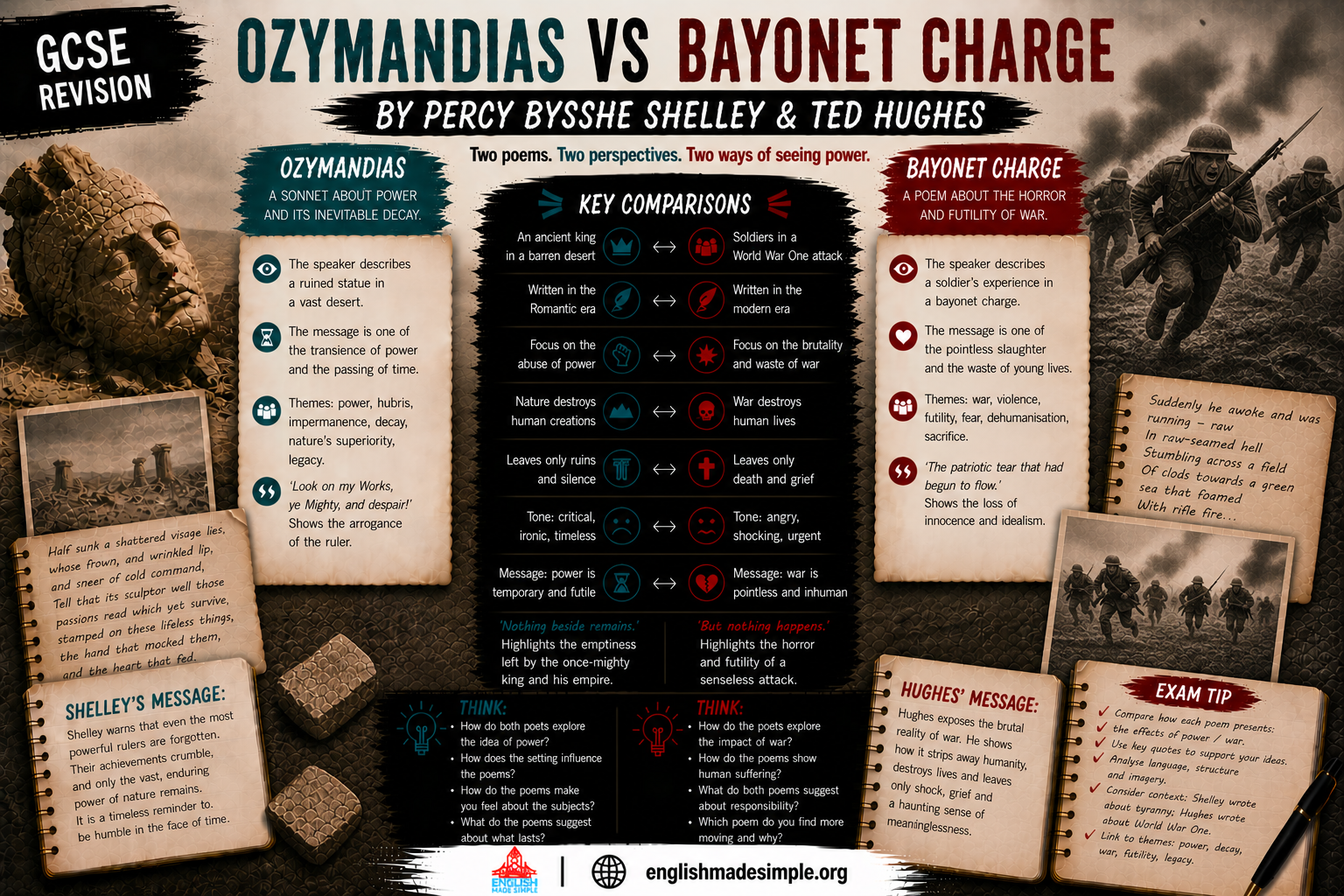
Ozymandias by Percy Bysshe Shelley and Bayonet Charge by Ted Hughes both explore power, conflict, and human vulnerability, but from very different perspectives. Shelley presents a ruler whose political power has collapsed over time, while Hughes shows a soldier experiencing the chaos and fear of battle in the present moment. Together, the poems suggest that power—whether political or military—is unstable and often exposes human weakness rather than strength.
Quick Comparison Summary
| Theme |
Ozymandias |
Bayonet Charge |
| Power |
Political authority |
Military force |
| Conflict |
Empire and conquest |
Battlefield experience |
| Identity |
Lost over time |
Destroyed in the moment |
| Time |
Erases legacy |
Slows and distorts experience |
| Tone |
Ironic, reflective |
Chaotic, intense |
Similarity 1: Both poems show the limits of power
In Ozymandias, the ruler’s command “Look on my Works” is undermined by “Nothing beside remains”.
In Bayonet Charge, the soldier’s sense of purpose collapses as he runs in confusion.
Grade 9 Comparison Point:
Both poets show that power is unreliable and often fails in reality.
Similarity 2: Both poems explore conflict
Shelley implies conflict through empire and dominance.
Hughes presents immediate conflict through the soldier’s experience of battle.
Grade 9 Comparison Point:
Both poems suggest conflict is chaotic and ultimately meaningless.
Similarity 3: Both poems explore identity
In Ozymandias, identity fades as power disappears.
In Bayonet Charge, identity breaks down under pressure.
Grade 9 Comparison Point:
Both poems show identity being shaped by conflict and power.
Difference 1: Type of power
Ozymandias
Political and long-term power.
Bayonet Charge
Immediate, physical military power.
Grade 9 Comparison Point:
Shelley critiques authority over time, while Hughes critiques power in the moment.
Difference 2: Perspective
Ozymandias
Distant narrative.
Bayonet Charge
Close third-person perspective.
Grade 9 Comparison Point:
Shelley reflects, Hughes immerses.
Difference 3: Structure
Ozymandias
Bayonet Charge
- Free verse
- Enjambment
- Fragmentation
Grade 9 Comparison Point:
Shelley contains power, Hughes disrupts it.
Key Quotes Comparison Table
| Ozymandias |
Bayonet Charge |
| “Look on my Works” |
“Suddenly he awoke and was running” |
| “sneer of cold command” |
“his terror’s touchy dynamite” |
| “Nothing beside remains” |
“King, honour, human dignity” |
| “lone and level sands” |
“cold clockwork of the stars” |
Context Comparison
Ozymandias
- Shelley criticised tyranny.
Bayonet Charge
- Hughes explores modern warfare and instinct.
Exam Question 1
Compare how poets present power in Ozymandias and Bayonet Charge.
Grade 9 Model Response
Both Shelley and Hughes present power as something that appears dominant but ultimately proves unstable and unreliable when confronted with reality. In Ozymandias, Shelley presents political power as something rooted in control, legacy, and authority. The imperative “Look on my Works, ye Mighty, and despair!” suggests that the ruler believes his power is permanent and overwhelming. The elevated language reinforces his sense of superiority, as he attempts to assert dominance not only over his subjects but over future generations. However, this confidence is immediately undermined by the stark statement “Nothing beside remains”, which reveals that time has erased all traces of his empire. Shelley therefore suggests that political power is ultimately fragile and cannot endure beyond the lifespan of the individual who holds it.
In contrast, Bayonet Charge presents power as immediate and physical, yet equally unstable. The soldier initially appears to possess power through his role in the military, but this quickly dissolves as he becomes overwhelmed by fear. The phrase “his terror’s touchy dynamite” suggests that his emotions are volatile and uncontrollable, highlighting the fragility of human power in moments of extreme stress. Additionally, the listing of abstract ideals such as “King, honour, human dignity” shows how these concepts lose meaning in the chaos of battle. Unlike Ozymandias, who clings to power through arrogance, the soldier begins to question its purpose entirely.
Structurally, Shelley uses the controlled form of a sonnet to present power as something contained and reflective, reinforcing its eventual collapse. Hughes, however, uses fragmented structure and enjambment to mirror the soldier’s disorientation, suggesting that power cannot be neatly controlled or understood in the moment.
Therefore, both poets present power as unstable. Shelley shows it collapsing over time, while Hughes shows it disintegrating instantly under pressure.
Exam Question 2
Compare how poets present conflict in Ozymandias and Bayonet Charge.
Grade 9 Model Response
Both Shelley and Hughes present conflict as something that ultimately exposes the weaknesses of human ambition and control, but they do so in very different ways. In Ozymandias, conflict is implied through the ruler’s achievements and dominance. The command “Look on my Works” suggests a history of conquest and power, indicating that Ozymandias has engaged in conflict to establish his empire. However, the ruined statue and the “lone and level sands” show that these conflicts have not resulted in any lasting success. Shelley therefore suggests that conflict driven by ambition and the desire for power is ultimately meaningless, as it does not endure over time.
In Bayonet Charge, Hughes presents conflict as immediate, chaotic, and deeply personal. The opening line “Suddenly he awoke and was running” throws the reader into the middle of the action, creating a sense of urgency and confusion. The use of enjambment and fragmented imagery reflects the soldier’s disorientation, emphasising that conflict is not orderly or heroic, but chaotic and terrifying. The metaphor “cold clockwork of the stars” suggests that the universe is indifferent to human conflict, reinforcing the idea that war is insignificant on a larger scale.
Structurally, Shelley condenses the consequences of conflict into a single image of decay, while Hughes expands the experience through a series of intense, fragmented moments. This highlights the difference between long-term insignificance and immediate experience.
Therefore, both poets present conflict as ultimately futile, but Shelley focuses on its long-term irrelevance, while Hughes emphasises its immediate chaos and emotional impact.
Exam Question 3
Compare how poets present the role of the individual in conflict.
Grade 9 Model Response
Both Shelley and Hughes explore the role of the individual within conflict, but they present contrasting perspectives on power, identity, and control. In Ozymandias, the individual is a ruler who seeks to dominate others and establish a lasting legacy. The “sneer of cold command” suggests arrogance and authority, indicating that he sees himself as central to his empire. However, as the statue lies broken in the desert, this individual is reduced to a symbol of failure. Shelley suggests that individuals who rely on power for identity are ultimately insignificant, as their influence fades over time.
In Bayonet Charge, the individual is a soldier who is caught in the chaos of war. Unlike Ozymandias, who attempts to assert control, the soldier is overwhelmed by events beyond his control. The close third-person perspective allows the reader to experience his fear and confusion, particularly through phrases such as “his terror’s touchy dynamite”. This highlights the psychological impact of conflict, showing that individuals are vulnerable rather than powerful in war.
Structurally, Shelley distances the reader from the individual through a framed narrative, while Hughes immerses the reader in the soldier’s experience through fragmented and continuous language. This contrast emphasises the difference between a distant historical figure and a present, vulnerable individual.
Therefore, both poets present individuals as limited within conflict. Shelley shows the eventual insignificance of those who seek power, while Hughes emphasises the immediate vulnerability of those who experience it.
Further Revision Links
You might also like…
Final Grade 9 Tip
When comparing these poems, remember: Shelley shows power fading over time, while Hughes shows it collapsing instantly under pressure.