Ozymandias vs Poppies: AQA Power and Conflict Poetry Comparison (Grade 9 Guide)
Introduction
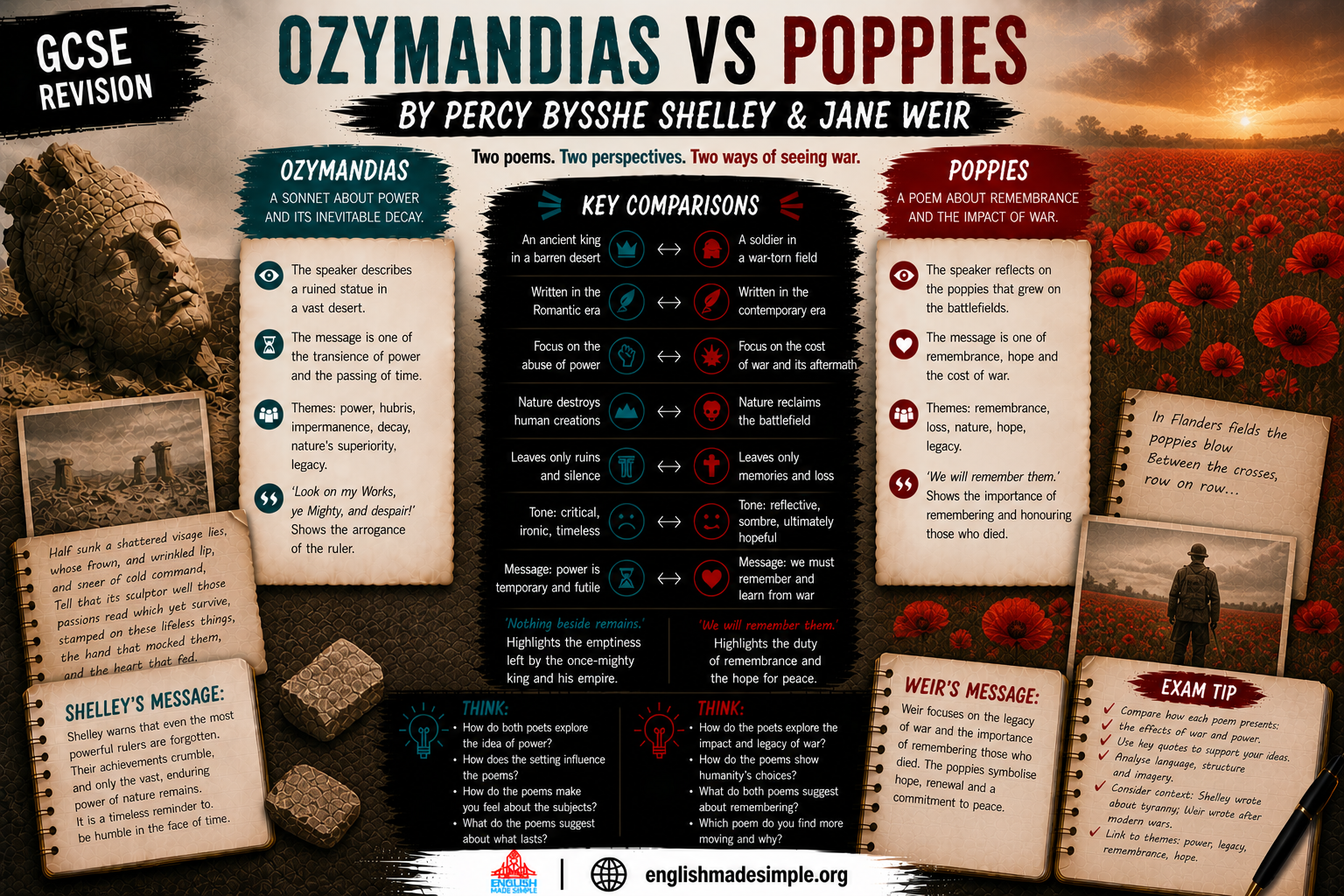
Ozymandias by Percy Bysshe Shelley and Poppies by Jane Weir both explore power, identity, and the consequences of conflict, but from very different perspectives. Shelley focuses on the collapse of political power over time, while Weir explores the emotional impact of war on those left behind. Together, the poems suggest that while power fades, emotional experiences and human relationships remain deeply significant.
Quick Comparison Summary
| Theme |
Ozymandias |
Poppies |
| Power |
Political authority |
Emotional / personal power |
| Conflict |
Empire and conquest |
Modern war and separation |
| Identity |
Lost over time |
Shaped by memory and relationships |
| Time |
Destroys legacy |
Deepens emotional impact |
| Tone |
Ironic, critical |
Reflective, sorrowful |
Similarity 1: Both poems explore the consequences of conflict
In Ozymandias, conflict is implied through the ruler’s dominance and empire, yet all that remains is a “colossal wreck”.
In Poppies, conflict is shown through its emotional aftermath, particularly the mother’s sense of loss.
Grade 9 Comparison Point:
Both poets suggest that conflict leads to lasting consequences, even if these differ in form.
Similarity 2: Both poems explore the effects of time
Shelley presents time as destructive: “Nothing beside remains”.
Weir presents time as emotionally impactful, as memories become more significant over time.
Grade 9 Comparison Point:
Both poets show that time changes how events are understood.
Similarity 3: Both poems explore identity
In Ozymandias, identity fades as power collapses.
In Poppies, identity is shaped through relationships and memory.
Grade 9 Comparison Point:
Both poems show identity as influenced by external forces.
Difference 1: Type of power
Ozymandias
Political and tyrannical power.
Poppies
Emotional and relational power.
Grade 9 Comparison Point:
Shelley critiques authority, while Weir explores personal emotional experience.
Difference 2: Perspective
Ozymandias
Distant narrative voice.
Poppies
Personal, first-person voice.
Grade 9 Comparison Point:
Shelley distances the reader, while Weir creates intimacy.
Difference 3: Structure
Ozymandias
- Sonnet form
- Framed narrative
Poppies
- Free verse
- Fragmented memory structure
Grade 9 Comparison Point:
Shelley compresses time, while Weir reflects emotional development.
Key Quotes Comparison Table
| Ozymandias |
Poppies |
| “Look on my Works” |
“one of your blazer buttons” |
| “sneer of cold command” |
“released a song bird from its cage” |
| “Nothing beside remains” |
“hoping to hear” |
| “lone and level sands” |
“the world overflowing like a treasure chest” |
Context Comparison
Ozymandias
- Shelley criticised political tyranny.
Poppies
- Inspired by modern war and its impact on families.
Grade 9 Comparison Point:
Both poems reflect different aspects of conflict in their contexts.
How to Write a Grade 9 Comparison Paragraph
Both Shelley and Weir explore the consequences of conflict and power. In Ozymandias, the ruler’s authority fades over time, while in Poppies, the emotional effects of conflict remain strong. However, Shelley focuses on political power, while Weir focuses on personal experience.
Exam Question 1
Compare how poets present power in Ozymandias and Poppies.
Grade 9 Model Response
Both Shelley and Weir present power as something that influences human experience, but they explore very different types of power and their effects. In Ozymandias, Shelley focuses on political power, presenting it as something rooted in control and dominance. The ruler’s command “Look on my Works, ye Mighty, and despair!” reflects a belief in the permanence and superiority of his authority. However, this confidence is completely undermined by the image “Nothing beside remains”, which shows that time has erased all evidence of his empire. Shelley therefore suggests that political power is temporary and ultimately meaningless.
In contrast, Poppies presents a more subtle and emotional form of power. The mother does not hold authority over others, but her emotional experience is powerful in shaping the reader’s understanding of conflict. Through personal details such as “one of your blazer buttons”, Weir emphasises the intimacy of the relationship and the depth of her loss. This suggests that emotional connections have a more lasting impact than political authority.
Structurally, Shelley uses a sonnet to contain the rise and fall of power within a fixed form, reinforcing its eventual limitation. Weir’s free verse, however, allows for a more fluid and personal exploration of emotion, reflecting the ongoing nature of grief.
Therefore, both poets present power as influential, but Shelley shows it as temporary and external, while Weir shows it as internal and enduring.
Exam Question 2
Compare how poets present the effects of conflict in Ozymandias and Poppies.
Grade 9 Model Response
Both poems explore the effects of conflict, but they focus on different aspects of its impact. In Ozymandias, Shelley presents the long-term consequences of conflict and conquest. The ruler’s achievements, suggested by “Look on my Works”, imply a history of dominance and control. However, the ruined statue and the surrounding “lone and level sands” highlight that these achievements have not lasted. Shelley suggests that conflict driven by ambition ultimately leads to no lasting success.
In Poppies, Weir focuses on the emotional effects of conflict on individuals. The mother’s experience reflects the personal cost of war, particularly through her sense of loss and separation. The metaphor “released a song bird from its cage” suggests both freedom and vulnerability, emphasising the emotional complexity of letting her son go. Unlike Shelley, who presents conflict as historically distant, Weir brings it into the present through personal experience.
Structurally, Shelley condenses the consequences of conflict into a single image of decay, while Weir develops them through a series of memories, creating a sense of emotional progression.
Therefore, both poets show that conflict has consequences, but Shelley emphasises long-term insignificance, while Weir highlights immediate emotional impact.
Exam Question 3
Compare how poets present the role of the individual in conflict.
Grade 9 Model Response
Both Shelley and Weir explore the role of the individual in relation to conflict, but they present contrasting perspectives. In Ozymandias, the individual is the ruler, whose identity is defined by power and control. The “sneer of cold command” suggests arrogance and authority, indicating that he sees himself as central to his empire. However, as the statue lies broken, this individual is reduced to a symbol of failure. Shelley therefore suggests that individuals who rely on power for identity are ultimately insignificant.
In Poppies, the individual is the mother, whose experience is defined by emotional connection rather than authority. Her identity is shaped by her relationship with her son, and the poem focuses on her internal thoughts and memories. The line “hoping to hear your playground voice catching on the wind” reflects her longing and inability to move on, suggesting that individuals are deeply affected by conflict even when they are not directly involved.
The difference in narrative perspective reinforces this contrast. Shelley uses a distant voice, which reduces the ruler to a historical figure, while Weir uses a personal voice to create emotional immediacy. This highlights the difference between public power and private experience.
Therefore, both poets present individuals as shaped by conflict, but Shelley shows their eventual insignificance, while Weir emphasises their emotional depth and lasting impact.
Further Revision Links
You might also like…
Final Grade 9 Tip
When comparing these poems, remember: Shelley shows the collapse of political power, while Weir shows the lasting emotional impact of conflict on individuals.