Ozymandias vs Kamikaze: AQA Power and Conflict Poetry Comparison (Grade 9 Guide)
Introduction
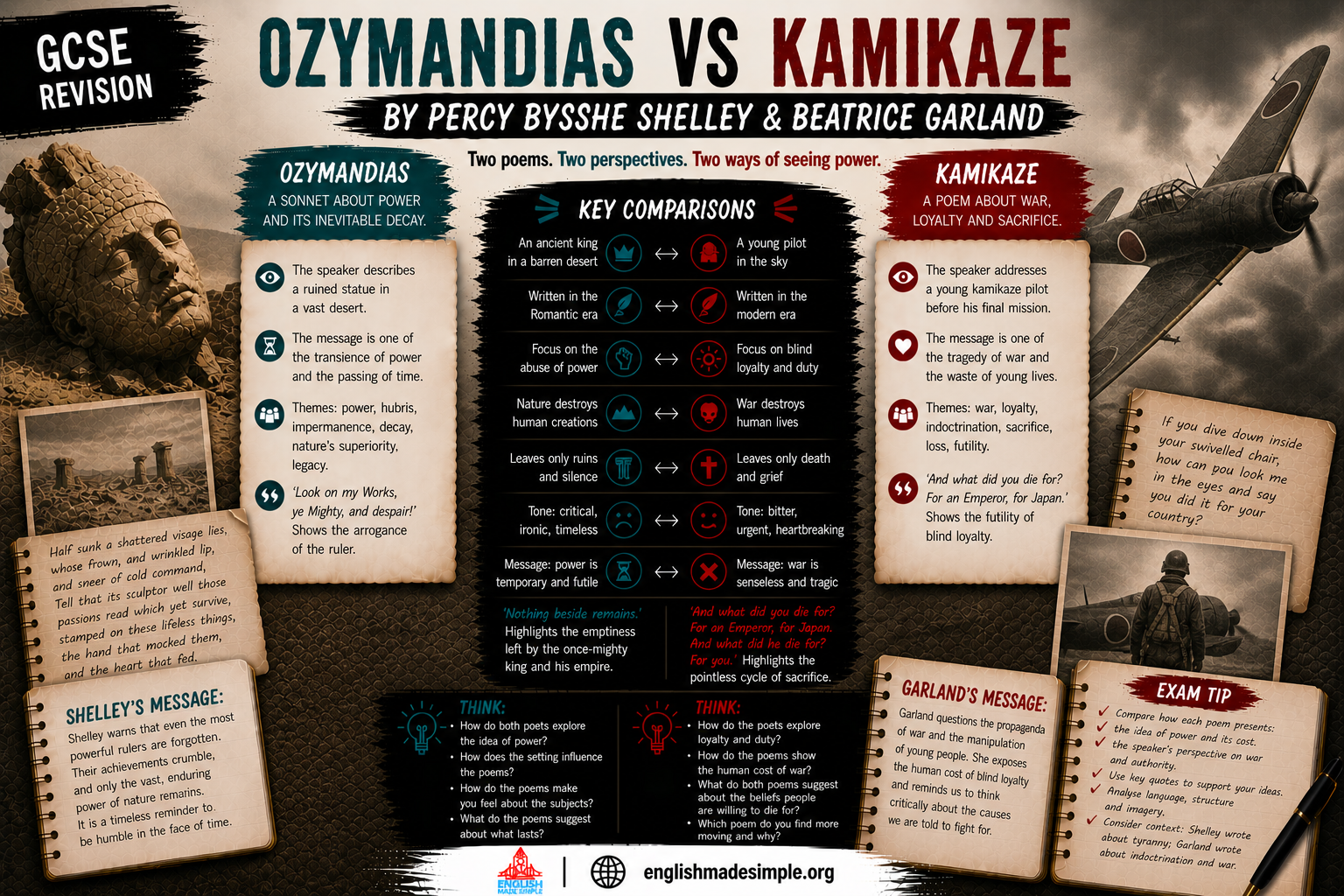
Ozymandias by Percy Bysshe Shelley and Kamikaze by Beatrice Garland both explore power, identity, and the consequences of human decisions, but from different perspectives. Shelley presents a ruler whose political power has collapsed over time, while Garland explores a pilot whose personal decision leads to lifelong social rejection. Together, the poems suggest that systems of power—whether political or cultural—can shape identity, but are ultimately fragile.
Quick Comparison Summary
| Theme |
Ozymandias |
Kamikaze |
| Power |
Political authority |
Cultural / social expectations |
| Identity |
Lost over time |
Destroyed by society |
| Control |
Ruler dominates others |
Society enforces honour |
| Time |
Erases legacy |
Extends consequences |
| Tone |
Ironic, critical |
Reflective, tragic |
Similarity 1: Both poems explore power and its consequences
In Ozymandias, the ruler attempts to assert dominance through “Look on my Works, ye Mighty, and despair!”.
In Kamikaze, power is shown through societal expectations of honour and duty.
Grade 9 Comparison Point:
Both poems show how systems of power influence individuals and shape outcomes.
Similarity 2: Both poems show the impact of time
Shelley shows power fading: “Nothing beside remains”.
Garland shows long-term consequences, as the pilot is treated as if he “no longer existed”.
Grade 9 Comparison Point:
Both poets show that time changes how power and decisions are remembered.
Similarity 3: Both poems explore identity
In Ozymandias, identity is reduced to a broken statue.
In Kamikaze, identity is erased socially through rejection.
Grade 9 Comparison Point:
Both poems show identity being shaped and damaged by external forces.
Difference 1: Type of power
Ozymandias
Political and tyrannical power.
Kamikaze
Cultural and societal power.
Grade 9 Comparison Point:
Shelley critiques rulers, while Garland critiques social expectations.
Difference 2: Outcome for the individual
Ozymandias
Power collapses and identity is forgotten.
Kamikaze
The individual survives but is rejected.
Grade 9 Comparison Point:
Shelley shows power disappearing, while Garland shows consequences continuing.
Difference 3: Structure
Ozymandias
- Sonnet form
- Framed narrative
Kamikaze
- Narrative structure
- Reflective ending
Grade 9 Comparison Point:
Shelley compresses time, while Garland shows a life-long narrative.
Key Quotes Comparison Table
| Ozymandias |
Kamikaze |
| “Look on my Works” |
“a one-way journey into history” |
| “sneer of cold command” |
“green-blue translucent sea” |
| “Nothing beside remains” |
“he no longer existed” |
| “lone and level sands” |
“which had been the better way to die” |
Context Comparison
Ozymandias
- Shelley criticised political tyranny.
Kamikaze
- Based on WWII Japanese pilots and honour culture.
Grade 9 Comparison Point:
Both poems reflect different forms of power shaping identity.
How to Write a Grade 9 Comparison Paragraph
Both Shelley and Garland explore how power shapes identity. In Ozymandias, the ruler’s authority is reduced to nothing over time, while in Kamikaze, societal expectations destroy the pilot’s identity. However, Shelley shows power fading, while Garland shows its lasting consequences.
Exam Question 1
Compare how poets present power in Ozymandias and Kamikaze.
Grade 9 Model Response
Both Shelley and Garland present power as a force that shapes human behaviour and identity, but they ultimately reveal its limitations. In Ozymandias, Shelley presents political power as something that appears absolute but is ultimately temporary. The imperative “Look on my Works, ye Mighty, and despair!” suggests that the ruler believes his authority is permanent and unquestionable. However, this confidence is undermined by the stark image “Nothing beside remains”, which shows that time has erased his empire. Shelley therefore suggests that political power is fragile and cannot endure beyond the lifespan of the individual who wields it.
In contrast, Kamikaze presents power as a social and cultural force. The expectations placed on the pilot reflect a system of honour that values sacrifice over individual choice. Unlike Ozymandias, the pilot does not attempt to dominate others, but is instead controlled by societal norms. The fact that he is treated as if he “no longer existed” shows how powerful these expectations are, as they effectively erase his identity without physically killing him.
Structurally, Shelley’s use of a sonnet reflects the containment of power within a fixed form, while Garland’s narrative structure shows the unfolding consequences of power over time. This highlights the difference between the immediate assertion of authority and the long-term impact of social control.
Therefore, both poets present power as influential but ultimately limited. Shelley shows it collapsing over time, while Garland shows it continuing to affect individuals through societal pressure.
Exam Question 2
Compare how poets present identity in Ozymandias and Kamikaze.
Grade 9 Model Response
Both poems explore identity as something shaped by external forces, but they present its fate differently. In Ozymandias, identity is closely linked to power and legacy. The ruler’s identity is preserved only through the statue, which captures his “sneer of cold command”. However, as the statue is broken and surrounded by empty desert, this identity becomes meaningless. Shelley suggests that identity built on power is unstable and easily lost once that power disappears.
In Kamikaze, identity is also shaped by external expectations, but in a more personal and emotional way. The pilot’s identity is defined by his role within society and the expectations placed upon him. When he chooses to return home, he rejects these expectations, but is then punished through social rejection. The phrase “he no longer existed” suggests that identity can be erased not only through time, but through the judgement of others. Unlike in Ozymandias, the individual is still alive, which makes the loss of identity more tragic.
The difference in narrative perspective reinforces this contrast. Shelley uses a distant voice to present the ruler as a figure of the past, while Garland uses a personal narrative to show the emotional consequences of identity loss. This creates a stronger sense of empathy for the pilot, compared to the detached portrayal of Ozymandias.
Therefore, Shelley presents identity as something that fades with power, while Garland presents it as something that can be destroyed by society even in the present. Both poets suggest that identity is vulnerable, but for different reasons.
Exam Question 3
Compare how poets present the consequences of human actions.
Grade 9 Model Response
Both Shelley and Garland explore the consequences of human actions, but they present them in contrasting ways. In Ozymandias, the consequences of the ruler’s actions are seen over a long period of time. His attempts to assert dominance and create a lasting legacy ultimately fail, as shown by the ruined statue. The vast desert setting emphasises that his achievements have been completely erased, suggesting that human ambition is insignificant in the face of time.
In Kamikaze, the consequences of the pilot’s decision are immediate and long-lasting. His choice to turn back from the mission saves his life, but results in social rejection. The idea that he is treated as if he “no longer existed” shows that the consequences of his actions affect every aspect of his life. Unlike in Ozymandias, where the consequences are impersonal and historical, Garland presents them as deeply personal and ongoing.
Structurally, Shelley condenses the consequences into a single image, while Garland develops them over the course of a narrative. This highlights the difference between abstract and personal consequences.
Therefore, both poets show that human actions have consequences, but Shelley focuses on long-term insignificance, while Garland emphasises immediate and lasting personal impact.
Further Revision Links
You might also like…
Final Grade 9 Tip
When comparing these poems, remember: Shelley shows power fading into insignificance, while Garland shows society’s power continuing to shape identity.