
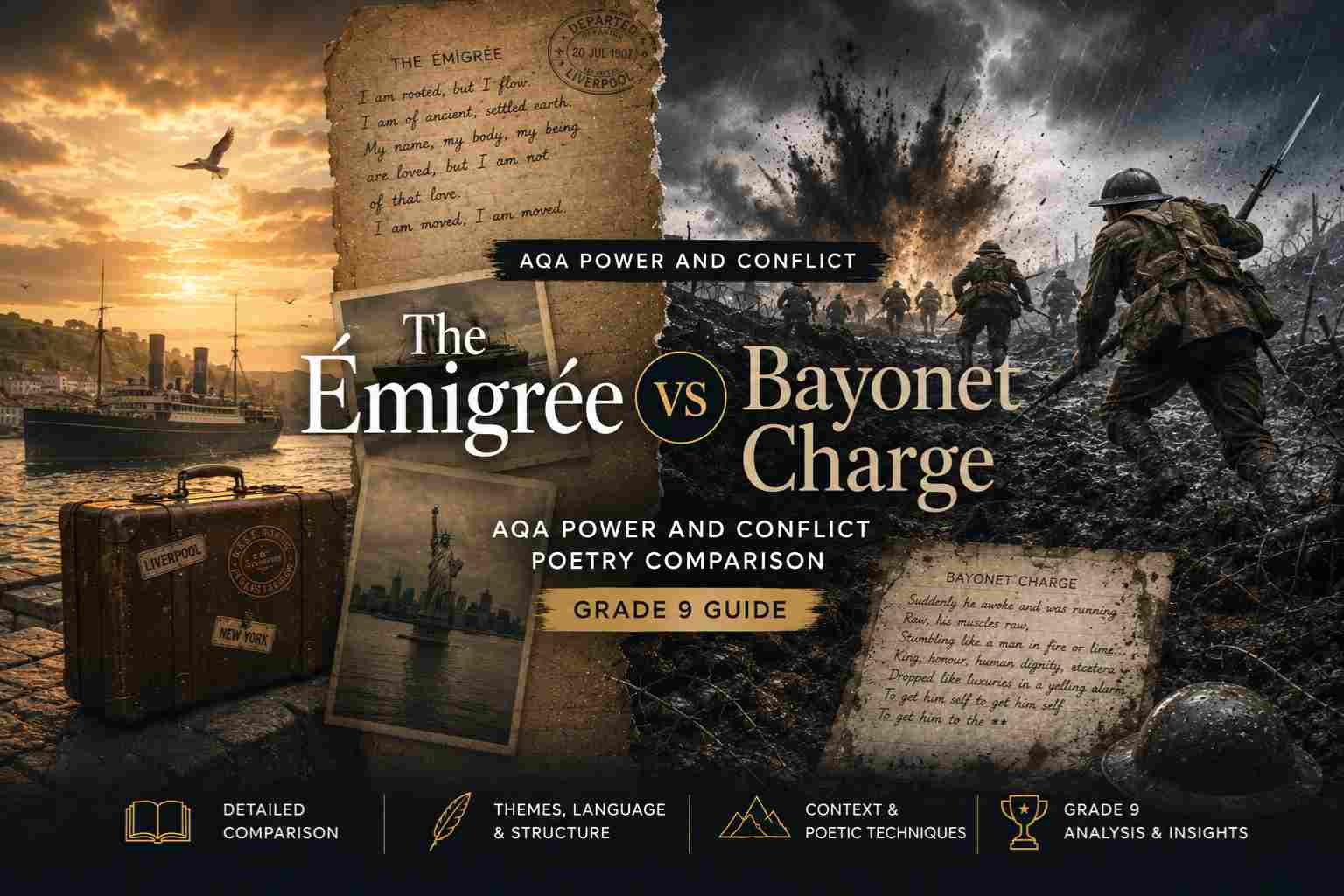
The Émigrée vs Bayonet Charge: AQA Power and Conflict Poetry Comparison (Grade 9 Guide)
Introduction
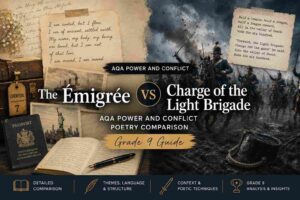
The Émigrée by Carol Rumens and Bayonet Charge by Ted Hughes both explore conflict, power, and human vulnerability, but from very different perspectives. Rumens focuses on the emotional effects of political conflict and exile, while Hughes presents the immediate chaos and fear experienced by a soldier in battle. Together, the poems suggest that conflict can affect both identity and survival, leaving lasting emotional and psychological consequences.
Quick Comparison Summary
| Theme | The Émigrée | Bayonet Charge |
|---|---|---|
| Conflict | Political conflict / exile | Physical warfare |
| Power | Memory resists oppression | War overwhelms individuals |
| Perspective | Reflective exile | Immediate soldier experience |
| Tone | Nostalgic, defiant | Chaotic, panicked |
| Structure | Controlled, consistent | Fragmented and fast-paced |

Order Book Now
Key similarities: a Grade 9 comparison
Similarity 1: Both poems explore the effects of conflict
In The Émigrée, conflict forces the speaker to leave her homeland.
In Bayonet Charge, conflict places the soldier in immediate danger.
Grade 9 Comparison Point:
Both poets show that conflict profoundly affects individuals.
Similarity 2: Both poems explore human vulnerability
The speaker in The Émigrée is emotionally vulnerable because of displacement.
The soldier in Bayonet Charge is physically and psychologically vulnerable.
Grade 9 Comparison Point:
Both poems show how conflict removes stability and security.
Similarity 3: Both poems explore power
Rumens presents political power causing exile.
Hughes presents war as a force that overwhelms human control.
Grade 9 Comparison Point:
Both poets show individuals struggling against larger forces.
The Émigrée and Bayonet Charge: key differences
Difference 1: Presentation of conflict
The Émigrée
Conflict is remembered and reflective.
Bayonet Charge
Conflict is immediate and violent.
Grade 9 Comparison Point:
Rumens focuses on emotional aftermath, Hughes focuses on direct experience.
Difference 2: Tone
The Émigrée
Hopeful and nostalgic.
Bayonet Charge
Panicked and disturbing.
Grade 9 Comparison Point:
Rumens preserves positivity, Hughes emphasises fear.
Difference 3: Structure
The Émigrée
- Three controlled stanzas
- Stable form
Bayonet Charge
- Enjambment
- Fragmented movement
Grade 9 Comparison Point:
Rumens reflects emotional control, Hughes reflects chaos.

Buy T-Shirt Now
Key Quotes Comparison Table
| The Émigrée | Bayonet Charge |
|---|---|
| “sunlight-clear” | “Suddenly he awoke and was running” |
| “There once was a country” | “his terror’s touchy dynamite” |
| “they accuse me” | “bullets smacking the belly out of the air” |
| “my memory of it is sunlight-clear” | “cold clockwork of the stars” |
Context Comparison
The Émigrée
- Political exile and displacement
- Identity shaped by memory
Bayonet Charge
- Modern warfare
- Focus on instinct, fear, and survival
How to answer a comparison question on The Émigrée and Bayonet Charge
Exam Question 1
Compare how poets present the effects of conflict in The Émigrée and Bayonet Charge.
Grade 9 Model Response
Both Rumens and Hughes present conflict as something that has a powerful impact on individuals, but they explore these effects in different ways. In The Émigrée, conflict causes displacement and separation from the speaker’s homeland. The phrase “There once was a country” creates a sense of loss and nostalgia, suggesting that the speaker’s connection to her country now exists mainly through memory. However, the repeated description of the country as “sunlight-clear” suggests that memory helps preserve her identity despite political conflict.
In contrast, Bayonet Charge presents conflict as immediate and physically overwhelming. The opening line “Suddenly he awoke and was running” immediately places the reader into the chaos of battle. Hughes uses violent imagery such as “bullets smacking the belly out of the air” to show the brutality of war. Unlike the speaker in The Émigrée, who reflects calmly on the past, the soldier experiences conflict in the moment, driven by fear and survival instinct.
Structurally, Rumens uses a controlled and consistent form to reflect emotional resilience, while Hughes uses enjambment and fragmented movement to mirror the confusion and panic of battle.
Therefore, both poets present conflict as deeply impactful, but Rumens focuses on emotional displacement, while Hughes emphasises immediate physical danger and fear.
Exam Question 2
Compare how poets present human vulnerability in The Émigrée and Bayonet Charge.
Grade 9 Model Response
Both poems explore human vulnerability, but they focus on different forms of it. In The Émigrée, vulnerability is emotional and linked to identity. The speaker has been separated from her homeland and faces judgement from others, as suggested by “they accuse me”. Despite this, her memories remain positive and stable, suggesting resilience.
In Bayonet Charge, vulnerability is physical and psychological. The soldier is overwhelmed by fear, shown in the phrase “his terror’s touchy dynamite”. This metaphor suggests that fear is explosive and uncontrollable. The questioning of “King, honour, human dignity” also suggests that war destroys the ideals that once motivated the soldier.
Structurally, Rumens’ controlled structure reflects emotional stability, while Hughes’ fragmented form reflects panic and instability.
Therefore, both poets show that conflict makes people vulnerable, but Rumens presents resilience through memory, while Hughes highlights fear and chaos.
Exam Question 3
Compare how poets present power in The Émigrée and Bayonet Charge.
Grade 9 Model Response
Both Rumens and Hughes explore power and its effects, but they present it differently. In The Émigrée, power is political and linked to exile. The phrase “they accuse me” suggests that authority figures attempt to control or silence the speaker. However, the speaker resists this power through memory, preserving a positive image of her homeland.
In Bayonet Charge, power is associated with war itself. The soldier appears powerless against the violence surrounding him. The imagery of “cold clockwork of the stars and nations” suggests that larger political forces operate mechanically and without concern for individuals.
Structurally, Rumens’ stable form reflects controlled resistance, while Hughes’ chaotic structure reflects the overwhelming power of war.
Therefore, both poets present individuals struggling against larger forces, but Rumens focuses on resistance through memory, while Hughes highlights the destructive power of warfare.
Further Revision Links
- AQA Power and Conflict Poetry Anthology (All 15 Poems): https://englishmadesimple.org/aqa-power-and-conflict-poetry-anthology-complete-gcse-revision-guide-all-15-poems/
- The Émigrée – GCSE Poetry Guide: https://englishmadesimple.org/the-emigree-by-carol-rumens-gcse-poetry/
- Bayonet Charge – GCSE Poetry Guide: https://englishmadesimple.org/bayonet-charge-by-ted-hughes-gcse-poetry/
You might also like…
- The Émigrée vs Exposure: https://englishmadesimple.org/the-emigree-vs-exposure-aqa-power-and-conflict-poetry-comparison-grade-9-guide/
- The Émigrée vs Remains: https://englishmadesimple.org/the-emigree-vs-remains-aqa-power-and-conflict-poetry-comparison-grade-9-guide/
- Storm on the Island vs Bayonet Charge: https://englishmadesimple.org/storm-on-the-island-vs-bayonet-charge-aqa-power-and-conflict-poetry-comparison-grade-9-guide/
Final Grade 9 Tip
When comparing these poems, remember: Rumens presents conflict as something that shapes identity through memory and exile, while Hughes shows conflict as immediate, violent, and psychologically overwhelming.