Bayonet Charge vs Poppies: AQA Power and Conflict Poetry Comparison (Grade 9 Guide)
Introduction
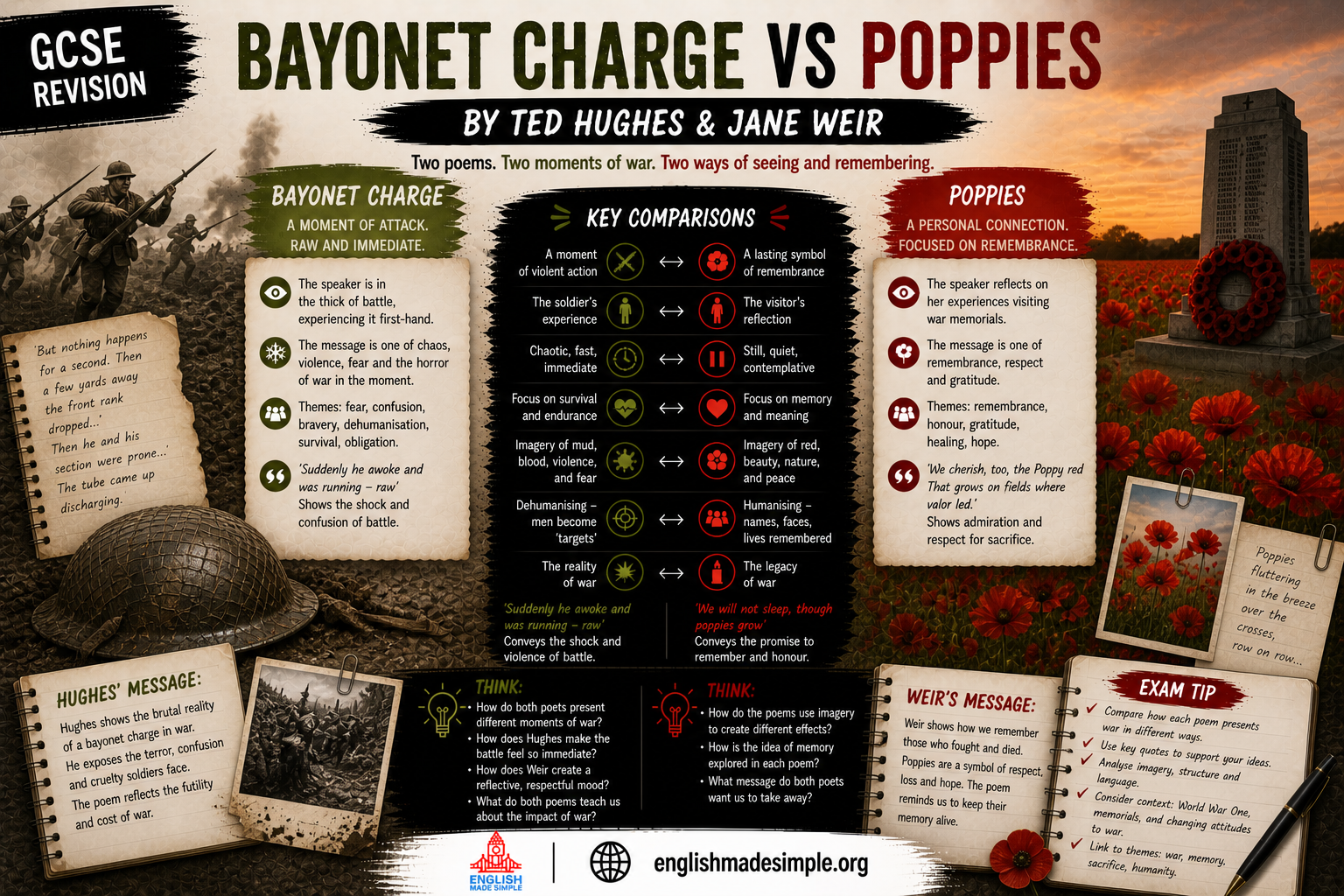
Bayonet Charge by Ted Hughes and Poppies by Jane Weir both explore the impact of war, but from very different perspectives. Hughes presents the immediate, chaotic experience of a soldier in battle, while Weir focuses on the emotional consequences for a mother whose son goes to war. Together, they reveal how conflict affects both those who fight and those left behind.
This Grade 9 comparison guide will help you compare both poems confidently in exams.
Quick Comparison Summary
| Theme | Bayonet Charge | Poppies |
|---|---|---|
| Perspective | Soldier in battle | Mother at home |
| Conflict | Immediate and physical | Emotional and psychological |
| Fear | Sudden panic | Ongoing anxiety |
| Memory | Minimal, present-focused | Central and reflective |
| Tone | Chaotic, intense | Tender, sorrowful |
Similarity 1: Both poems show the impact of war on individuals
In Bayonet Charge, the soldier is overwhelmed by fear: “his terror’s touchy dynamite” suggests explosive panic.
In Poppies, the mother experiences emotional distress, shown through small details like “one of your blazer buttons”.
Grade 9 Comparison Point:
Both poets show that war deeply affects individuals, even if they experience it differently.
Similarity 2: Both poems present fear
In Bayonet Charge, fear is immediate: “Suddenly he awoke and was running” throws the reader into panic.
In Poppies, fear is quieter but persistent, shown through the mother’s longing and uncertainty.
Grade 9 Comparison Point:
Both poems explore fear, but Hughes presents sudden terror while Weir presents ongoing emotional anxiety.
Similarity 3: Both poems challenge heroic ideas of war
Hughes questions patriotism through “King, honour, human dignity”.
Weir avoids glorifying war entirely, focusing on emotional loss instead.
Grade 9 Comparison Point:
Both poets reject traditional ideas of war as noble or heroic.
Difference 1: Experience of conflict
Bayonet Charge
Direct experience of battle and survival.
Poppies
Indirect experience through emotional impact.
Grade 9 Comparison Point:
Hughes presents physical danger, while Weir presents emotional consequences.
Difference 2: Structure
Bayonet Charge
- Free verse
- Enjambment
- Rapid movement
Poppies
- Free verse
- Fragmented memories
- Reflective pacing
Grade 9 Comparison Point:
Hughes creates chaos, while Weir creates emotional reflection.
Difference 3: Tone
Bayonet Charge
Panicked and intense.
Poppies
Calm but deeply emotional.
Key Quotes Comparison Table
| Bayonet Charge | Poppies |
| “Suddenly he awoke” | “one of your blazer buttons” |
| “his terror’s touchy dynamite” | “released a song bird from its cage” |
| “King, honour, human dignity” | “hoping to hear” |
| “cold clockwork” | “the world overflowing like a treasure chest” |
Context Comparison
Bayonet Charge
- Modern poem exploring universal soldier experience.
- Focus on instinct and fear.
Poppies
- Inspired by modern wars.
- Focus on families affected by conflict.
Grade 9 Comparison Point:
Both poems reflect modern understanding of war’s emotional impact.
How to Write a Grade 9 Comparison Paragraph
Both Hughes and Weir present the impact of war on individuals. In Bayonet Charge, the soldier is overwhelmed by fear, shown in “his terror’s touchy dynamite”. Similarly, in Poppies, the mother experiences emotional anxiety and loss. However, Hughes focuses on immediate physical danger, while Weir focuses on long-term emotional consequences.
Exam Question 1
Compare how poets present the effects of conflict on individuals in Bayonet Charge and Poppies.
Grade 9 Model Response
Both poets present conflict as deeply affecting individuals. In Bayonet Charge, the soldier experiences immediate fear and confusion in battle. In Poppies, the mother experiences emotional pain and anxiety.
However, Hughes focuses on physical experience, while Weir focuses on emotional impact. Therefore, both poems show conflict affecting individuals, but in different ways.
Exam Question 2
Compare how poets present fear in Bayonet Charge and Poppies.
Grade 9 Model Response
Fear is central to both poems. In Bayonet Charge, fear is sudden and overwhelming. In Poppies, fear is quieter but persistent.
Both poets show fear influencing behaviour. However, Hughes presents panic, while Weir presents anxiety.
Exam Question 3
Compare how poets present conflict from different perspectives.
Grade 9 Model Response
Hughes presents conflict from the perspective of a soldier in battle, focusing on physical danger. Weir presents conflict from a mother’s perspective, focusing on emotional impact.
Therefore, both poems show different sides of war, highlighting its wide-reaching effects.
Further Revision Links
To strengthen your comparison skills, read the full anthology hub and detailed poem guides:
- AQA Power and Conflict Poetry Anthology (All 15 Poems): https://englishmadesimple.org/aqa-power-and-conflict-poetry-anthology-revision-guide/
- Bayonet Charge by Ted Hughes – GCSE Poetry Guide: https://englishmadesimple.org/bayonet-charge-by-ted-hughes-gcse-poetry/
- Poppies by Jane Weir – GCSE Poetry Guide: https://englishmadesimple.org/poppies-by-jane-weir-gcse-poetry/
You might also like…
- Exposure vs Bayonet Charge: https://englishmadesimple.org/exposure-vs-bayonet-charge/
- War Photographer vs Poppies: https://englishmadesimple.org/war-photographer-vs-poppies/
- Remains vs Poppies: https://englishmadesimple.org/remains-vs-poppies/
Explore these comparisons to deepen your understanding of conflict and its emotional impact.
Final Grade 9 Tip
When comparing these poems, remember: Hughes shows the chaos of battle, while Weir shows the emotional impact of war at home.