
GCSE MATHS • HIGHER TIER
Basic Probability Made Simple
Understand chance, identify outcomes and calculate probabilities confidently.
Clear method
Exam practice
Worked proofs
Basic Probability in Four Moves
1
Identify
Identify the event and the possible outcomes.
2
Count
Count the favourable outcomes and the total possible outcomes.
3
Calculate
Use the probability formula and simplify when needed.
4
Interpret
Check that the probability lies between 0 and 1 and makes sense.
What You’ll Learn
Understand what probability measures.
Use the probability scale from 0 to 1.
Apply the basic probability formula.
Calculate probabilities from dice, coins, bags, spinners and cards.
Write probabilities as fractions, decimals and percentages.
Interpret probability in real-life situations.
Key Rules
Probability measures how likely an event is to happen.
Use the formula :
Probability = Favourable outcomes ÷ Total possible outcomes.
Probabilities must be between 0 and 1.
A probability of 0 means impossible.
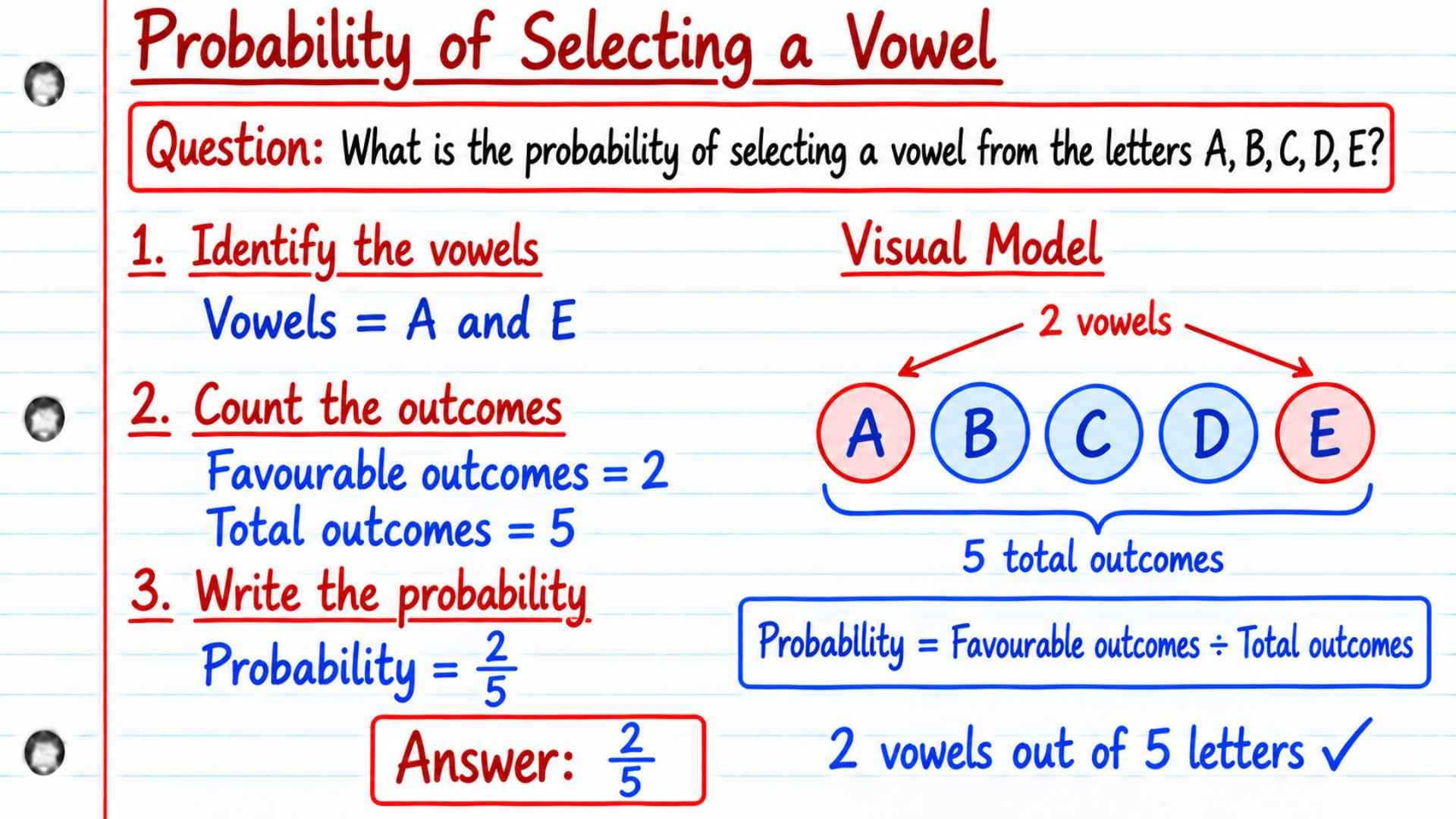
Worked Proof: Basic Probability
Step-by-Step Method
- 1. Identify the event you are finding the probability of.
- 2. Count the number of favourable outcomes.
- 3. Count the total number of possible outcomes.
- 4. Divide the favourable outcomes by the total outcomes.
- 5. Simplify the fraction if possible.
More Worked Examples
1
Question: What is the probability of rolling a 3 on a fair six-sided dice?
Step 1: Count favourable outcomes .
Only one outcome gives a 3 .
Step 2: Count total outcomes.
There are 6 possible outcomes.
Probability = 1/6
Step 2: Count total outcomes.
There are 6 possible outcomes.
Probability = 1/6
2
Question: What is the probability of tossing a fair coin and getting heads?
Favourable outcomes = 1
Total outcomes = 2
Probability = 1/2
Probability = 1/2
3
Question: A bag contains 5 red balls and 3 blue balls. What is the probability of selecting a red ball?
Total balls = 8
Red balls = 5
Probability = 5/8
Probability = 5/8
4
Question: A spinner has 8 equal sections. Three are green. Find the probability of landing on green.
Probability = 3/8
- Common GCSE Mistakes
- Not counting all possible outcomes.
- Using the wrong number of favourable outcomes.
- Failing to simplify probability fractions.
- Confusing probability with possibility.
- Exam Tips
- Write down the favourable outcomes before calculating.
- Count the total number of possible outcomes carefully.
- Use the probability formula when outcomes are equally likely.
- Simplify fraction answers where possible.
- Remember that every probability must be between 0 and 1.
- Convert between fractions, decimals and percentages when the question requires it.
Skills Used in Basic Probability
Ready to Practise?
Watch the Basic Probability Tutorial
Step-by-step walkthroughs of Basic Probability with clear methods and exam tips.
Frequently Asked Questions
Probability measures how likely an event is to occur.
Probabilities range from 0 to 1, where 0 is impossible and 1 is certain.
Probability = Number of favourable outcomes ÷ Total number of possible outcomes.
Yes. Probabilities can be written as fractions, decimals or percentages.
The probability is 1/2, which is 0.5 or 50%.
The source identifies failure to simplify fractions as a common GCSE mistake.
