
GCSE MATHS • HIGHER TIER
Volume of Prisms Made Simple
Learn how to identify a prism, find its cross-sectional area, calculate volume, and rearrange the prism formula to find missing measurements.
Clear method
Exam practice
Worked proofs
Three-Figure Bearings in Four Moves
1
Identify
Identify the constant cross-section of the prism.
2
Area
Calculate the area of the cross-section.
3
Multiply
Multiply the cross-sectional area by the prism length.
4
Units
Give the final volume in cubic units such as cm³, m³ or mm³.
What You’ll Learn
Understand volume
Understand that volume measures the amount of space inside a three-dimensional object and is measured in cubic units.
Recognise a prism
Identify a prism as a three-dimensional shape with a constant cross-section throughout its length.
Find the cross-sectional area
Calculate the area of the shape at the end of the prism before finding its volume.
Calculate volume
Use Volume = Cross-sectional Area × Length to calculate the volume of a prism.
Find missing measurements
Rearrange the prism formula to find a missing cross-sectional area or length.
Key Rules
Use the prism formula
Volume = Cross-sectional Area × Length
Find the cross-section first
Calculate the area of the constant end shape before multiplying by the length.
Use the correct area formula
The cross-section may be a rectangle, triangle, trapezium or another shape, so use the appropriate area formula.
Use cubic units
Volume must be written in cubic units such as cm³, m³ or mm³.
Worked Proof: Volume of lPrism
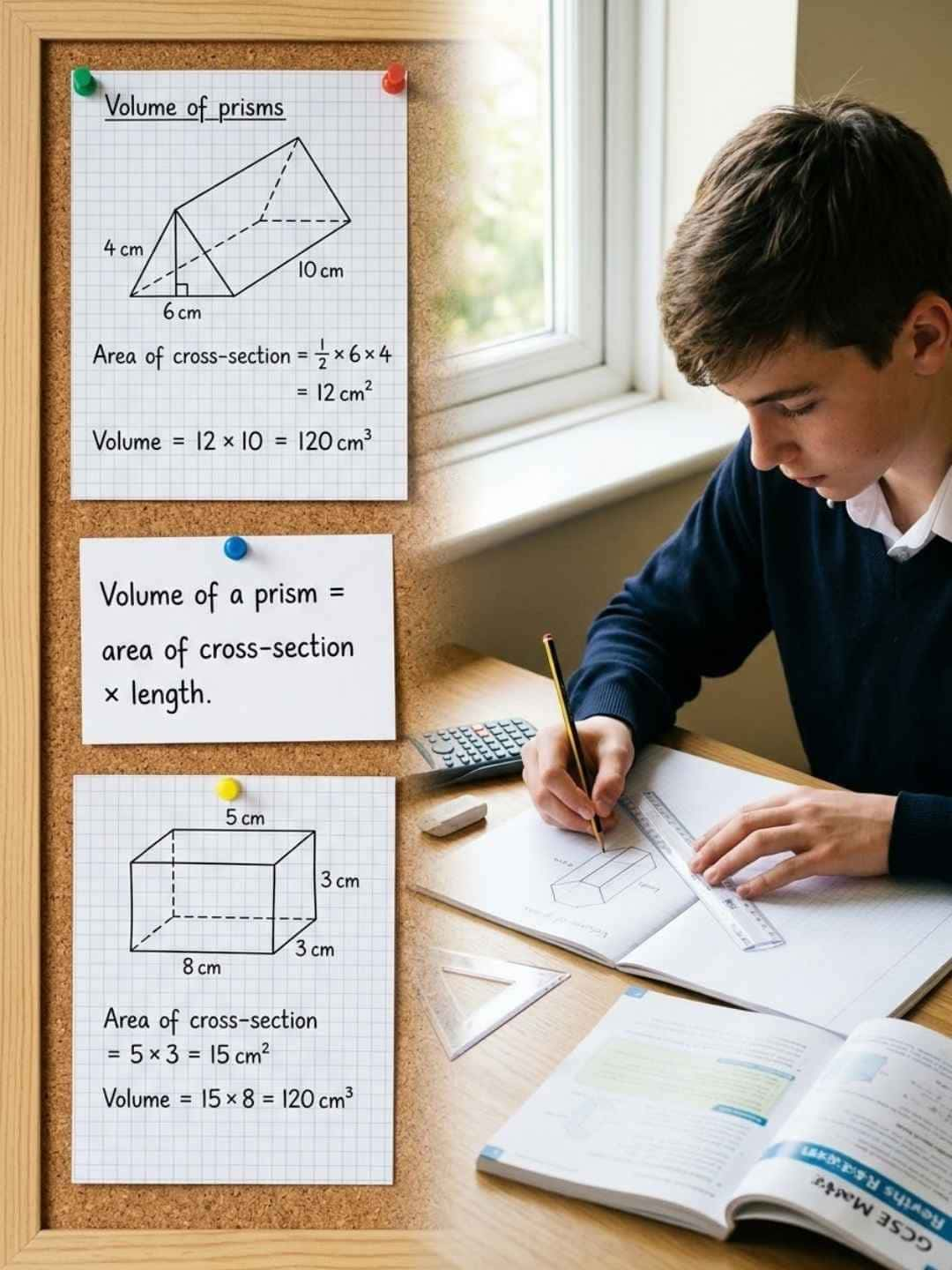
Question: A triangular prism has a triangular cross-section with base 6 cm and height 4 cm. The prism length is 10 cm.
1. Identify
The cross-section is a triangle.
2. Find the cross-sectional area
Area = ½ × 6 × 4 = 12 cm²
3. Identify the length
Length = 10 cm
4.Calculate the volume
Volume = 12 × 10 = 120 cm³
5. Answer
Volume = 120 cm³
More Worked Examples
1
Rectangular Prism
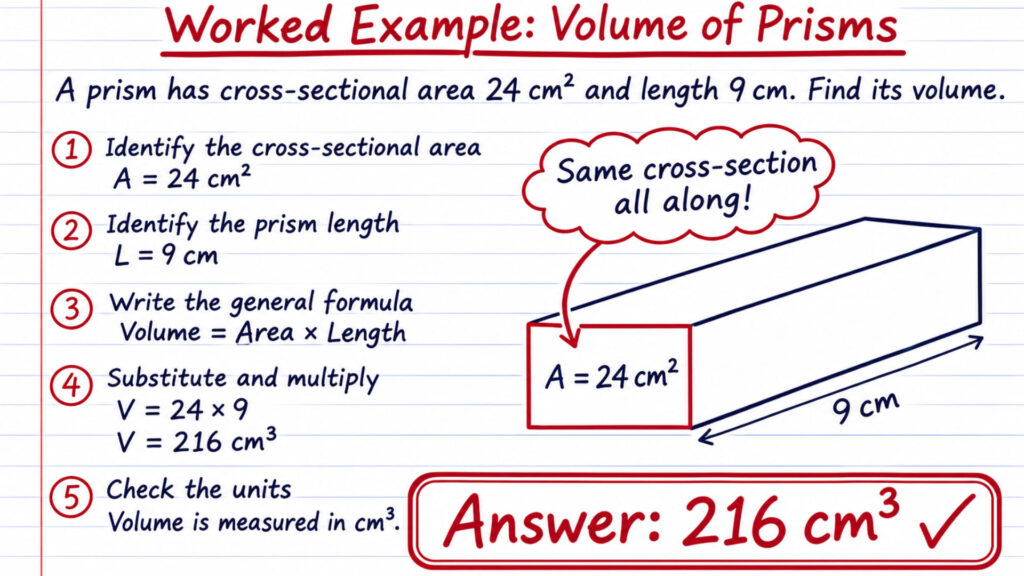
Question: A rectangular prism has a cross-sectional area of 12 cm² and a length of 8 cm.
Volume = Area × Length
= 12 × 8
= 96 cm³
2
Trapezium Cross-Section
Question: A prism has a trapezium cross-section with area 15 cm² and length 9 cm.
Volume = 15 × 9
= 135 cm³
3
Finding the Cross-Sectional Area
Question: A prism has volume 200 cm³ and length 10 cm. Find the cross-sectional area.
Area = Volume ÷ Length
= 200 ÷ 10
= 20 cm²
4
Finding the Length
Question: A prism has volume 360 cm³ and cross-sectional area 30 cm². Find the length.
Length = Volume ÷ Area
= 360 ÷ 30
= 12 cm
- Common GCSE Mistakes
- Cross-section first: Calculate its area before finding volume.
- Area, not perimeter: Use the cross-sectional area.
- Keep units consistent: Do not mix measurement units.
- Cubic units: Write volume in cm³, m³ or mm³.
- Check arithmetic: Recheck multiplication and division.
- Exam Tips
- Identify the cross-section before calculating.
- Write V = A × L before substituting.
- Show the cross-sectional area separately.
- Rearrange carefully for missing values.
- Check that volume answers use cubic units.
Skills Used in Volume of Prisms
Ready to Practise?
Watch the Volume of Prisms Tutorial
Step-by-step walkthroughs of Volume of Prisms with clear methods and exam tips.
Frequently Asked Questions
Volume = Cross-sectional Area × Length.
The cross-section is the constant shape at the end of the prism and remains the same throughout its length.
Find the area of the triangular cross-section first, then multiply that area by the length of the prism.
Divide the volume by the prism length.
