
How to Avoid Sign Errors in Algebra: A GCSE Student Guide
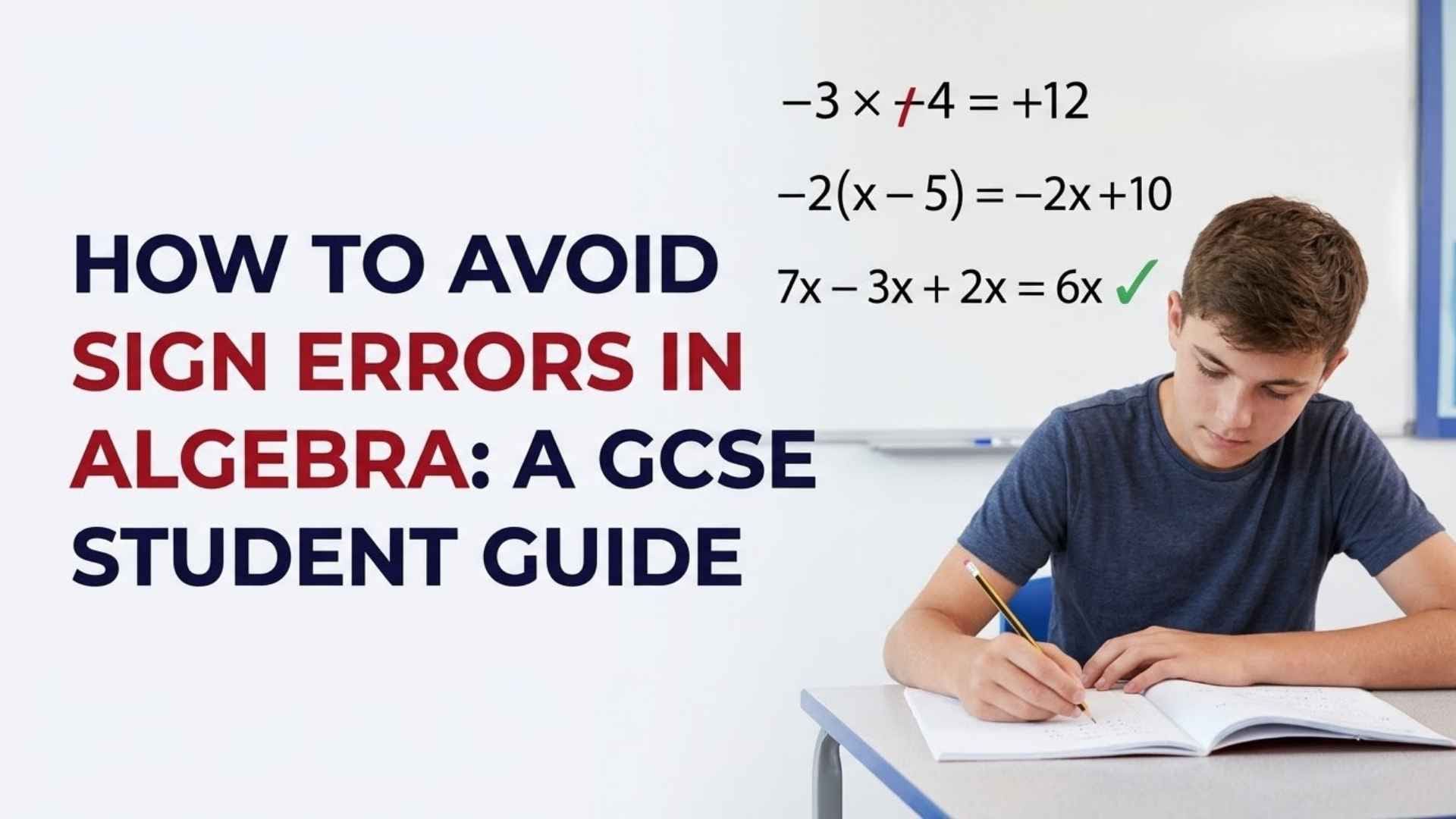
Learning how to avoid sign errors in algebra can stop correct methods from turning into wrong final answers. Minus signs cause problems in substitution, brackets, equations, collecting terms, quadratics and fractions. This guide shows where sign mistakes happen, how to prevent them and how to check your working before you move on. During GCSE maths revision, pay attention to the first line where an answer becomes wrong, not only the final line. If the method is correct but a sign changes incorrectly, you have found a specific habit to fix rather than an entire topic you need to relearn.
Table of Contents
What Is a Sign Error in Algebra?
A sign error happens when a positive or negative sign is copied, changed or calculated incorrectly. To avoid sign errors in algebra, treat the sign as part of the term. Read (-5x) as “negative five x”, not as a five and a separate minus symbol that can be forgotten. For GCSE algebra revision, circle or underline the first incorrect sign when you mark a question. Then write the correct step beside it. This helps you distinguish a sign problem from a problem with the whole algebra method.
How to Avoid Sign Errors in Algebra with Negative Numbers
One of the easiest ways to avoid sign errors in algebra is to decide the sign before calculating the number. For multiplication and division, two signs that are the same give a positive result, while different signs give a negative result.
For example, (-6\times-3=18). Decide “negative times negative is positive” first, then calculate (6\times3). Separating the sign decision from the arithmetic reduces the chance of writing (-18) automatically. GCSE maths practice should include short negative-number questions if these rules are not secure. You do not need to spend a whole session on them. A few calculations at the start of algebra practice can strengthen the number skill that later appears inside expansion, substitution and equations.
Put Brackets Around Negative Values When Substituting
To avoid sign errors in algebra during substitution, replace a negative value using brackets. If (x=-4) and the expression is (3x+2), write (3(-4)+2). The brackets make it clear that the value being substituted is negative. During GCSE maths revision, be especially careful when powers are involved. If (x=-3), then (x^2) becomes ((-3)^2=9). Writing the substitution clearly helps you see what is being squared and prevents the minus sign from becoming ambiguous.
For GCSE algebra revision, practise substitution with both positive and negative values. Mark the line where you replace the letter before checking the arithmetic. If the substitution line is wrong, every calculation after it may also be wrong even if you follow the later steps correctly.
Watch the Sign Outside a Bracket
A reliable way to avoid sign errors in algebra is to multiply the term outside the bracket by every term inside it. With (-2(x-5)), calculate (-2\times x=-2x) and (-2\times-5=+10), giving (-2x+10). GCSE maths practice can also include a quick expansion check. After expanding, choose a simple value for the letter and evaluate both the original expression and your expanded answer. If the results do not match, recheck the multiplication and signs.
Be Careful When Collecting Like Terms
To avoid sign errors in algebra when simplifying, keep the sign attached to each term. In (7x-3x+2x), think of the terms as (+7x), (-3x) and (+2x). Then the coefficient calculation is (7-3+2=6). During GCSE maths revision, check whether a minus sign belongs to a term before you rewrite the expression. Students sometimes copy (5x-4+2x) as (5x+4+2x), creating an error before any algebra has actually been done.
Solve Equations by Showing the Operation
A strong way to avoid sign errors in algebra is to stop thinking “move it across and change the sign”. Instead, write the operation you perform on both sides. For (3x-5=10), add 5 to both sides to get (3x=15), then divide by 3. Your GCSE maths revision will be easier to check when each line has one purpose. On longer equations, combine only the steps you can follow confidently. An extra line is often better than having to restart because several mental operations were mixed together.
Subtracting an Expression Needs Extra Care
To avoid sign errors in algebra, remember that a minus sign in front of brackets affects every term. For example, (8-(2x-3)) becomes (8-2x+3). The subtraction changes both signs inside the bracket when the bracket is removed.
Sign Errors in Quadratics
Quadratics give you several opportunities to make a sign mistake, especially when expanding, factorising or using the quadratic formula. To avoid sign errors in algebra, write the values of (a), (b) and (c) clearly before substituting them into a formula, including a negative sign when a coefficient is negative. Another way to avoid sign errors in algebra when using the quadratic formula is to write (a), (b) and (c) on a separate line first. If (b) is negative, then the (-b) part of the formula means the negative of a negative number, which becomes positive.
Sign Errors in Algebraic Fractions
To avoid sign errors in algebraic fractions, keep numerator and denominator brackets visible while simplifying or combining expressions. A minus sign outside a fraction can affect the whole numerator, and cancelling terms incorrectly can create errors that are not really sign problems at all. Your GCSE maths revision should also separate sign mistakes from cancelling mistakes. You can cancel factors, not individual terms joined by addition or subtraction. Factorising first often makes the structure clearer and reduces the chance of changing a sign incorrectly.
Check an Equation by Substitution
One of the best ways to avoid sign errors in algebra is to check using the original question. If you solved an equation, substitute your answer back into it. If both sides give the same value, that is strong evidence that your solution and signs are correct. For GCSE algebra revision, make checking part of practice rather than something you try only in the exam. You will learn which questions are quick to verify. Factorising can be checked by expanding, equations by substitution and some rearrangements by substituting sensible values.
During GCSE maths revision, do not change a negative answer simply because it looks unusual. A negative value may be completely valid. Check it using the original question or an inverse method instead of turning it positive without mathematical reason.
Build a Sign-Error Practice Routine
The most reliable way to avoid sign errors in algebra over time is to keep a short list of the errors you actually make. Examples might include “forget negative outside bracket”, “change sign when copying” or “forget brackets around negative substitution”. During GCSE maths revision, review that list before a practice set. Choose one error to watch for while you work. This makes checking specific rather than relying on the vague instruction to “be careful”.
For GCSE algebra revision, redo the exact question you got wrong and then answer a similar question with different numbers. If you can correct only the original, you may remember the answer rather than understand the fix. A fresh example shows whether the new habit transfers.
What Should You Check in the Exam?
To avoid sign errors in algebra under exam conditions, use a short check rather than rereading every line equally. Look first at negative substitutions, negative multipliers, subtraction of brackets, sign changes in equations and any formula where you inserted a negative coefficient. Your GCSE maths revision should train this check before the real exam. A strategy is only useful under pressure if you have practised it. Add a ten-second sign scan after selected questions so it becomes part of your normal process.
GCSE maths practice should also teach you when to move on. If a check confirms your method, do not keep changing a correct answer because you feel uncertain. Use evidence from substitution, expansion or the original equation, then continue with the paper.
Final Advice
Learning to avoid sign errors in algebra is mainly about making signs visible and giving every change a reason. Bracket negative substitutions, multiply every term, keep signs attached to terms and show operations on both sides of equations. During GCSE maths revision, focus on the sign mistake you actually make rather than calling every error “careless”. Repeated errors usually have a pattern. Once you identify that pattern, you can practise a specific response until it becomes automatic.
For GCSE algebra revision, use English Made Simple topic guides alongside your school materials and practise the exact contexts where signs cause trouble. A short correction routine repeated regularly is more useful than simply telling yourself to “be more careful”.
Use GCSE maths practice to test your improved habits with fresh questions. If the same type of sign error stops appearing across several sessions, that is meaningful progress. Keep the checking method that worked and apply it to longer algebra questions.
Frequently Asked Questions
Why do I keep making sign errors in algebra?
You may be doing too many steps mentally, copying signs separately from terms or using memorised “move and change” rules without showing the operation. To avoid sign errors in algebra, slow down at the risky step and make every positive or negative sign clearly visible in your working.
Should I always use brackets for negative substitutions?
Yes. Brackets make the substituted negative value clear, especially when multiplication or powers are involved.
How can I check an algebra answer quickly?
Use a check suited to the question. Substitute a solution into an equation, expand a factorised expression or compare both sides after rearranging.
Is a negative answer usually wrong?
No. Negative answers can be completely valid. Check the mathematics rather than changing the sign because the answer looks unexpected.
What is the best way to practise sign errors?
Collect examples of your real mistakes, correct the first wrong line, answer a similar fresh question and revisit the same skill after a gap.
