
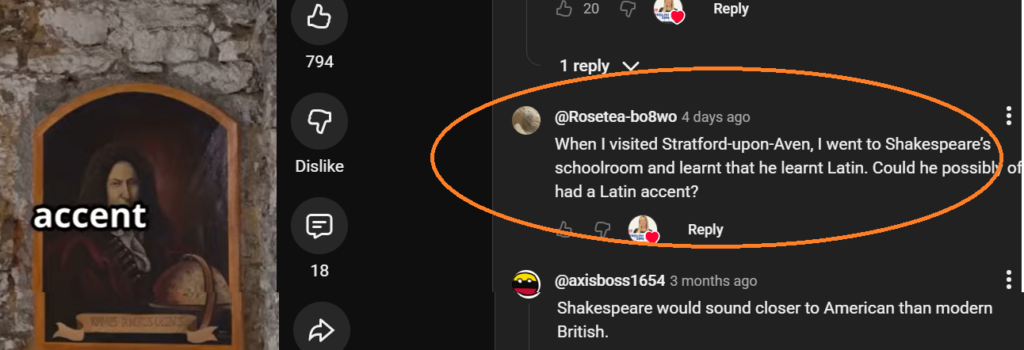
Recently on one of our Youtube videos someone asked if Shakespeare’s knowledge of Latin influenced his accent to answer this we need to go through various points.
The link to the video is here.
Here is an image of the original question:
1. Latin during the time of Shakespeare.
The English of Shakespeare’s time did not preserve the original Roman (Classical Latin) pronunciation.
What was preserved was a learned tradition, not the ancient accent itself.
Here’s the clear breakdown.
🎭 The time and people
We’re talking about William Shakespeare (late 16th–early 17th century) and Early Modern England.
1️⃣ Classical Latin pronunciation was already lost long before
By Shakespeare’s lifetime:
-
Classical Latin phonology (1st c. BCE Rome) had been gone for over 1,000 years
-
Even medieval Romans did not speak like Cicero
-
Latin survived as:
-
A written language
-
A liturgical language
-
A scholarly language
-
But not as a native spoken language with a continuous accent.
So there was nothing “pure” left to preserve.
2️⃣ Medieval & Renaissance Latin ≠ Roman Latin
By the Middle Ages, Latin pronunciation had regionalised.
Each country read Latin using the sounds of its own language.
Examples:
-
Italians read Latin with Italian sounds
-
French with French sounds
-
Germans with German sounds
-
English with English sounds
This is called ecclesiastical / national Latin pronunciation.
3️⃣ How did Shakespeare’s England pronounce Latin?
✍️ English Renaissance Latin sounded roughly like:
-
Latin letters mapped onto English phonology
-
Vowels approximated English vowel values
-
Stress patterns often English-influenced
For example:
-
Caesar → pronounced roughly “SEE-zer”
-
Virgilius → “VER-jil”
-
ratio → “RAY-shee-oh”
This is nothing like Classical Latin, where:
-
Caesar = KAI-sar
-
Virgilius = Wir-GEE-lee-us
-
ratio = RAH-tee-oh
4️⃣ Why Classical pronunciation wasn’t preserved
a) Latin stopped being spoken natively
Once no children grow up speaking a language, phonology inevitably drifts.
b) Writing hides sound change
Latin spelling stayed conservative, but pronunciation shifted underneath it.
c) Education emphasised grammar, not phonetics
Schoolboys learned:
-
Declensions
-
Syntax
-
Rhetoric
Not how Romans actually sounded.
5️⃣ Did anyone in Shakespeare’s time know Classical Latin sounded different?
Interestingly: some humanists suspected it.
Renaissance scholars:
-
Noticed spelling clues in ancient poetry
-
Knew rhyme and metre didn’t work with medieval pronunciation
-
Began debating “restored” pronunciation
But:
-
There was no consensus
-
No audio tradition
-
No systematic reconstruction yet
The modern reconstructed Classical Latin pronunciation only emerged properly in the 19th century.
6️⃣ Important nuance: spelling ≠ sound
Shakespeare’s English:
-
Used many Latin loanwords
-
Preserved Latin spelling
-
But pronounced them in English ways
So while English looked closer to Latin on the page, it sounded very different.
7️⃣ Comparison snapshot
| Feature | Classical Latin (Rome) | Shakespeare’s Latin |
|---|---|---|
| Native speakers | Yes | No |
| Pronunciation continuity | ❌ | ❌ |
| Accent preserved | ❌ | ❌ |
| Grammar preserved | ✅ | ✅ |
| Pronounced like English | ❌ | ✅ |
🧠 The key insight (one sentence)
Shakespeare’s England inherited Latin as a text, not as a sound.
✅ Bottom line
-
❌ Classical Roman pronunciation was not preserved
-
❌ Shakespeare did not hear Latin like the Romans
-
✅ Latin was pronounced through English phonology
-
✅ Modern “Classical Latin pronunciation” is a modern scholarly reconstruction
2. Impact of Shakespeare’s knowledge of Latin on his accent.
Shakespeare’s knowledge of Latin had almost no effect on his spoken accent or on the “standard” London accent of his time.
What it did shape was vocabulary, rhetoric, rhythm, and thought patterns, not pronunciation.
Here’s the clean breakdown.
🎭 The linguistic setting
We’re talking about William Shakespeare and Early Modern London (c. 1580–1620).
At that time:
-
Latin was learned, not spoken natively
-
English accents were formed by local English speech, not education
-
There was no prestige “Latin-based accent” the way there is today with, say, French in some eras
1️⃣ Latin did not shape Shakespeare’s spoken accent
Why not?
Accent is formed by:
-
Childhood environment
-
Local speech community
-
Social class
-
Region
Shakespeare:
-
Grew up in Stratford-upon-Avon
-
Learned Latin at grammar school, starting around age 7
-
Acquired his accent before advanced Latin study
By the time he was deeply reading Latin authors:
-
His accent was already set
➡️ Learning Latin later cannot overwrite native phonology.
2️⃣ London elites didn’t sound “more Latin” either
Even among:
-
Lawyers
-
Clergy
-
Courtiers
-
University men
Latin was:
-
Read aloud with English phonology
-
Used for writing, debate, and schooling
-
Code-switched, not fused into English speech
No evidence suggests:
-
A special “Latinate” accent
-
Roman-style pronunciation
-
Or Latin-influenced vowels/consonants in English speech
The London elite accent was shaped by:
-
Court usage
-
Regional leveling
-
Social mobility
—not Latin.
3️⃣ What Latin did influence (very strongly)
This is where the impact really was.
🧠 a) Vocabulary
Shakespeare massively expanded English with:
-
Latinate words
-
Abstract nouns
-
Rhetorical precision
Examples:
-
obscene
-
indistinguishable
-
assassination
-
expectation
These were Latin-based words, but pronounced as English words.
🏛️ b) Sentence structure & rhetoric
Latin shaped:
-
Long, periodic sentences
-
Rhetorical balance
-
Antithesis
-
Parallelism
This is why Shakespeare’s language often feels:
“Elevated” but not foreign
🎼 c) Poetic rhythm (not accent)
Latin verse influenced:
-
How ideas are paced
-
Where emphasis falls
-
Dramatic pauses
But the sounds themselves remained English.
4️⃣ Did Latin affect how Shakespeare wrote dialogue?
Yes — but subtly.
Shakespeare often:
-
Gave Latinate speech to educated or elite characters
-
Used simpler Anglo-Saxon vocabulary for commoners
-
Played with class differences through word choice, not accent
However:
-
Actors spoke in their own English accents
-
There was no attempt to “sound Roman” or “sound learned”
5️⃣ Accent in Shakespeare’s plays: what mattered instead
What shaped pronunciation on stage:
-
Early Modern English phonology
-
Rhymes (which worked differently than today)
-
Meter
-
Regional leveling in London
Not:
-
Latin schooling
-
Classical pronunciation ideals
6️⃣ A key comparison (very important)
Think of it this way:
Modern English speakers study French at school —
but it does not give them a French accent in English.
Latin worked the same way.
🧠 The core insight (one sentence)
Latin shaped how Shakespeare thought and wrote, not how he sounded.
✅ Bottom line
-
❌ Shakespeare’s Latin did not change his accent
-
❌ London elite accents were not Latinised
-
✅ Latin influenced:
-
Vocabulary
-
Rhetoric
-
Intellectual style
-
-
✅ Pronunciation stayed firmly English
3. What would Shakespeare’s accent have sounded like?
The two points above namely that:
- The Latin taught in Shakespeare’s time phonologically bore no resemblance to the original Latin of the Romans a situation which was similar even in Italy itself the homeland of the Latin language.
- That even though Shakespeare knew Latin it would have no impact on his accent or phonology in much the same way a British person learning French would speak modern English with a French accent
lead us on to the question of what did Shakespeare’s accent sound like?
Below is a clear, evidence-based reconstruction of what William Shakespeare likely sounded like when speaking everyday English on and off stage.
🎧 What kind of accent are we reconstructing?
This is Early Modern English (c. 1580–1620) as spoken in London, influenced by:
-
Shakespeare’s Warwickshire upbringing
-
London accent levelling
-
Pre–18th-century sound changes
It is not:
-
Modern RP
-
Modern Cockney
-
Modern West Midlands
But it shares features with all three.
🔊 Core sound features (the big differences)
1️⃣ Rhotic R (this is huge)
Shakespeare pronounced all his R’s.
So:
-
heart → hart
-
word → werd
-
far → fahr
This alone makes it sound closer to modern West Country, Irish, or American English than modern southern British English.
2️⃣ Shorter, purer vowels
The Great Vowel Shift was still in progress, not finished.
Examples:
| Word | Shakespeare’s sound | Modern RP |
|---|---|---|
| time | toym / təim | taim |
| name | nehm | neɪm |
| house | hoose | haʊs |
| day | deh | deɪ |
Vowels were:
-
Tighter
-
Less diphthong-heavy
-
More continental-sounding
3️⃣ Clear consonants
-
T and D clearly pronounced
-
No glottal stop
-
Final consonants fully sounded
So:
-
often → off-ten
-
soft → soft (no dropping)
4️⃣ Different rhythm
Speech was:
-
Faster
-
More syllable-timed
-
Less “drawn out” than modern RP
This is why Shakespeare’s rhymes worked better in his own time.
Example rhyme that worked then but not now:
love / prove
They rhymed in Shakespeare’s pronunciation.
🗣️ A short sample (modern vs Shakespearean sound)
Let’s take this famous line:
“To be, or not to be, that is the question.”
Approximate Shakespearean pronunciation:
“Tuh bee, or nawt tuh bee, that iz thuh kwes-tyon.”
Key points:
-
be = bee
-
not = nawt
-
question = kwes-tyon
-
All R’s pronounced
🎭 Another example (Hamlet)
Original:
“The lady doth protest too much, methinks.”
Shakespeare’s likely sound:
“Thuh lay-dee doth pro-test too mooch, me-thinks.”
Notice:
-
lady = lay-dee
-
much closer to mooch
-
methinks fully pronounced
🧠 What modern accent is it closest to?
Surprisingly close to:
-
South-West England
-
Some Irish English
-
Some American English (especially Appalachian)
This is why Americans sometimes say:
“Shakespeare sounds oddly familiar”
They kept rhotic R; England later dropped it.
❌ What it did NOT sound like
-
❌ Not posh
-
❌ Not theatrical RP
-
❌ Not flowery or slow
-
❌ Not exaggerated
It was:
Earthy, fast, muscular, and direct
🎙️ Why this matters for performance
When spoken in original pronunciation:
-
Jokes land better
-
Rhymes suddenly work
-
Insults hit harder
-
The language feels less distant
That’s why some theatres now perform Shakespeare in OP (Original Pronunciation).
🧠 One-sentence takeaway
Shakespeare sounded more like a rhotic West-country Londoner than a modern “posh Englishman”.
For those curious as to what Shakespeare’s accent may have sounded like and would prefer to listen to something rather than read information on it, you can watch these videos.
This video has a rendition of Hamlet’s famous ‘To be or not to be?’ speech.
If you listen to it you can quite clearly here that it sounds nothing like the ‘posh’ RP accent of the southern English middle class such as Hugh Grant, Benedict Cumberbatch and others but something more akin to someone from the west country, someone more from a rural agricultural background than an urban upper-middle class Londoner.
Here is another video by the well-known Youtuber Simon Roper dealing with this topic whereby he explains that though Shakespeare’s accent was not at all modern RP neither is the reactionary position that his accent sounded like ‘modern American’ correct either but instead it was its own distinct 17th century English accent. We need to bear in mind that even back then England had a huge diversity of accents even more than it does now (some say England – excluding Scotland, Wales and Ireland – has over 40 accents at least in the modern era despite homogenising influences such as mass media and universal education).
To finish this article we will present some videos of the Appalachian English of the north-east of the modern USA which is very different to general American English phonology of now and quite conservative in that it retains a lot of the original phonetic traits of older forms of English.
What do you think?
What appeals to you more if you were to hear a Shakespeare play? The original Shakespearean accent or the ‘posher’ RP accent of modern day England such as that of Kenneth Branagh in Henry VI?
Leave your comments below!
1. https://englishmadesimple.org/the-origin-of-the-english-language-part-1/
2. https://englishmadesimple.org/the-history-of-the-english-language-part-2/
3. https://englishmadesimple.org/the-history-of-the-english-language-part-3/
